طراحی و تبیین مدل تجاری سازی محصولات نوآورانه شرکت های دانش بنیان در حوزه شیمیایی با رویکرد آمیخته
DOI:
https://doi.org/10.61838/kman.jtesm.3.2.17کلمات کلیدی:
تجاری سازی, محصولات نوآورانه, شرکت های دانش بنیان شیمیاییچکیده
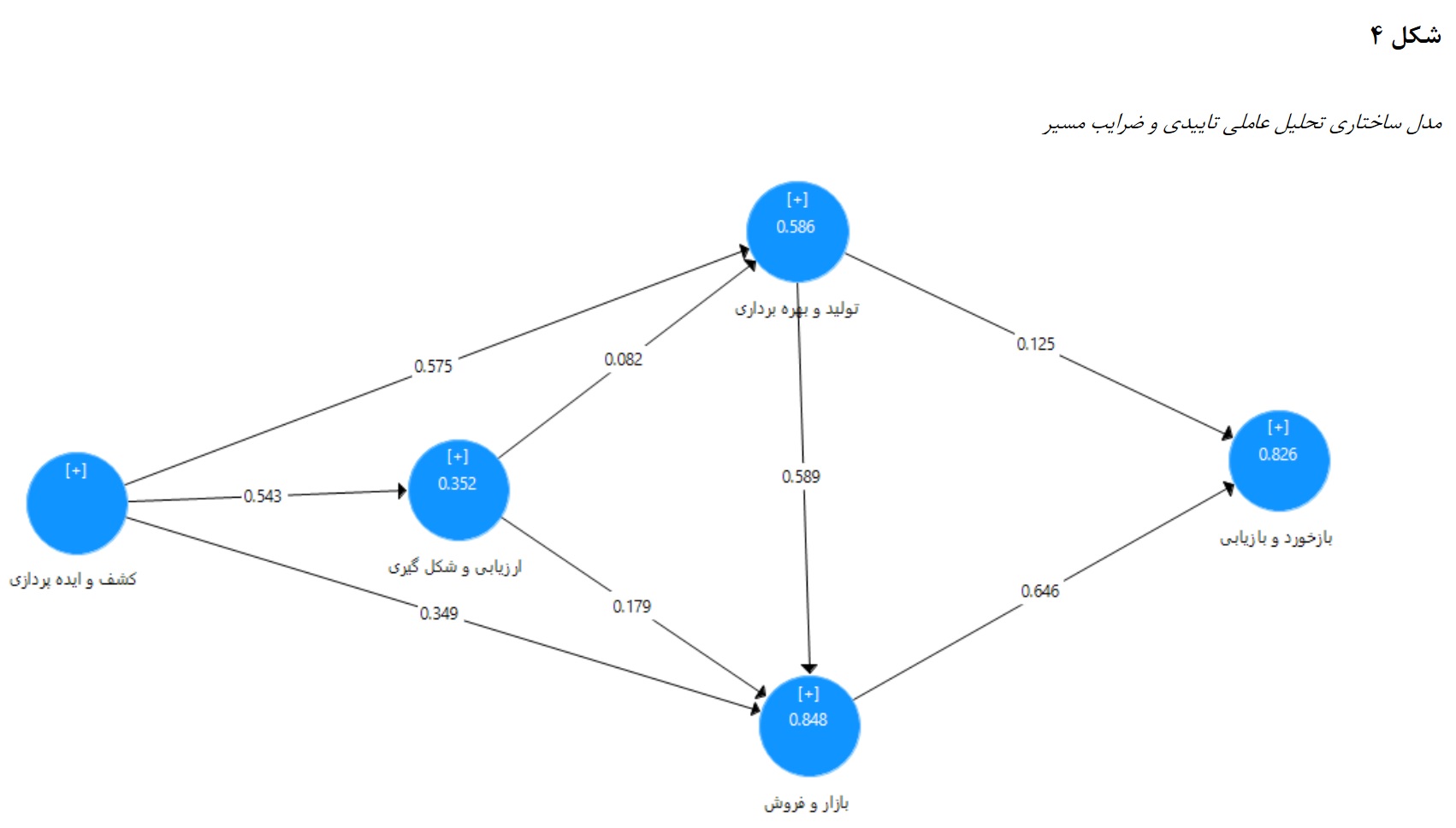
تجاری سازی محصولات نوآورانه یکی از رموز موفقیت شرکت های دانش بنیان می باشد. هدف این مطالعه شناسایی و استخراج متغیرهای تجاری سازی، تولید مدل از طریق تعیین روابط و آزمون آن می باشد. تحقیق از نظر نتایج پژوهش، توسعه ای و از لحاظ اجرای پژوهش آمیخته (کیفی-کمّی) است. جامعه آماری در بخش کیفی شامل 17 نفر از خبرگان می باشد که به روش نمونه گیری غیر احتمالی هدفمند و نظری و با تکنیک گلوله برفی انخاب شدند. در فاز کیفی از تحلیل محتوای و تکنیک کدگذاری برای شناسایی و استخراج شاخص ها، مولفه ها و متغیرهای مدل استفاده شده است. یافته های بخش کیفی نشان داد مدل تجاری سازی تحقیق دارای متغیرهای «کشف و ایده پردازی»، «ارزیابی و شکل گیری»، «تولید و بهره برداری»، «بازار و فروش»، و «بازخورد و بازیابی» می باشد. یافته های بخش کمی به روش مدلسازی تفسیری-ساختاری نشان داد که مدل دارای چهار سطح می باشد به گونه ای که متغیر « کشف و ایده پردازی» بیشترین تاثیرگذاری را بر «ارزیابی و شکل گیری» دارد. «ارزیابی و شکل گیری» بر «بازار و فروش» و «تولید و بهره برداری» اثر دارد و در نهایت این متغیرها بر «بازخورد و بازیابی» نفوذ دارد. یافته های آزمون روابط با روش مدلسازی معادلات ساختاری نشان داد که بین همه روابط پیش بینی شده در مدل، اثر مثبت و معنیداری وجود دارد و رابطه در مدل تایید شد و برای بهبود تجاری سازی محصولات نوآورانه شیمایی باید کشف و ایده پردازی متناسب با اهداف توسعه پایدار و اقتصاد مدور صورت گیرد.
دانلودها
مراجع
Al-Rikabi, Y. K., & Montazer, G. A. (2023). Designing an E-learning Readiness Assessment Model for Iraqi Universities
Employing Fuzzy Delphi Method. Education and Information Technologies, 1-41. https://doi.org/10.1007/s10639-
-11889-0
Bilovodska, O., Melnyk, Y., Alenin, Y., & Arkusha, L. (2020). Implementation of marketing and legal tools in the process
of commercialization for innovative products in strategic management and entrepreneurship. International Journal
for Quality Research, 14(4), 1261-1278. https://doi.org/10.24874/IJQR14.04-18
Cainelli, G., D'Amato, A., & Mazzanti, M. (2020). Resource efficient eco-innovations for a circular economy: Evidence
from EU firms. Research Policy, 49(1), 103827. https://doi.org/10.1016/j.respol.2019.103827
Cheah, S. L. Y., & Yuen-Ping, H. O. (2021). Commercialization performance of outbound open innovation projects in
public research organizations: The roles of innovation potential and organizational capabilities. Industrial Marketing
Management, 94, 229-241. https://doi.org/10.1016/j.indmarman.2021.02.012
Chen, P., & Kim, S. (2023). The impact of digital transformation on innovation performance-The mediating role of
innovation factors. Heliyon, 9(3), e13916. https://doi.org/10.1016/j.heliyon.2023.e13916
Çolak, H., & Kağnıcıoğlu, C. H. (2023). Predicting the Blockchain Technology Acceptance in Supply Chains with InterFirm Perspective: An Integrated DEMATEL and PLS-SEM Approach. Journal of Business-to-Business Marketing,
-24. https://doi.org/10.1080/1051712X.2023.2214543
Daneshjoovash, K., Jafari, P., & Khamseh, A. (2021). Commercialization cycle of entrepreneurial ideas in hightechnology firms. Journal of Innovation and Creativity in Human Science, 10(3), 41-68.
https://www.sid.ir/paper/392731/en
Daneshjoovash, S. K., Jafari, P., & Khamseh, A. (2021). Effective commercialization of high-technology entrepreneurial
ideas: a meta-synthetic exploration of the literature. Journal of Small Business & Entrepreneurship, 33(6), 663-688.
https://doi.org/10.1080/08276331.2020.1789825
De Jesus, A., Antunes, P., Santos, R., & Mendonça, S. (2018). Eco-innovation in the transition to a circular economy:
An analytical literature review. Journal of Cleaner Production, 172, 2999-3018.
https://doi.org/10.1016/j.jclepro.2017.11.111
Elo, S., Kääriäinen, M., Kanste, O., Pölkki, T., Utriainen, K., & Kyngäs, H. (2014). Qualitative content analysis: A focus
on trustworthiness. Sage Open, 4(1), 2158244014522633. https://doi.org/10.1177/2158244014522633
Evertsen, P. H., Rasmussen, E., & Nenadic, O. (2022). Commercializing circular economy innovations: A taxonomy of
academic spin-offs. Technological Forecasting and Social Change, 185, 122102.
https://doi.org/10.1016/j.techfore.2022.122102
Kaipainen, J., & Aarikka-Stenroos, L. (2021). From vision to commercialization of a circular economy innovation: a
longitudinal study of overcoming challenges throughout the full innovation process. In Sustainable Innovation and
Entrepreneurship. Edward Elgar. https://doi.org/10.4337/9781800373099.00013
Kim, J. H., Seok, B. I., Choi, H. J., Jung, S. H., & Yu, J. P. (2020). Sustainable management activities: A study on the
relations between technology commercialization capabilities, sustainable competitive advantage, and business
performance. Sustainability, 12(19), 7913. https://doi.org/10.3390/su12197913
Kumar, V., Vrat, P., & Shankar, R. (2022). Factors influencing the implementation of industry 4.0 for sustainability in
manufacturing. Global Journal of Flexible Systems Management, 23(4), 453-478. https://doi.org/10.1007/s40171-
-00312-1
Martínez-Noya, A., & Garcia-Canal, E. (2021). Innovation performance feedback and technological alliance portfolio
diversity: The moderating role of firms' R&D intensity. Research Policy, 50(9), 104321.
https://doi.org/10.1016/j.respol.2021.104321
Meijer, L. L. J., Huijben, J. C. C. M., Van Boxstael, A., & Romme, A. G. L. (2019). Barriers and drivers for technology
commercialization by SMEs in the Dutch sustainable energy sector. Renewable and Sustainable Energy Reviews,
, 114-126. https://doi.org/10.1016/j.rser.2019.05.050
Ncube, A., Mtetwa, S., Bukhari, M., Fiorentino, G., & Passaro, R. (2023). Circular Economy and Green Chemistry: The
Need for Radical Innovative Approaches in the Design for New Products. Energies, 16(4), 1752.
https://doi.org/10.3390/en16041752
Olawore, A. S., Wong, K. Y., Ma'aram, A., & Sutopo, W. (2023). Prioritization of Technology Commercialization
Success Factors Using Fuzzy Best Worst Method. Journal of Open Innovation: Technology, Market, and
Complexity, 100096. https://doi.org/10.1016/j.joitmc.2023.100096
Raguseo, E., Pigni, F., & Vitari, C. (2021). Streams of digital data and competitive advantage: The mediation effects of
process efficiency and product effectiveness. Information & Management, 58(4), 103451.
https://doi.org/10.1016/j.im.2021.103451
Rb, D., Patil, R. R., Angadi, S. S., & Kulkarni, D. M. (2022). Commercialization of innovative pharmaceutical products
- practical aspects and problems: a review. Indian Journal of Research Methods in Pharmaceutical Sciences, 1(1),
-11. https://ijrmps.com/wp-content/uploads/journal/published_paper/volume-1/issue-2/IJRMPS_gkNz4S7e.pdf
Samansiri, S., Fernando, T., & Ingirige, B. (2023). Critical Failure Factors of Flood Early Warning and Response Systems
(FEWRS): A Structured Literature Review and Interpretive Structural Modelling (ISM) Analysis. Geosciences,
(5), 137. https://doi.org/10.3390/geosciences13050137
Sarkar, B., Ullah, M., & Sarkar, M. (2022). Environmental and economic sustainability through innovative green products
by remanufacturing. Journal of Cleaner Production, 332, 129813. https://doi.org/10.1016/j.jclepro.2021.129813
Tawate, S., Gupta, R., & Jain, K. (2019). Development of a Technology Commercialization Model for Indian
Biotechnology Firms. Ieee Transactions on Engineering Management, 1-13.
https://ieeexplore.ieee.org/abstract/document/8850335/
Tiberius, V., Schwarzer, H., & Roig-Dobon, S. (2021). Radical innovations: between established knowledge and future
research opportunities. Journal of Innovation & Knowledge, 6(3), 145-153. https://doi.org/10.1016/j.jik.2020.09.001
Tuni, A., Ijomah, W. L., Gutteridge, F., Mirpourian, M., Pfeifer, S., & Copani, G. (2023). Risk assessment for circular
business models: A fuzzy Delphi study application for composite materials. Journal of Cleaner Production, 389,
https://doi.org/10.1016/j.jclepro.2022.135722
Wang, C., Sun, Y., Lim, M. K., Ghadimi, P., & Azadnia, A. H. (2023). An analysis of barriers for successful
implementation of municipal solid waste management in Beijing: an integrated DEMATEL-MMDE-ISM approach.
Industrial Management & Data Systems, 123(3), 931-966. https://doi.org/10.1108/IMDS-08-2022-0464
Woodfield, P. J., Ooi, Y. M., & Husted, K. (2023). Commercialisation patterns of scientific knowledge in traditional lowand medium-tech industries. Technological Forecasting and Social Change, 189, 122349.
https://doi.org/10.1016/j.techfore.2023.122349
Ye, Y., Zhou, J., Guan, X., & Sun, X. (2022). Commercialization of cultured meat products: Current status, challenges,
and strategic prospects. Future Foods, 100177. https://doi.org/10.1016/j.fufo.2022.100177
دانلودها
گاهشمار انتشار
- ارسال
- بازنگری
- پذیرش
شماره
نوع مقاله
مجوز
حق نشر 1403 تکنولوژی در کارآفرینی و مدیریت استراتژیک

این پروژه تحت مجوز بین المللی Creative Commons Attribution-NonCommercial 4.0 می باشد.