Cognitive Bias Patterns of Managers and Investors Using Artificial Intelligence in the Iranian Capital Market
Keywords:
Artificial Intelligence, Investor Behavior Pattern, Herd Behavior, Cognitive BiasAbstract
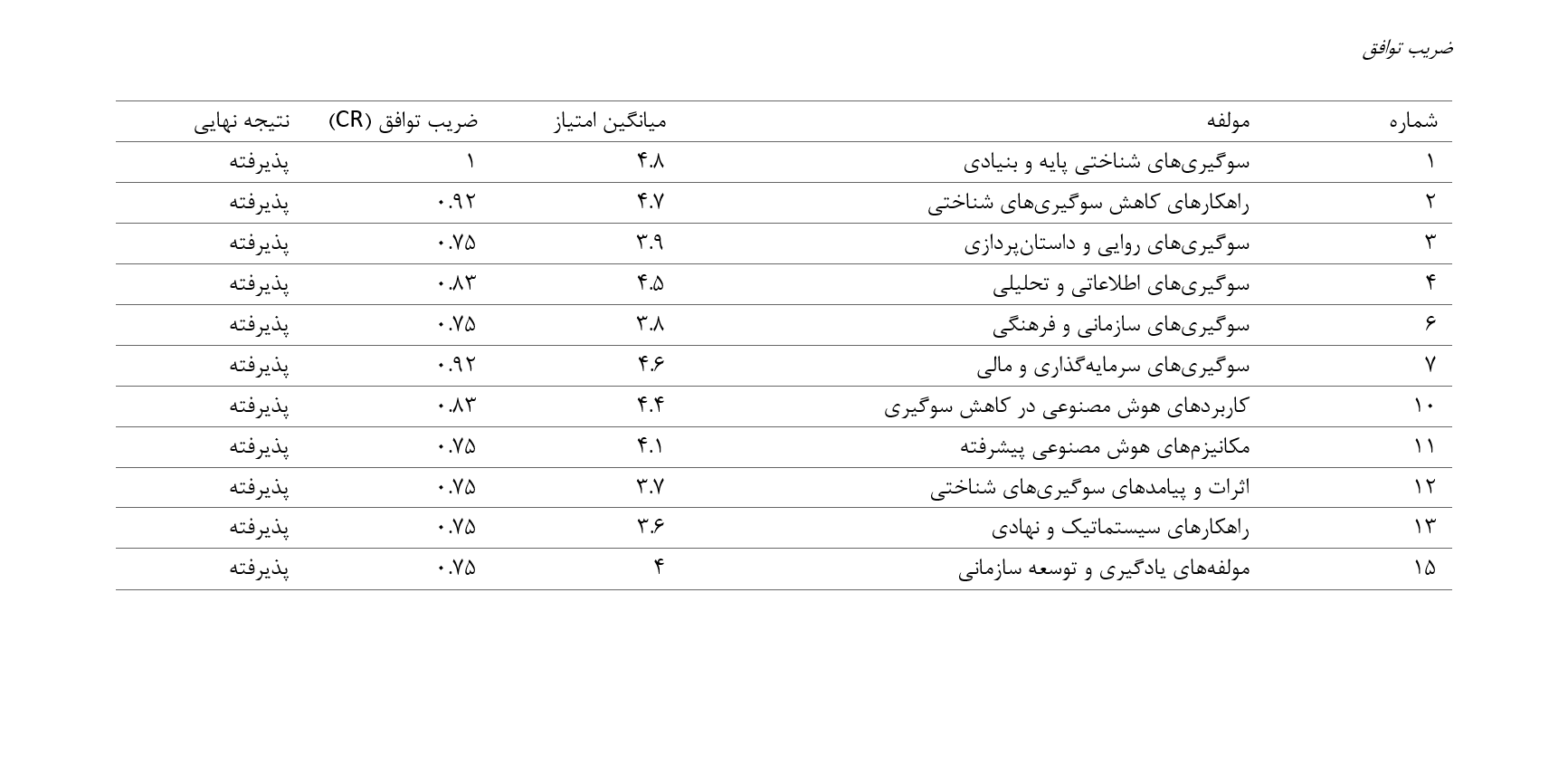
The purpose of this study was to identify, analyze, and validate the patterns of cognitive biases among managers and investors in the Iranian capital market and to examine the role of artificial intelligence in reducing and managing these biases. This study was developmental in purpose and adopted an exploratory mixed-methods design with a dominant qualitative approach. Data were collected through in-depth semi-structured interviews with capital market experts, including managers, analysts, and investors with more than five years of professional experience. Through qualitative content analysis, 456 initial codes were extracted from the interviews and systematically categorized into 35 major components using thematic analysis. To validate the identified components, a two-round Delphi technique was employed involving 12 capital market experts. Consensus Ratio (CR) values were also calculated to determine the level of agreement among participants and identify the final components suitable for the conceptual model of the study. The findings revealed that fundamental cognitive biases obtained the highest mean score (4.8), followed by cognitive bias reduction strategies (4.7), investment and financial biases (4.6), and informational and analytical biases (4.5). Applications of artificial intelligence in reducing biases achieved a mean score of 4.4, while advanced AI mechanisms scored 4.1. In the second Delphi round, 10 final components were confirmed with consensus ratios ranging from 0.75 to 1. The results demonstrated that artificial intelligence significantly contributes to reducing cognitive biases through large-scale data analysis, behavioral pattern recognition, scenario simulation, generation of alternative perspectives, and intelligent warning systems, thereby improving investment decision quality and analytical accuracy The study concluded that cognitive biases substantially influence managerial and investment decision-making in the Iranian capital market and may lead to reduced analytical quality, irrational risk-taking, and emotionally driven behaviors. Artificial intelligence, through data-driven analysis, hidden pattern detection, and enhancement of human judgment, can serve as an effective tool for managing and mitigating these biases. Furthermore, integrating human intelligence with artificial intelligence can facilitate the development of smarter decision-making systems, improve investment efficiency, and strengthen the stability of financial markets.
Downloads
References
Ahmad, U., Van Keulen, M., Briassouli, A., & Saad, M. (2025). Cognitive Biases, Robo Advisor and Investment Decision Psychology: An Investor's Perspective from New York Stock Exchange. Acta Psychologica, 256, 105048. https://doi.org/10.1016/j.actpsy.2025.105048
Athota, V. S., Pereira, V., Hasan, Z., Vaz, D., Laker, B., & Reppas, D. (2023). Overcoming Financial Planners' Cognitive Biases through Digitalization: A Qualitative Study. Journal of Business Research, 154, 113291.
Azad, P., & Sharma, M. (2025). Examining the Influence of Behavioural Finance on Institutional Investors and Their Financial Decision-Making in Financial Markets. International Journal of Accounting and Economics Studies, 12, 197-202. https://doi.org/10.14419/cky8bc30
Bakar, S., & Yi, A. N. C. (2016). The Impact of Psychological Factors on Investors' Decision Making in Malaysian Stock Market: A Case of Klang Valley and Pahang. Procedia Economics and Finance, 35.
Basak, S., Kar, S., Saha, S., Khaidem, L., & Dey, S. R. (2019). Predicting the Direction of Stock Market Prices Using Tree-Based Classifiers. The North American Journal of Economics and Finance, 47, 552-567.
Ben Aissia, D. (2020). Home and Foreign Investor Sentiment and The Stock Returns. The Quarterly Review of Economics and Finance, 59(C).
Berthet, V. (2022). The Impact of Cognitive Biases on Professionals' Decision-Making: A Review of Four Occupational Areas. Frontiers in psychology, 12, 802439.
Bisht, D., Singh, R., Gehlot, A., Akram, S. V., Singh, A., Montero, E. C., & Twala, B. (2022). Imperative Role of Integrating Digitalization in the Firms Finance: A Technological Perspective. Electronics, 11(19), 3252.
Buhren, C., Meier, F., & Plessner, M. (2023). Ambiguity Aversion: Bibliometric Analysis and Literature Review of the Last 60 Years. Management Review Quarterly, 73(2), 495-525.
Bustos, O., & Pomares-Quimbaya, A. (2020). Stock Market Movement Forecast: A Systematic Review. Expert Systems with Applications, 156, 113464.
Chaweewanchon, A., & Chaysiri, R. (2022). Markowitz Mean-Variance Portfolio Optimization with Predictive Stock Selection Using Machine Learning. International Journal of Financial Studies, 10(3), 64.
Dalika, N., & Seetharam, Y. (2020). Sentiment and Returns: An Analysis of Investor Sentiment in the South African Market. Investment Management and Financial Innovations, 12(1).
Frazzini, A. (2006). The Disposition Effect and Underreaction to News. The Journal of Finance, 61(4).
Gavrilakis, N., & Floros, C. (2022). The Impact of Heuristic and Herding Biases on Portfolio Construction and Performance: The Case of Greece. Review of Behavioral Finance, 14(3), 436-462.
Guest, N. M., Twedt, B. J., & Murren Vosse, M. (2023). Institutional Investors and Echo Chambers: Evidence from Social Media Connections and Political Ideologies.
Gupta, S., & Shrivastava, M. (2022). Herding and Loss Aversion in Stock Markets: Mediating Role of Fear of Missing Out (FOMO) in Retail Investors. International Journal of Emerging Markets, 17(7), 1720-1737.
Hasso, T., Pelster, M., & Breitmayer, B. (2020). Terror Attacks and Individual Investor Behavior: Evidence from the 2015-2017 European Terror Attacks. Journal of Behavioral and Experimental Finance.
Ipek, A., & Mandaci, E. P. (2025). The Relevance of Behavioral Biases to Investment Decision and Performance: A Meta-Analytic Review. Qualitative Research in Financial Markets, ahead-of-print(ahead-of-print). https://doi.org/10.1108/QRFM-09-2024-0280
Jain, J., Walia, N., Kaur, M., & Singh, S. (2022). Behavioural Biases Affecting Investors' Decision-Making Process: A Scale Development Approach. Management Research Review, 45(8), 1079-1098.
Johnson, J. (2019). Artificial Intelligence and Future Warfare: Implications for International Security. Defense & Security Analysis, 35(2), 147-169.
Kariofyllas, S., Philippas, D., & Siriopoulos, C. (2017). Cognitive Biases in Investors' Behaviour under Stress: Evidence from the London Stock Exchange. International Review of Financial Analysis, 54.
Karki, U., Bhatia, V., & Sharma, D. (2024). A Systematic Literature Review on Overconfidence and Related Biases Influencing Investment Decision Making. Economic and Business Review, 26(2), 130-150.
Kiky, A. (2021). Status-Quo Bias in Valuing Investment Assets: A Behavioural Experiment on Gain or Loss. Ultima Management: Jurnal Ilmu Manajemen, 13(2), 256-270.
Kumar, J., & Prince, N. (2023). Overconfidence Bias in Investment Decisions: A Systematic Mapping of Literature and Future Research Topics. Fiib Business Review, 23197145231174344.
Li, T. (2021). How Does People's Social Attachment Influence Their Investment Decision? Using Empathy to Explain Availability Bias Queensland University of Technology].
Loebiantoro, I., Cham, T.-H., Cheng, E., Annuar, N., & Mirzaliev, S. (2025). Is It Risky? The Impact of Personality Traits and Behavioural Biases on Investment Decisions. Asian Journal of Business Research, 15, 104-120.
Mingzheng, W. (2024). Illusion of Control. In The ECPH Encyclopedia of Psychology. Springer. https://doi.org/10.1007/978-981-99-6000-2_209-1
Mitchell, R., Michalski, J., & Carbonell, T. (2013). An Artificial Intelligence Approach. Springer.
Narang, M., Joshi, M. C., Bisht, K., & Pal, A. (2022). Stock Portfolio Selection Using a New Decision-Making Approach Based on the Integration of Fuzzy CoCoSo with Heronian Mean Operator. Decision Making: Applications in Management and Engineering, 5(1), 90-112.
Nian, F., Liu, X., & Diao, H. (2022). Mechanism of Investor Behavior Propagation in Stock Market. Physica.
Owusu, S. P., & Laryea, E. (2023). The Impact of Anchoring Bias on Investment Decision-Making: Evidence from Ghana. Review of Behavioral Finance, 15(5), 729-749.
Perez Liston, D. (2020). Sin Stock Returns and Investor Sentiment. The Quarterly Review of Economics and Finance, 59(C).
Peters, U. (2022). What Is the Function of Confirmation Bias? Erkenntnis, 87(3), 1351-1376.
Phan, T. N. T., Bertrand, P., & Vo, X. V. (2021). The Role of Investor Behavior in Emerging Stock Markets: Evidence from Vietnam. The Quarterly Review of Economics and Finance.
Rehman, M., Dhiman, B., Nguyen, N. D., Dogra, R., & Sharma, A. (2024). Behavioral Biases and Regional Diversity: An In-Depth Analysis of Their Influence on Investment Decisions-A SEM and MICOM Approach. Qubahan Academic Journal, 4(2), 70-85.
Rihan, M., Elwekeil, M., Yang, Y., Huang, L., Xu, C., & Selim, M. M. (2020). Deep-VFog: When Artificial Intelligence Meets Fog Computing in V2X. IEEE Systems Journal, 15(3), 3492-3505.
Seok, S. I., Cho, H., & Ryu, D. (2024). Firm-Specific Investor Sentiment and Daily Stock Returns. The North American Journal of Economics and Finance, 50.
Shah, S. S. H., Khan, M. A., Ahmed, M., Meyer, D. F., & Olah, J. (2024). A Micro-Level Evidence of How Investor and Manager Herding Behavior Influence the Firm Financial Performance. Sage Open, 14(1), 21582440231219358.
Shahzad, R. (2025). Behavioral Finance: Impact of Psychology, Market Forces, and Social. Journal of Finance and Accounting Research, 6. https://doi.org/10.32350/jfar.62.03
Singh, D., Malik, G., & Jha, A. (2024). Overconfidence Bias among Retail Investors: A Systematic Review and Future Research Directions. Investment Management & Financial Innovations, 21(1), 302.
Uma, B., & Maheswari, V. (2025). The Psychological and Behavioural Determinants of Mutual Fund Investment Decisions in Bengaluru: A Mixed-Method Approach. International Journal of Accounting and Economics Studies, 12, 230-238. https://doi.org/10.14419/jn051k29
Vafaeimehr, A., Schulmerich, M., & Paterlini, S. (2023). Top Investment Banks, Confirmation Bias, and the Market Pricing of Forecast Revisions. International Review of Financial Analysis, 88, 102574.
Yawalkar, M. V. V. (2019). A Study of Artificial Intelligence and Its Role in Human Resource Management. International Journal of Research and Analytical Reviews, 6(1), 20-24.
Yawen, H., Yan, M., & Zhang, D. (2020). Herd Behaviour and Investor Sentiment: Evidence from UK Mutual Funds. International Review of Financial Analysis.

Downloads
Published
Submitted
Revised
Accepted
Issue
Section
License
Copyright (c) 2025 Jamileh Shakeri (Author); Mehdi Heydari; Rasoul Baradaran Hasanzadeh (Author)

This work is licensed under a Creative Commons Attribution-NonCommercial 4.0 International License.