ارائه چارچوب سیاستگذاری هوشمند برای تنظیم بازار کار در عصر اتوماسیون مبتنی بر هوش مصنوعی
کلمات کلیدی:
سیاستگذاری هوشمند, بازار کار, هوش مصنوعی, اتوماسیون, حکمرانی دادهمحور, پایداری اشتغال, اقتصاد دیجیتالچکیده
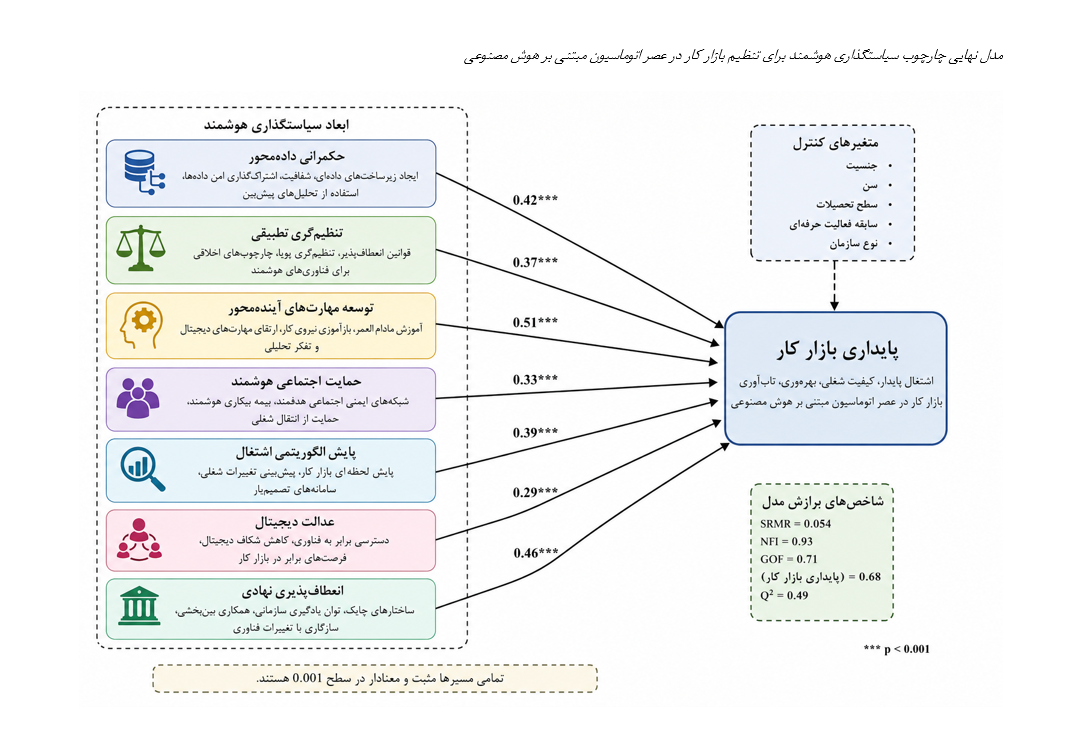
پژوهش حاضر با هدف ارائه چارچوب سیاستگذاری هوشمند برای تنظیم بازار کار در عصر اتوماسیون مبتنی بر هوش مصنوعی و شناسایی ابعاد مؤثر بر پایداری بازار کار انجام شد. این پژوهش از نظر هدف کاربردی و از نظر روش اجرا آمیخته اکتشافی بود. در بخش کیفی، با 18 نفر از خبرگان حوزه سیاستگذاری، اقتصاد دیجیتال، هوش مصنوعی و مدیریت منابع انسانی در شهر تهران مصاحبه نیمهساختاریافته انجام شد و دادهها با روش تحلیل مضمون تحلیل گردید. در بخش کمی، جامعه آماری شامل متخصصان حوزه بازار کار، مدیران اجرایی، اعضای هیئت علمی و کارشناسان فناوری بود که از میان آنان 312 نفر به روش نمونهگیری طبقهای تصادفی انتخاب شدند. ابزار گردآوری دادهها پرسشنامه محققساخته مبتنی بر یافتههای بخش کیفی بود. دادهها با استفاده از نرمافزارهای SPSS-27 و Smart PLS-4 و از طریق تحلیل عاملی تأییدی و مدلسازی معادلات ساختاری تحلیل شدند. نتایج نشان داد که تمامی ابعاد سیاستگذاری هوشمند شامل حکمرانی دادهمحور، تنظیمگری تطبیقی، توسعه مهارتهای آیندهمحور، حمایت اجتماعی هوشمند، پایش الگوریتمی اشتغال، عدالت دیجیتال و انعطافپذیری نهادی اثر مثبت و معناداری بر پایداری بازار کار دارند. در میان متغیرها، توسعه مهارتهای آیندهمحور بیشترین تأثیر را بر پایداری بازار کار داشت. همچنین شاخصهای برازش مدل شامل GOF=0.71، NFI=0.93 و SRMR=0.054 نشاندهنده برازش مطلوب مدل پژوهش بودند. مقدار ضریب تعیین برای پایداری بازار کار برابر با 0.68 بهدست آمد که بیانگر قدرت تبیین بالای مدل پیشنهادی است. یافتههای پژوهش نشان داد که تنظیم بازار کار در عصر هوش مصنوعی نیازمند رویکردی هوشمند، دادهمحور، منعطف و چندبعدی است. توسعه مهارتهای نوین، تقویت ظرفیت نهادی، گسترش حمایتهای اجتماعی هوشمند و استفاده از نظامهای حکمرانی مبتنی بر داده میتوانند نقش مهمی در افزایش تابآوری و پایداری بازار کار ایفا کنند. همچنین موفقیت سیاستگذاری در اقتصاد دیجیتال مستلزم هماهنگی میان ابعاد فناورانه، اجتماعی، آموزشی و اقتصادی است.
دانلودها
مراجع
Adhikari, P., & Hamal, P. (2024). Impact and Regulations of AI on Labor Market and Employment in USA. https://doi.org/10.20944/preprints202407.0906.v1
Benlİ, M., & Çağlar, A. (2024). A Fuzzy Approach to Economic Freedom Performance. International Studies of Economics, 20(1), 43-68. https://doi.org/10.1002/ise3.92
Branco, R., Miró, J., & Natili, M. (2024). Back From the Cold? Progressive Politics and Social Policy Paradigms in Southern Europe After the Great Recession. Politics & Society, 52(4), 630-661. https://doi.org/10.1177/00323292241226806
Cruz‐Martínez, G., & Hernández‐Moreno, J. (2025). Dualization and Social Policies: A Conceptual and Analytical Framework. Politics & Policy, 53(3). https://doi.org/10.1111/polp.70039
Dia, I., & Ondoa, H. A. (2023). Does Economic Freedom Improve FDI Inflows in Sub-Saharan Africa? Journal of Economic Integration, 38(3), 383-410. https://doi.org/10.11130/jei.2023.38.3.383
Dix-Carneiro, R., & Kovak, B. K. (2023). Globalization and Inequality in Latin America. SSRN Electronic Journal. https://doi.org/10.2139/ssrn.4538027
Doellgast, V., Bidwell, M., & Colvin, A. J. S. (2021). New Directions in Employment Relations Theory: Understanding Fragmentation, Identity, and Legitimacy. Ilr Review, 74(3), 555-579. https://doi.org/10.1177/0019793921993445
Fauzi, F., Ibrahim, M. B. H., & Irawan, A. (2024). The Evolution of Employment Law and Its Impact on Workplace Dynamics. Ahrmr, 2(1), 1-10. https://doi.org/10.60079/ahrmr.v2i1.184
Finseraas, H., & Nyhus, O. H. (2024). The Political Consequences of Technological Change That Benefits Low-Skilled Workers. Political Science Research and Methods, 13(2), 298-314. https://doi.org/10.1017/psrm.2024.5
Fransen, L., Curley, M., & Lally, A. (2024). Advancing Sustainability Through Supply Chain Legislation? A Policy Trilemma. Environmental Science Advances, 3(9), 1317-1328. https://doi.org/10.1039/d4va00048j
Getman, A. P., Yaroshenko, O. M., Середа, О., Maliuha, L. J., & Zhygalkin, I. P. (2023). Social Dialogue at the National and European Levels as a Factor in the Formation of a Common Labor and Social Policy. Society Register, 7(3), 51-72. https://doi.org/10.14746/sr.2023.7.3.04
Ha, W., Yang, P., Choi, Y.-S., Ra, S., Hayashi, R., & McCutcheon, C. (2023). Crossing the Rivers by Touching the Stones: Alternative Approaches in Technical and Vocational Education and Training From the People's Republic of China and the Republic of Korea. ECNU Review of Education, 6(4), 654-676. https://doi.org/10.1177/20965311231182157
Hipólito, I. (2024). Complex Systems Analysis of Generative AI: Mapping Interdependencies in Societal Impact. https://doi.org/10.31235/osf.io/aq4tw
Hossain, A. N. M. Z., & Sheikh, M. S. (2021). Why Is the Research on Higher Education and Labor Market Nexus Needed in Transitional Bangladesh? Journal of Human Resource and Sustainability Studies, 09(02), 304-316. https://doi.org/10.4236/jhrss.2021.92019
Humied, I. A. H. (2023). Key Determinants and Strategies for Cybersecurity Education in Yemen. Journal of Digital Educational Technology, 3(2), ep2304. https://doi.org/10.30935/jdet/13178
Kahancová, M., & Staroňová, K. (2023). Arms-Length Influence: Public Sector Wage Setting and Export-Led Economic Growth in Czechia and Slovakia. European Journal of Industrial Relations, 30(1), 97-119. https://doi.org/10.1177/09596801231215901
Kelly, C., Dansereau, L., Jack, E. M., Pirzada, S., Oh, Y., Bhushan, P., Pelly, L., Linton, J., McCarthy, C., & Cometto, G. (2025). Interventions That Strengthen the Care Workforce: A Realist Synthesis Review. Health Affairs Scholar, 3(7). https://doi.org/10.1093/haschl/qxaf128
Krutilla, K., & Graham, J. D. (2023). Benefit-Cost Analysis of Air Pollution, Energy, and Climate Regulations. https://doi.org/10.1017/9781009189460
Leandro, R. S. (2023). Platforms, Politics, and Policy Change: Framing a Governance Approach to TNCs in the Gig Economy. Rips Revista De Investigaciones Políticas Y Sociológicas, 22(2). https://doi.org/10.15304/rips.22.1.9463
Leandro, R. S., & Fernández-Ardèvol, M. (2024). The Politics of Policy Change in Platform Capitalism: A Systematic Review of the Literature on the Regulation of Transportation Network Companies (TNCs). Platforms & Society, 1. https://doi.org/10.1177/29768624241304599
Lee, S. C., Fleckenstein, T., & Chun, Y. (2025). From Labor Market Dualization to Inclusive Growth? Trade Unions and the Politics of Labor Market Reform in South Korea. Politics & Society, 53(3), 476-507. https://doi.org/10.1177/00323292251325941
Lim, T. (2023). Fragmented Labor Regime: FDI, Labor Regulation, and Workers’ Protests in China. Journal of East Asian Studies, 23(1), 125-149. https://doi.org/10.1017/jea.2022.31
Liu, X., & Kang, Z. (2023). Environmental Regulation and Employment Changes in Chinese Manufacturing Enterprises: Micro Evidence From the Top 10,000 Energy-Consuming Enterprises Program. Sustainability, 15(18), 13867. https://doi.org/10.3390/su151813867
Maydell, R. v. (2025). European Governance of Artificial Intelligence: Bridging Uncertainty With Evidence‐Informed Policy Making. Contemporary European Politics, 3(3). https://doi.org/10.1002/cep4.70016
Nerhagen, L., & Hammes, J. J. (2024). Policy Diffusion, Environmental Federalism, and Economic Efficiency – How Institutions Influence the Implementation of EU Legislation in Two Nordic Countries. Journal of Benefit-Cost Analysis, 15(1), 105-127. https://doi.org/10.1017/bca.2024.7
Obasi, I. C., & Benson, C. (2025). The Impact of Digitalization and Information and Communication Technology on the Nature and Organization of Work and the Emerging Challenges for Occupational Safety and Health. International journal of environmental research and public health, 22(3), 362. https://doi.org/10.3390/ijerph22030362
Petrescu, C., Voicu, B., Ellena, A. M., Bettencourt, L., & Lendzhova, V. (2025). Patterns of School‐to‐Work‐Transition Societies With High Rates of NEETs. Journal of adolescence, 97(7), 1772-1783. https://doi.org/10.1002/jad.70000
Preminger, J., & Bondy, A. S. (2022). Conflicting Imperatives? Ethnonationalism and Neoliberalism in Industrial Relations. Ilr Review, 76(4), 646-673. https://doi.org/10.1177/00197939221145117
Ranger, N., Mahul, O., & Monasterolo, I. (2021). Managing the Financial Risks of Climate Change and Pandemics: What We Know (And Don't Know). One Earth, 4(10), 1375-1385. https://doi.org/10.1016/j.oneear.2021.09.017
Salgado, R., Hellwig, K.-P., García-Escribano, M., Mogues, T., Moszoro, M., Soto, M., Agarwal, R., Hodge, A., Moussa, R., Sodsriwiboon, P., Turunen, J., Khondker, B. H., Kitsios, E., Mukherjee, S., Balasundharam, V., Blagrave, P., Cerutti, E., Gudmundsson, R., Lian, W., . . . Georgieva, K. (2022). South Asia's Path to Resilient Growth. https://doi.org/10.5089/9781513587219.071
Sonderegger, S., Bennett, S., Sri, V., Lalani, U., Hariyani, S., & Roberton, T. (2021). Visualizing the Drivers of an Effective Health Workforce: A Detailed, Interactive Logic Model. https://doi.org/10.21203/rs.3.rs-214245/v1
Teixeira, T. (2021). Global Production Networks and the Uneven Development of Regional Training Systems: Conceptualizing an Approach and Proposing a Research Agenda. Progress in Human Geography, 46(2), 507-526. https://doi.org/10.1177/03091325211050060
Tjaden, J., & Spörlein, C. (2023). How Much Do “Local Policies” Matter for Refugee Integration? An Analytical Model and Evidence From a Highly Decentralized Country. International Migration Review, 59(3), 1194-1218. https://doi.org/10.1177/01979183231205561

دانلود
چاپ شده
ارسال
بازنگری
پذیرش
شماره
نوع مقاله
مجوز
حق نشر 2026 Alireza Mahanian

این پروژه تحت مجوز بین المللی Creative Commons Attribution-NonCommercial 4.0 می باشد.