شناسایی عوامل موفقیت اکوسیستمهای کارآفرینی دانشگاهپایه با رویکرد فراترکیب
کلمات کلیدی:
اکوسیستم کارآفرینی دانشگاهپایه, عوامل موفقیت, فراترکیب, نوآوری, شبکهسازیچکیده
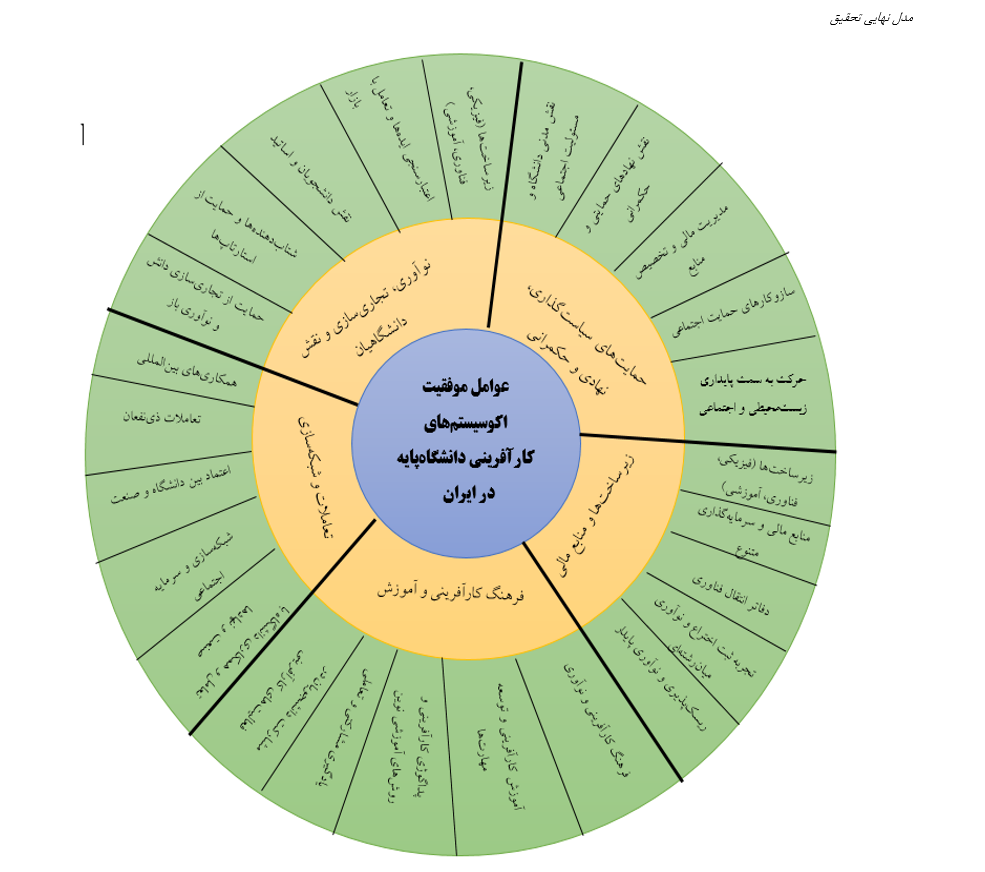
پژوهش حاضر با هدف شناسایی، ترکیب و ارائه چارچوبی یکپارچه از عوامل موفقیت اکوسیستمهای کارآفرینی دانشگاهپایه در ایران انجام شد. این پژوهش از نظر هدف کاربردی و از نظر روش، توصیفی–تبیینی با رویکرد کیفی بود که با استفاده از مرور نظاممند و فراترکیب انجام شد. جامعه پژوهش شامل مقالات و پایاننامههای فارسی و انگلیسی منتشرشده در بازه 2015 تا 2025 بود. پس از جستوجو در پایگاههای داخلی و خارجی، 70 منبع اولیه شناسایی شد و پس از اعمال معیارهای ورود و خروج، حذف موارد تکراری و ارزیابی کیفیت، 31 منبع شامل 15 منبع انگلیسی و 16 منبع فارسی وارد تحلیل نهایی شدند. کیفیت مطالعات با ابزار CASP و چکلیست کارلسن ارزیابی شد و میزان توافق ارزیابان با ضریب کاپای کوهن 0.78 تأیید گردید. تحلیل دادهها بر اساس مدل هفتمرحلهای سندلوسکی انجام شد و برای اصلاح و تأیید مقولههای نهایی، از نظر 7 متخصص در قالب گروه کانونی استفاده شد. نتایج فراترکیب نشان داد که عوامل موفقیت اکوسیستمهای کارآفرینی دانشگاهپایه در پنج مقوله اصلی قابل تبیین است: سیاستگذاری، حمایتهای نهادی و حکمرانی؛ زیرساختها و منابع مالی؛ فرهنگ کارآفرینی و آموزش؛ تعاملات و شبکهسازی؛ و نوآوری، تجاریسازی و نقش دانشگاهیان. یافتهها نشان داد موفقیت این اکوسیستمها وابسته به تعامل همزمان عوامل نهادی، ساختاری، فرهنگی، مالی، آموزشی و شبکهای است و هیچ عامل منفردی بهتنهایی نمیتواند پایداری و اثربخشی اکوسیستم را تضمین کند. چارچوب ارائهشده میتواند بهعنوان ابزاری راهبردی برای سیاستگذاران آموزش عالی، مدیران دانشگاهی و طراحان برنامههای کارآفرینی جهت طراحی، بهبود، ارزیابی و تقویت اکوسیستمهای کارآفرینی دانشگاهپایه مورد استفاده قرار گیرد.
دانلودها
مراجع
Al Qahtani, H., & Sankar, J. P. (2025). Key factors for success in enhancing entrepreneurial ecosystem of universities in GCC. Entrepreneurship Education, 1-30. https://doi.org/10.1007/s41959-025-00139-8
Aliabadi, V., Movahedi, R., Yaghoubi Farani, A., & Papzan, A. (2020). Presenting a conceptual model of the academic entrepreneurial ecosystem in agricultural faculties of western Iran. Research in Agricultural Education Management(52), 3-26.
Alizadeh, N., Nikouei, A., & Mokhtari, H. (2018). Content analysis of the components constituting the entrepreneurial ecosystem. Entrepreneurship and Sustainable Agricultural Development Studies, 5(4), 89-104.
Ankrah, S., & Omar, A. T. (2015). Universities-industry collaboration: A systematic review. Scandinavian Journal of Management, 31(3), 387-408. https://doi.org/10.1016/j.scaman.2015.02.003
Audretsch, D. B., Belitski, M., & Cherkas, N. (2021). Entrepreneurial ecosystems in cities: The role of institutions. PLoS One, 16(3), e0247609. https://doi.org/10.1371/journal.pone.0247609
Audretsch, D. B., Leyden, D. P., & Link, A. N. (2017). Universities as research partners in publicly supported entrepreneurial firms. In Universities and the Entrepreneurial Ecosystem (pp. 182-198). Edward Elgar Publishing. https://doi.org/10.4337/9781786432797.00023
Belitski, M., & Heron, K. (2017). Expanding entrepreneurship education ecosystems. Journal of Management Development, 36(2), 163-177. https://doi.org/10.1108/JMD-06-2016-0121
Belz, F. M., & Binder, J. K. (2017). Sustainable entrepreneurship: A convergent process model. Business Strategy and the Environment, 26(1), 1-17. https://doi.org/10.1002/bse.1887
Besharov, M. L., & Smith, W. K. (2014). Multiple institutional logics in organizations: Explaining their varied nature and implications. Academy of Management Review, 39(3), 364-381. https://doi.org/10.5465/amr.2011.0431
Bruton, G. D., Ahlstrom, D., & Li, H. L. (2010). Institutional theory and entrepreneurship: Where are we now and where do we need to move in the future? Entrepreneurship Theory and Practice, 34(3), 421-440. https://doi.org/10.1111/j.1540-6520.2010.00390.x
Chaudhary, S., Kaur, P., Alofaysan, H., Halberstadt, J., & Dhir, A. (2023). Connecting the dots? Entrepreneurial ecosystems and sustainable entrepreneurship as pathways to sustainability. Business Strategy and the Environment, 32(8), 5935-5951. https://doi.org/10.1002/bse.3466
David, A., & Terstriep, J. (2025). Against all odds: Migrant entrepreneurs in entrepreneurial ecosystems with constraints. Journal of Enterprising Communities: People and Places in the Global Economy, 19(2), 248-275. https://doi.org/10.1108/JEC-03-2024-0052
de Matos Martins, I., Leon Olave, M. E., & Rocha, R. (2022). Critical elements to the development of an entrepreneurship ecosystem: The case of Sergipe. Teoria e Prática em Administração, 12(2). https://doi.org/10.22478/ufpb.2238-104X.2022v12n2.63015
Entezari, Y. (2022). Requirements for developing a university-based entrepreneurial ecosystem in Iran. Quarterly Journal of Research and Planning in Higher Education, 25(1), 1-25.
Etzkowitz, H. (2013). The Triple Helix: University-Industry-Government Innovation and Entrepreneurship. Routledge.
Etzkowitz, H., Ranga, M., Benner, M., Guaranys, L., Maculan, A. M., & Kneller, R. (2008). Pathways to the entrepreneurial university: Towards a global convergence. Science and Public Policy, 35(9), 681-695. https://doi.org/10.3152/030234208X389701
Fallah, M., Amiri, M., Hajiheydari, N., Seyedamiri, N., & Esfidani, M. (2019). Designing an entrepreneurial ecosystem model for IT start-up businesses: Case study of South Khorasan. Public Management Research, 12(45), 59-84.
Farahmandmehr, A., Sharififar, F., & Nikbakhsh, R. (2021). Positioning the subsystems of the entrepreneurial ecosystem in sport. Strategic Studies on Youth and Sports, 20(54), 37-58.
Fuster, E., Padilla-Meléndez, A., Lockett, N., & del-Águila-Obra, A. R. (2019). The emerging role of university spin-off companies in developing regional entrepreneurial university ecosystems: The case of Andalusia. Technological Forecasting and Social Change, 141, 219-231. https://doi.org/10.1016/j.techfore.2018.10.020
Guerrero, M., Urbano, D., & Fayolle, A. (2016). Entrepreneurial activity and regional competitiveness: Evidence from European entrepreneurial universities. The Journal of Technology Transfer, 41(1), 105-131. https://doi.org/10.1007/s10961-014-9377-4
Hahn, T., Preuss, L., Pinkse, J., & Figge, F. (2014). Cognitive frames in corporate sustainability: Managerial sensemaking with paradoxical and business case frames. Academy of Management Review, 39(4), 463-487. https://doi.org/10.5465/amr.2012.0341
Hameed, K., Shahzad, K., & Yazdani, N. (2023). Global incidences of inclusive entrepreneurial ecosystem: Conceptualization and measurement framework. Journal of the Knowledge Economy, 14(4), 5033-5064. https://doi.org/10.1007/s13132-023-01427-1
Hariram, N. P., Mekha, K. B., Suganthan, V., & Sudhakar, K. (2023). Sustainalism: An integrated socio-economic-environmental model to address sustainable development and sustainability. Sustainability, 15(13), 10682. https://doi.org/10.3390/su151310682
Hosseinzadeh, M., Samadi Foroushani, M., & Sadraei, R. (2022). Dynamic performance development of entrepreneurial ecosystem in the agricultural sector. British Food Journal, 124(7), 2361-2395. https://doi.org/10.1108/BFJ-08-2021-0909
Hsieh, R. M., & Kelley, D. (2020). A study of key indicators of development for university-based entrepreneurship ecosystems in Taiwan. Entrepreneurship Research Journal, 10(2), 20180331. https://doi.org/10.1515/erj-2018-0331
Isenberg, D. J. (2010). How to start an entrepreneurial revolution. Harvard business review, 88(6), 41-50.
Jameh Bozorgi, M. J., & Meygoonpouri, M. (2023). Designing a model for developing the academic entrepreneurial ecosystem with a cultural-environment approach in Iran. Iranian Journal of Agricultural Economics and Development Research, 54(2), 557-574.
Juusola, K. (2015). Mercury beats Minerva?: Essays on the accelerating impact of market logic permeating higher education University of Jyväskylä].
Keykha, A., & Pourkarimi, J. (2021). Research synthesis of the components of the academic entrepreneurial ecosystem. Entrepreneurship Development Quarterly, 14(2), 301-320.
Kitagawa, F., Sánchez Barrioluengo, M., & Uyarra, E. (2016). Third mission as institutional strategies: Between isomorphic forces and heterogeneous pathways. Science and Public Policy, 43(6), 736-750. https://doi.org/10.1093/scipol/scw015
Lahikainen, K. (2021a). The emergence of a university-based entrepreneurship ecosystem Lappeenranta-Lahti University of Technology LUT].
Lahikainen, K. (2021b). Understanding the emergence of the university-based entrepreneurial ecosystem: Comparing the university and company actors perspectives. In Sustainable Entrepreneurship and Entrepreneurial Ecosystems (pp. 92-111). Edward Elgar Publishing. https://doi.org/10.4337/9781839109690.00013
Lalezari Mosalla, B., Sanaeipour, H., Cheraghali, M., & Sharifzadeh, M. S. (2022). Identifying factors affecting the development of the entrepreneurial ecosystem in Iran's stone industry. Journal of Innovation Economy Ecosystem Studies, 2(3).
Lam, A. (2011). What motivates academic scientists to engage in research commercialization: Gold, ribbon or puzzle? Research Policy, 40(10), 1354-1368. https://doi.org/10.1016/j.respol.2011.09.002
Mascarenhas, C., Marques, C. S., Galvão, A. R., & Santos, G. (2017). Entrepreneurial university: Towards a better understanding of past trends and future directions. Journal of Enterprising Communities: People and Places in the Global Economy, 11(3), 316-338. https://doi.org/10.1108/JEC-02-2017-0019
Mason, C., & Brown, R. (2014). Entrepreneurial ecosystems and growth oriented entrepreneurship.
Meygoonpouri, M., Arabiyoun, A., Pourbasir, M. M., & Mobini Dehkordi, A. (2019). Designing a university-campus entrepreneurial ecosystem using interpretive structural modeling. Educational Technology, 13(4), 969-980.
Mir, N., Rahimikia, A., & Daraei, M. (2024). Designing an entrepreneurial ecosystem model in the university with a knowledge-based approach. Management and Educational Perspective, 6(2).
Mohaghar, A., Mohammadi, M., Mokhtarzadeh, N., & Shahidipour, R. (2019). A conceptual framework for the formation of university-based entrepreneurial ecosystems in Tehran. Innovation Management, 8(4), 33-60.
Moraes, B. G. (2024). Mapping the pathways of science-based academic entrepreneurs in the Queen's University ecosystem Queen's University].
Motamedinia, Z., Movahed Mohammadi, S. H., Elmbeygi, A., & Mehdizadeh, H. (2021). Content analysis of barriers to the growth of the entrepreneurial ecosystem in the context of the national agricultural higher education system. Entrepreneurship and Sustainable Agricultural Development Studies, 8(2), 81-96.
Motamedinia, Z., Movahed Mohammadi, S. H., & Mehdizadeh, H. (2022). Explaining an entrepreneurial ecosystem model in the context of Iran's agricultural higher education system. Entrepreneurship and Sustainable Agricultural Development Studies, 9(2), 19-36.
Neumeyer, X., Santos, S. C., & Morris, M. H. (2019). Who is left out: Exploring social boundaries in entrepreneurial ecosystems. The Journal of Technology Transfer, 44(2), 462-484. https://doi.org/10.1007/s10961-018-9694-0
Ninh, T. T. T., & Hue, T. T. (2025). Sustainable entrepreneurial ecosystems: What are the main schools of thought and topical trends? Discover Sustainability, 6(1), 115. https://doi.org/10.1007/s43621-025-00931-5
Nouri, F., Shariatmadari, M., & Abbasi Sarvak, L. (2021). Identifying the indigenous model of the fourth-generation entrepreneurial university of Islamic Azad University and examining its psychometric characteristics. A New Approach in Educational Management, 12(6), 181-195.
Novela, S., Syarief, R., Fahmi, I., & Arkeman, Y. (2022). Key factors of entrepreneurial university transformation: A model development using ISM method and MICMAC analysis. Journal of Applied Research in Higher Education, 14(3), 1144-1159. https://doi.org/10.1108/JARHE-02-2021-0045
O'Brien, E., Cooney, T. M., & Blenker, P. (2019). Expanding university entrepreneurial ecosystems to under-represented communities. Journal of Entrepreneurship and Public Policy, 8(3), 384-407. https://doi.org/10.1108/JEPP-03-2019-0025
Padilla-Meléndez, A., & del-Aguila-Obra, A. R. (2022). Governance of entrepreneurial universities in the context of entrepreneurial ecosystems: The perspective of the university technology transfer offices. Studies in Higher Education, 47(5), 973-981. https://doi.org/10.1080/03075079.2022.2055321
Powell, W. W., & Colyvas, J. A. (2008). Microfoundations of institutional theory. In The Sage Handbook of Organizational Institutionalism (pp. 276). https://doi.org/10.4135/9781849200387.n11
Rasmussen, E., & Borch, O. J. (2010). University capabilities in facilitating entrepreneurship: A longitudinal study of spin-off ventures at mid-range universities. Research Policy, 39(5), 602-612. https://doi.org/10.1016/j.respol.2010.02.002
Rinkinen, S., Konsti-Laakso, S., & Lahikainen, K. (2024). University as an opportunity space enabler in a regional entrepreneurial ecosystem. European Planning Studies, 32(5), 1010-1028. https://doi.org/10.1080/09654313.2023.2246522
Roundy, P. T. (2017). Hybrid organizations and the logics of entrepreneurial ecosystems. International Entrepreneurship and Management Journal, 13(4), 1221-1237. https://doi.org/10.1007/s11365-017-0452-9
Schaeffer, P. R., Fischer, B., & Queiroz, S. (2018). Beyond education: The role of research universities in innovation ecosystems. foresight, 12(2), 50-61. https://doi.org/10.17323/2500-2597.2018.2.50.61
Shil, M., Shahriar, M. S., Sultana, S., Rahman, S. N., & Zayed, N. M. (2020). Introduction to university based entrepreneurship ecosystem (U-BEE): A model case study from Bangladesh. International Journal of Entrepreneurship, 24(1), 1-9.
Siegel, D. S., & Wright, M. (2015). Academic entrepreneurship: Time for a rethink? British Journal of Management, 26(4), 582-595. https://doi.org/10.1111/1467-8551.12116
Stam, E. (2015). Entrepreneurial ecosystems and regional policy: A sympathetic critique. European Planning Studies, 23(9), 1759-1769. https://doi.org/10.1080/09654313.2015.1061484
Stam, E., & Van de Ven, A. (2021). Entrepreneurial ecosystem elements. Small Business Economics, 56(2), 809-832. https://doi.org/10.1007/s11187-019-00270-6
Steigertahl, L., & Mauer, R. (2023). Investigating the success factors of the Nordic entrepreneurial ecosystem: Talent transformation as a key process. The International Journal of Entrepreneurship and Innovation, 24(1), 7-18. https://doi.org/10.1177/14657503211051217
Thomsen, B., Muurlink, O., & Best, T. (2018). The political ecology of university-based social entrepreneurship ecosystems. Journal of Enterprising Communities: People and Places in the Global Economy, 12(2), 199-219. https://doi.org/10.1108/JEC-08-2017-0068
Vazifeh Dolatabad, R., Meygoonpouri, M., & Irajpour, A. (2022). Factors affecting the formation of a technology-based academic entrepreneurial ecosystem: Case study of technical faculties of the University of Tehran. Industrial Management, 14(3), 391-420.
Wahyudi, S. E., Baihaqi, I., & Arvitrida, N. I. (2025). Unveiling the nexus: A comprehensive review of university-based digital entrepreneurship ecosystem to foster students' startup. In Eurasia Business and Economics Society Conference (pp. 23-34). Springer. https://doi.org/10.1007/978-3-031-80256-0_2
Wang, X., Sun, X., Liu, S., & Mu, C. (2021). A preliminary exploration of factors affecting a university entrepreneurship ecosystem. Frontiers in psychology, 12, 732388. https://doi.org/10.3389/fpsyg.2021.732388

دانلود
چاپ شده
ارسال
بازنگری
پذیرش
شماره
نوع مقاله
مجوز
حق نشر 1404 Kamyar Khoshnoudzadeh (Author); Mahdi Mohammadi; Sina Tarighi (Author)

این پروژه تحت مجوز بین المللی Creative Commons Attribution-NonCommercial 4.0 می باشد.