Metasynthesis of Leadership Skills Development Requirements Using Neuro-Linguistic Programming (NLP)
Keywords:
Leadership skills, Developing leadership skills, Neuro-linguistic programming (NLP), MetasynthesisAbstract
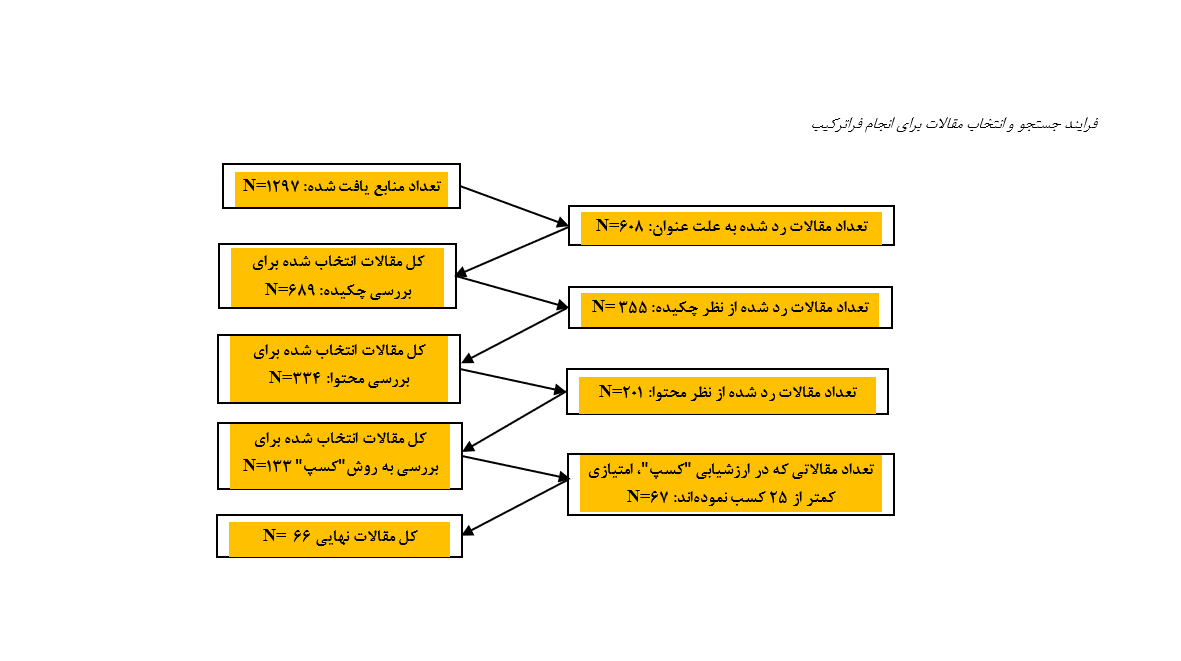
The purpose of this study is to develop a comprehensive framework for leadership skills development requirements using neuro-linguistic programming techniques. This qualitative and developmental study employed a meta-synthesis approach supported by qualitative content analysis. The research population consisted of all internal and international studies related to leadership skills development and NLP published between 2000 and 2025. A systematic search was conducted across major scientific databases, yielding 1,727 initial documents. Through multi-stage screening, based on relevance, methodological rigor, and quality assessment criteria, 66 high-quality studies were selected. Data were analyzed using the seven-step Sandelowski and Barroso method to extract conceptual patterns and synthesize findings. The inferential results revealed that leadership skills development requirements grounded in NLP can be categorized into three main themes comprising nine subthemes and sixty descriptive codes. The first theme focuses on intrapersonal and personality-based leadership skills, emphasizing self-leadership, authenticity, and personal capability. The second theme addresses interpersonal and group-related skills, including communication effectiveness, influence, persuasion, and developmental competencies. The third theme encompasses strategic and organizational requirements, reflecting social and organizational intelligence, cognitive and analytical capacities, executive and managerial competence, adaptability and agility, and value-creation capabilities. Overall, the analysis demonstrates that NLP facilitates deeper cognitive, communicative, and strategic development in leaders by reshaping mental models and enhancing behavioral flexibility. The study concludes that neuro-linguistic programming provides a multidimensional and integrative framework for strengthening leadership skills. By enabling leaders to modify internal patterns, improve communication, and enhance strategic awareness, NLP serves as a transformational tool for leadership development, organizational capacity building, and human capital enhancement.
Downloads
References
Ajmi, H. R. A. (2024). Principals’ Leadership Skills to Meet the National Strategy for Education in Basic Schools. Journal of Education and E-Learning Research, 11(2), 413-421. https://doi.org/10.20448/jeelr.v11i2.5644
Al‐Thawabiya, A., Singh, K., Al‐Lenjawi, B. A., & Alomari, A. (2023). Leadership styles and transformational leadership skills among nurse leaders in Qatar, a cross‐sectional study. Nursing Open. https://doi.org/10.1002/nop2.1636
Binder, M. (2025). How to Use Neuro-linguistic Programming (NLP) Techniques.
Blancada, N. A. A. (2023). Educational Leaders’ Management Skills, Leadership Behavior and Organizational Commitment. International Journal of Research Publications, 124(1). https://doi.org/10.47119/ijrp1001241520234837
Cripe, K. M., & Burleigh, C. (2022). Examining Leadership Skills, Behaviors, and Effective Communication for Virtual IT Project Managers. Team Performance Management, 28(3/4), 223-237. https://doi.org/10.1108/tpm-11-2021-0085
Faccia, A. (2023). NLP Sentiment Analysis and Accounting Transparency: A New Era of Financial Record Keeping. Computers, 13(1), 5. https://doi.org/10.3390/computers13010005
Fioravanti, M. L., Paulo, H. S. d. M., & Barbosa, E. F. (2021). Fostering Leadership Skills of Technology Professionals in Startups. Renote, 19(2), 406-415. https://doi.org/10.22456/1679-1916.121364
Gerling, C., & Lessmann, S. (2024). Leveraging AI and NLP for Bank Marketing: A Systematic Review and Gap Analysis. arXiv preprint. arXiv:2411.14463
Ghaderi Sheykhi Abadi, M., Nasiri, F., Afzali, A., & Taajobi, M. (2023). Construction and Standardization of Synergistic Leadership Questionnaire in Managers of Technical and Vocational Schools. Sociology of Education, 10(1), 193-203. https://doi.org/10.22034/ijes.2023.1989716.1389
Ghalami Bavil Aliayi, H., & Ali Mahdi, M. (2024). The effectiveness of communication skills training on psychological (organizational) capital and transformational leadership style. New Educational Thought Journal, 20(1), 133-144.
Gilli, K., Lettner, N., & Guettel, W. (2024). The future of leadership: new digital skills or old analog virtues? Journal of Business Strategy, 45(1), 10-16. https://doi.org/10.1108/JBS-06-2022-0093
Groenewald, E., Groenewald, C. A., Uy, F., Cantere Jr, G., Kilag, O. K., & Depoyart, J. (2024). Enhancing Leadership Skills for Addressing Learning Loss and Mental Health Challenges: Insights from School Leaders in Low-and Middle-Income Countries. International Multidisciplinary Journal of Research for Innovation, Sustainability, and Excellence (IMJRISE), 1(2), 226-232. https://www.researchgate.net/profile/Elma-Groenewald-2/publication/378513262
Henderikx, M., & Stoffers, J. (2023). Digital Transformation and Middle Managers’ Leadership Skills and Behavior: A Group Concept Mapping Approach. Frontiers in psychology, 14. https://doi.org/10.3389/fpsyg.2023.1147002
Idris, I., Suyuti, A., Supriyanto, A. S., & As, N. (2022). Transformational leadership, political skill, organizational culture and employee performance: A case study from tourism company in Indonesia. Geojournal of Tourism and Geosites, 40(1), 104-110. https://doi.org/10.30892/gtg.40112-808
Jørgensen, R. (2023). MultiFin: A Dataset for Multilingual Financial NLP. https://doi.org/10.18653/v1/2023.findings-eacl.66
Khandelwal, A. (2025). A Machine Learning Approach to Predicting Managerial Skills and Leadership Performance. Jnanabha, 55(01). https://doi.org/10.58250/jnanabha.2025.55104
Kilag, O. K. T. (2023). Importance of Upskilling and Reskilling in Educational Leadership and Management. Ejlhss, 1(1), 49-57. https://doi.org/10.61796/ejlhss.v1i1.12
Krampitz, J., Tenschert, J., Furtner, M., Simon, J., & Glaser, J. (2023). Effectiveness of online self-leadership training on leaders' self-leadership skills and recovery experiences. Journal of Workplace Learning, 35(9), 66-85. https://doi.org/10.1108/JWL-10-2022-0125
Mohamed Mahdy, F., Binzafrah, F., & Alqahtani, M. (2022). A Structural Framework for Neuro-Linguistic Programming (NLP) and its Consequence on Leadership Succession Planning Strategy Applying to the Leaders of King Khalid University and Qualified Personnel for Leadership Position. Business Ethics and Leadership, 6(2), 24-43. https://doi.org/10.21272/bel.6(2).24-43.2022
Muller, C. R., & Pelser, T. G. (2022). A proposed leadership skills development model for African FMCG business-networks: Super-Cube®. South African Journal of Economic and Management Sciences, 25(1), 4303. https://doi.org/10.4102/sajems.v25i1.4303
Muschard, B., Rozenfeld, H., Guzmán, V. E., Gerolamo, M., & Kohl, H. (2020). Characteristics and Skills of Leadership in the Context of Industry 4.0. Procedia Manufacturing,
Noori, R., Jafari Nia, S., Abdollahi, B., & Razaghi, A. M. (2025). Identifying and Prioritizing Essential Skills for E-Leadership. Quarterly Journal of Organizational Behavior Studies. https://obs.sinaweb.net/?_action=article&au=1692504&_au=%D9%86%D9%88%D8%B1%DB%8C%D8%8C%20%D8%B1%D9%88%D8%AD%20%D8%A7%D9%84%D9%87
Ohlsson, A., Alvinius, A., & Larsson, G. (2020). Smooth power: identifying high-level leadership skills promoting organizational adaptability. International Journal of Organization Theory & Behavior, 23(4), 297-313. https://doi.org/10.1108/IJOTB-02-2019-0009
Osei, A., & Ismail, A. (2023). Enhancing Entrepreneurial Leadership Skills Through Educational Workshops in Agriculture. International Journal of Agricultural Education and Extension, 29(2), 145-155.
Raby, R. L., Fischer, H., & Cruz, N. I. (2023). Community college international leaders' sensemaking: Entrepreneurial leadership skills and behavior. Community College Review, 51(1), 52-74. https://doi.org/10.1177/00915521221125822
Rahman, M. M., Salamzadeh, A., Dana, L. P., & Braga, V. (2024). Work‐Family Balance, Digital Leadership Skills, and Family Social Support as the Predictors of Subjective Well‐Being of Y‐Generation Managers. Strategic Change. https://doi.org/10.1002/jsc.2628
Ranjbar, H., Soleimani, N., & Shafizadeh, H. (2020). A process model for developing educational leadership skills: A qualitative research. School Management Quarterly, 8(3), 484-508. https://sid.ir/paper/958414/fa
Sandberg, B. (2023). Leadership Skills in Startups: a Quantitative Study on the Requirement Profile. Worldmbf, 1(1), 1-13. https://doi.org/10.33422/worldmbf.v1i1.123
Seifollahi, N., & Hassanzadeh, T. (2022). Investigating the impact of knowledge leadership on organizational entrepreneurship, with the mediating role of organizational innovation. Skill Development Journal, 11(41), 121-138. https://doi.org/10.52547/irtvto.11.41.6
Tabassum, M., Raziq, M. M., Allen, M. M. C., Sarwar, N., & Golra, O. A. (2024). Exploring Emergent Leadership in Agile Teams: Network Dynamics, Roles and Skills at the Individual Level. Business Process Management Journal, 30(5), 1615-1637. https://doi.org/10.1108/bpmj-02-2024-0110
Taherpour, F., & Nasehian, H. (2022). Analyzing the Relationship Between Sustainable Leadership Skills and Co-creation with the Mediation of Cognitive Trust Among Faculty Members of Birjand University. Quarterly Journal of Public Management Perspective, 13(4), 35-59. https://doi.org/10.52547/jpap.2022.227484.1194
Tran, Q. H. N. (2023). Library as a Learning Organization: The Influence of Leadership Skills on Organizational Citizenship Behavior at Vietnamese Libraries. The Learning Organization, 30(3), 339-354. https://doi.org/10.1108/tlo-10-2022-0126
Yadav, N. (2025). AI for Mental Health: The Use of Chatbots and NLP to Support Therapy and Early Detection. International Scientific Journal of Engineering and Management, 04(05), 1-7. https://doi.org/10.55041/isjem03402
Zhan, H., Cheng, K. M., Wijaya, L., & Zhang, S. (2024). Investigating the Mediating Role of Self-Efficacy Between Digital Leadership Capability, Intercultural Competence, and Employability Among Working Undergraduates. Higher education, skills and work-based learning. https://doi.org/10.1108/HESWBL-02-2024-0032

Downloads
Published
Submitted
Revised
Accepted
Issue
Section
License
Copyright (c) -1 Alireza Nikmaram (Author); Nour mohammad Yaqhoubi; Habibollah Salarzehi, Esmaeel Asadi, Abdolsamad khodami (Author)

This work is licensed under a Creative Commons Attribution-NonCommercial 4.0 International License.