تأثیر شبکههای همکاری بینسازمانی بر عملکرد نوآوری در کسبوکارهای کوچک و متوسط
کلمات کلیدی:
شبکههای همکاری بینسازمانی, عملکرد نوآوری, اعتماد سازمانی, ظرفیت جذب, تبادل دانش, کسبوکارهای کوچک و متوسط (SMEs)چکیده
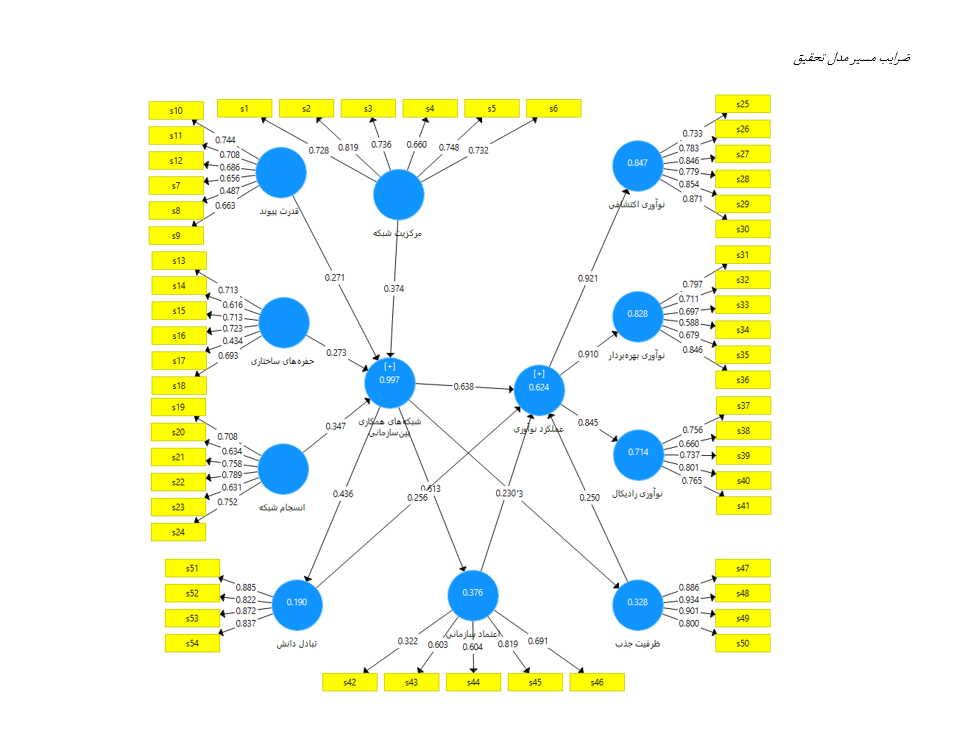
این پژوهش با هدف بررسی تأثیر شبکههای همکاری بینسازمانی بر عملکرد نوآوری در کسبوکارهای کوچک و متوسط با نقش میانجی اعتماد سازمانی، ظرفیت جذب و تبادل دانش انجام شد. پژوهش حاضر از نظر هدف کاربردی و از نظر روش، کمّی با رویکرد پیمایشی-همبستگی بود. جامعه آماری شامل مدیران ارشد کسبوکارهای کوچک و متوسط مستقر در شهرکهای صنعتی استان تهران بود. بر اساس تحلیل توان در نرمافزار G*Power، 155 نفر بهعنوان نمونه انتخاب شدند. دادهها با پرسشنامه محققساخته بر مبنای مقیاس لیکرت پنجدرجهای گردآوری شد. تحلیل دادهها با استفاده از SPSS نسخه 26 و SmartPLS نسخه 3 و روش مدلسازی معادلات ساختاری مبتنی بر حداقل مربعات جزئی انجام گرفت. نتایج نشان داد شبکههای همکاری بینسازمانی اثر مستقیم، مثبت و معناداری بر عملکرد نوآوری دارند (β=0.638, t=11.887, p<0.001). همچنین اثر شبکههای همکاری بر اعتماد سازمانی (β=0.613)، تبادل دانش (β=0.436) و ظرفیت جذب (β=0.573) معنادار بود. اعتماد سازمانی (β=0.230, p=0.005)، تبادل دانش (β=0.256, p=0.004) و ظرفیت جذب (β=0.250, p=0.008) نیز اثر مثبت و معناداری بر عملکرد نوآوری داشتند. اثرات غیرمستقیم از طریق اعتماد سازمانی، تبادل دانش و ظرفیت جذب نیز معنادار گزارش شد. مقدار GOF برابر با 0.603 نشاندهنده برازش قوی مدل بود. شبکههای همکاری بینسازمانی نقش مهمی در ارتقای عملکرد نوآوری کسبوکارهای کوچک و متوسط دارند و این اثر از طریق تقویت اعتماد سازمانی، ظرفیت جذب و تبادل دانش تشدید میشود. بنابراین، مدیریت هدفمند شبکههای همکاری میتواند راهبردی مؤثر برای بهبود نوآوری در SMEs باشد.
دانلودها
مراجع
Bafandeh-Zendeh, A., Norouzi, D., & Ali, S. (2010). Investigating the problems of managers of small and medium-sized enterprises (SMEs) in East Azerbaijan Province. Industrial Management Quarterly, Islamic Azad University, Sanandaj Branch, 13, 41-54.
Bahramfard, H., Bagheri, G., Kordnaeij, A., & Saberi, A. (2025). The decision to take advantage of the opportunity by emphasizing the role of the entrepreneur in sports businesses. Journal of Research in Sport Management, 15(29), 252-279.
Bahramfard, H., Bagheri Ragheb, G., & Kordnaeij, A. (2023). The role of inspiration in the decision to exploit entrepreneurial opportunities in sports businesses. Sport Management Journal, 15(4), 237-257. https://doi.org/10.22059/jsm.2023.358291.3135
Ceesay, L. B. (2021). Managing the relational capabilities of inter-organizational innovation ecosystems: Empirical investigations University of Gastone].
Chen, J., Di, H., & Wu, F. (2025). Exploratory and exploitative innovation performance in the artificial intelligence industry in China from the perspective of a collaboration network: A data-driven analysis. Entropy, 27(6), 577. https://doi.org/10.3390/e27060577
Ding, N., Wang, L., Markus, A., Xiong, Y., & Zhang, Y. (2025). When do intrafirm networks accelerate follow-on invention? Evidence from biotechnology firms. Technovation.
Flieger, M. (2024). Inter-organizational network collaboration: How organizations modify expected benefits when facing VUCA environment. European Research Studies Journal, 27(3), 852-868. https://doi.org/10.35808/ersj/3469
Guo, J., & Xie, F. (2020). The impact of firm's collaboration network position on innovation performance: Based on ICT industry. Journal of Systems & Management, 29(6), 1124-1135.
Henseler, J., Ringle, C. M., & Sarstedt, M. (2015). A new criterion for assessing discriminant validity in variance-based structural equation modeling. Journal of the Academy of Marketing Science, 43(1), 115-135. https://doi.org/10.1007/s11747-014-0403-8
Hosseini, S. R., Karimi, A., & Mohammadpour, Z. (2024). Social capital and innovation performance in industrial small and medium-sized enterprises: The moderating role of knowledge absorptive capacity. Innovation Management Quarterly, 13(2), 45-68.
Kusa, R. (2025). Testing mediating and moderating roles of inter-organizational collaboration in the entrepreneurial orientation context. European Management Studies, 23(1), 4-43. https://doi.org/10.7172/2956-7602.107.1
Kusa, R., Suder, M., Gretzinger, S., & Schachtebeck, C. (2025). Entrepreneurial orientation and networking as enablers of firm performance: A fuzzy-set based comparative analysis of micro, small and medium-sized enterprises. Management revue, 36(2), 1-16. https://doi.org/10.31083/MRev43389
Li, Y., Liu, X., & Chen, J. (2024). Collaboration networks and radical innovation: Two faces of tie strength and structural holes. Journal of Innovation & Knowledge, 9(4), 100148.
Liu, J., Zhao, M., & Wang, K. (2025). Professional connections and digital innovation of SMEs. The Journal of Technology Transfer. https://doi.org/10.1007/s10961-025-10201-1
Munoz, P. A., & Lu, L. (2011). Innovation networks: Exploring inter-organizational dynamics in open innovation environments. Proceedings of the First International Technology Management Conference,
Nalmpantia, A. D., Wong, C. Y., & Oghazi, P. (2024). Collaborating for innovation: The inhibiting role of constraints. Journal of Innovation & Knowledge, 9(3), 100496. https://doi.org/10.1016/j.jik.2024.100504
Norouzi, K., Alavian, M., & Sarvi, S. (2021). Academic critique: A framework for the emergence of innovation. Innovation Management, 9(1), 1-22.
Preacher, K. J., & Hayes, A. F. (2008). Asymptotic and resampling strategies for assessing and comparing indirect effects in multiple mediator models. Behavior Research Methods, 40(3), 879-891. https://doi.org/10.3758/BRM.40.3.879
Provan, K. G., Fish, A., & Sydow, J. (2007). Interorganizational networks at the network level: A review of the empirical literature on whole networks. Journal of Management, 33(3), 479-516. https://doi.org/10.1177/0149206307302554
Ricciardi, F., Zardini, A., & Rossignoli, C. (2016). Organizational dynamism and adaptive business model innovation: The triple paradox configuration. Journal of Business Research, 69(11), 5487-5493. https://doi.org/10.1016/j.jbusres.2016.04.154
Rost, K. (2011). The strength of strong ties in the creation of innovation. Research Policy, 40(4), 588-604. https://doi.org/10.1016/j.respol.2010.12.001
Stollberger, J., Al-Atwi, A. A., & De Cremer, D. (2023). Untangling the team social capital-team innovation link: The role of proportional task conflict. Human Relations, 76(6), 871-900. https://doi.org/10.1177/00187267221080995
Tahmasbi, R., Jalali, S. M., & Karimi, F. (2022). The effect of network cohesion and diversity on innovation performance in Iranian industrial SMEs. Public Management Research, 15(57), 107-128.
Weerasinghe, R. N., Jayawardane, A. K. W., & Yapa, U. A. S. (2021). The impact of open innovation practices and moderating effect of inter-organizational networks on innovation performance of large firms in Sri Lanka. Studies in Political Economy, 4(2).
Xie, X., Liu, X., & Chen, J. (2023). A meta-analysis of the relationship between collaborative innovation and innovation performance: The role of formal and informal institutions. Technovation, 102740. https://doi.org/10.1016/j.technovation.2023.102740
Xu, J., Wang, C., & Cui, Y. (2023). Multidimensional proximities and interorganizational coinnovation performance: The roles of intraorganizational collaboration network inefficiency. Frontiers in psychology, 14. https://doi.org/10.3389/fpsyg.2023.1121908
Zahoor, N., & Al-Tabbaa, O. (2020). Inter-organizational collaboration and SMEs' innovation: A systematic review and future research directions. Scandinavian Journal of Management, 36(2), 101109. https://doi.org/10.1016/j.scaman.2020.101109
Zhang, M., & Gao, L. (2021). Research on the relationship between subject factors and cross-organizational cooperation innovation performance based on meta-analysis. Journal of Management Science.
Zhang, R., Tang, Y., Li, Y., & Zhang, Y. (2025). What motivates the collaborative innovation relationship in infrastructure projects from dynamic network perspective. Technovation, 148, 103345. https://doi.org/10.1016/j.technovation.2025.103345
Zhang, Z., & Zhou, W. (2024a). How does network intermediary affect collaborative innovation? Evidence from Chinese listed companies. Journal of Data and Information Science, 9(4), 49-70. https://doi.org/10.2478/jdis-2024-0030
Zhang, Z., & Zhou, W. (2024b). Partners' centrality in scientific collaboration and exploratory innovation: Roles of patent stock and structural holes. Heliyon, 10(13), e33958. https://doi.org/10.1016/j.heliyon.2024.e33958
دانلودها
گاهشمار انتشار
- ارسال
- بازنگری
- پذیرش
شماره
نوع مقاله
مجوز
حق نشر 2026 Jahangir Yadollahi Farsi; Shabnam Shamsi , Najmeh Hossinzadeh (Author)

این پروژه تحت مجوز بین المللی Creative Commons Attribution-NonCommercial 4.0 می باشد.