Designing a Quadruple Helix Collaboration Model for Technological Entrepreneurship Development in the Food Industry
Keywords:
Quadrilateral collaboration model,, technological entrepreneurship, innovation ecosystem, data-driven theory, food industryAbstract
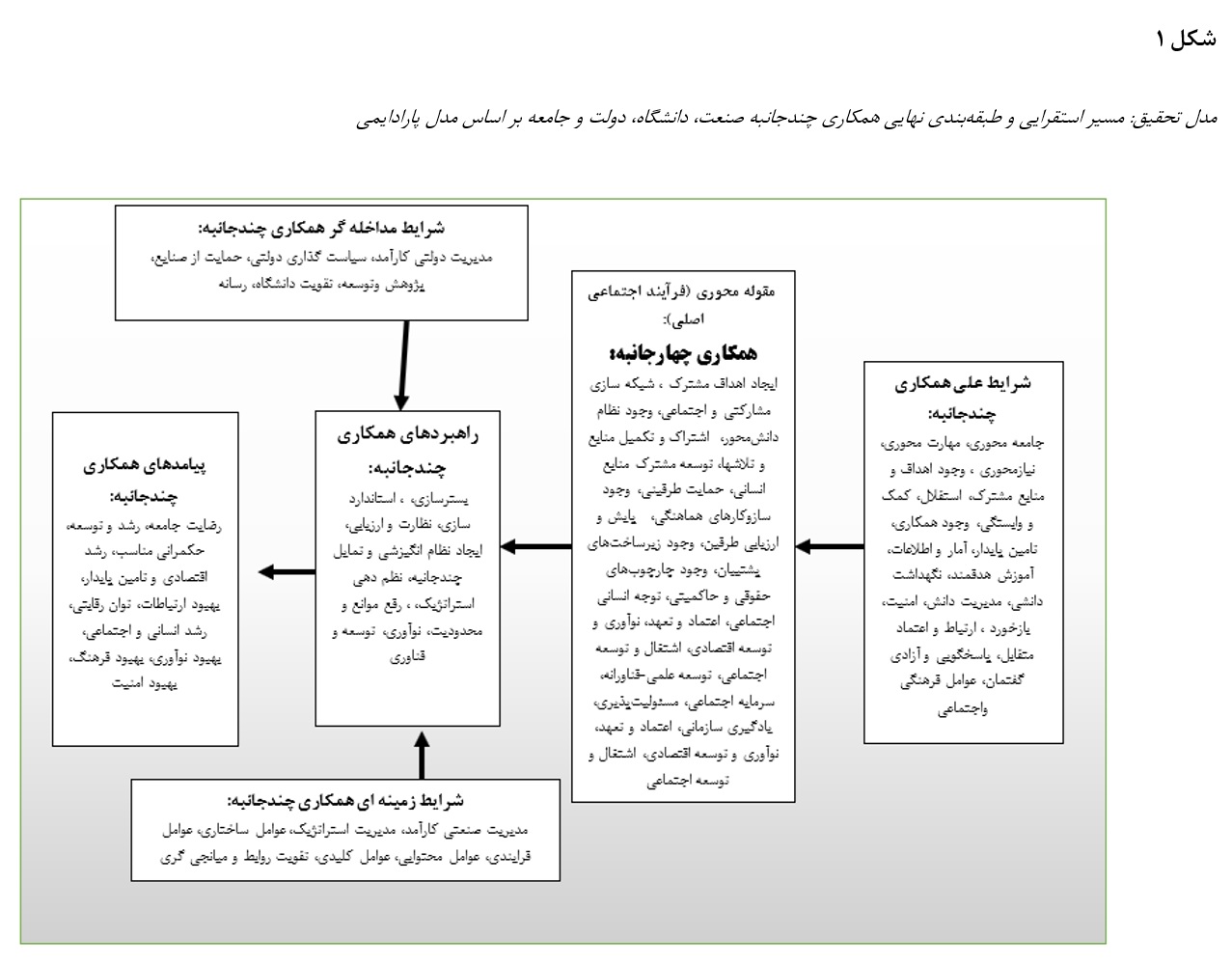
This study aims to design and explain a context-based and systematic quadruple helix collaboration model among industry, university, government, and society to foster technological entrepreneurship in the food industry of Mashhad. This research adopted an interpretive paradigm with an inductive qualitative approach using grounded theory methodology. Data were collected through 18 semi-structured interviews with senior experts from industry, academia, and government and analyzed using MAXQDA software. Credibility, transferability, dependability, and confirmability were ensured throughout the research process. The analysis resulted in 68 main categories and 221 subcategories organized into six major dimensions: causal conditions, core phenomenon, contextual conditions, intervening factors, strategies, and consequences. The final model reveals that quadruple helix collaboration represents a complex, multi-level, and dynamic system requiring institutional synergy, mutual trust, effective knowledge management, coordinated policymaking, and sustainable monitoring mechanisms. The proposed model provides a comprehensive theoretical–practical framework for policymakers, industrial managers, and academic leaders to enhance technological innovation, sustainable development, and social capital.
Downloads
References
Agrawal, D., Gupta, S., Dusad, C., Meena, M. L., Dangayach, G. S., & Jagtap, S. (2025). Identifying enablers for a circular healthcare supply chain: An integrated fuzzy DEMATEL-MMDE approach. Cleaner Engineering and Technology, 24, 100882. https://doi.org/10.1016/j.clet.2025.100882
Bauer, M., Ebersberger, B., & Bloch, C. (2021). Key performance indicators for evaluating university-industry collaborations. Journal of Business Research, 134, 223-235. https://doi.org/10.1016/j.jbusres.2021.05.043
Brown, P., & Jones, R. (2023). Organizational factors and leadership in multi-sector collaborations. International Journal of Project Management, 41(3), 145-162. https://doi.org/10.1016/j.ijproman.2022.102485
Cai, Y., & Ahmad, I. (2021). From an entrepreneurial university to a sustainable entrepreneurial university: Conceptualisation and evidence in the contexts of European university reforms. Higher Education Policy. https://doi.org/10.1057/s41307-021-00243-z
Cai, Y., & Lattu, A. (2021). Triple Helix or Quadruple Helix: Which model of innovation to choose for empirical studies? Minerva. https://doi.org/10.1007/s11024-021-09453-6
Chen, J., Zhang, M., & Lai, Y. (2021). Technological innovation and sustainable development: A global perspective. Journal of Cleaner Production, 278, 123567. https://doi.org/10.1016/j.jclepro.2020.123567
Chen, J., Zhang, M., & Lai, Y. (2022). Technological advancements and their role in fostering collaboration. Journal of Technology Transfer, 47(1), 223-240. https://doi.org/10.1007/s10961-021-09848-3
Chen, L., & Zhao, Y. (2024). Quadruple helix collaboration in traditional manufacturing sectors: A systematic review and research agenda. Journal of Manufacturing Technology Management, 35(3), 456-475. https://doi.org/10.1108/JMTM-08-2023-0321
da Silva, W. A., Dantas, Í. J. M., & Curth, M. (2025). Value co-creation as a service element in the context of health: A systematic review. International Journal of Pharmaceutical and Healthcare Marketing. https://doi.org/10.1108/IJPHM-02-2025-0014
European, C. (2021). Horizon Europe: The EU research and innovation programme 2021-2027. Publications Office of the European Union.
Farooq, M. B., & Khan, A. A. (2024). The evolving role of civil society in innovation ecosystems: From passive beneficiary to active co-creator. Technovation, 129, 102876. https://doi.org/10.1016/j.technovation.2023.102876
Garcia, L., & Martinez, E. (2023). Triple helix and beyond: Models of collaboration in the 21st century. International Journal of Collaboration, 37(1), 34-50. https://doi.org/10.1177/10464964221123456
Gupta, P., & Sinha, R. (2024). Analyzing intervention conditions in cross-sector partnerships for social innovation: A configurational approach. Public Management Review, 26(5), 1320-1343. https://doi.org/10.1080/14719037.2023.2196254
Johnson, H., & Lee, M. (2021). The impact of political and legal factors on industry-university-government collaboration. Policy Studies Journal, 49(2), 287-305. https://doi.org/10.1111/psj.12405
Miller, K., & Davis, J. (2023). Community and sustainable development in industry-university-government collaboration. Journal of Sustainable Development, 29(1), 77-94. https://doi.org/10.5539/jsd.v29n1p77
Molina, R., García-Aracil, A., & Fernández-de-Lucio, I. (2024). Unpacking the black box of university-industry-government-community collaboration: A grounded theory study in the agri-food sector. Research Policy, 53(2), 104945. https://doi.org/10.1016/j.respol.2023.104945
Murphy, A. (2025). Inside health systems' clinical-supply chain collaborations. Becker's Hospital Review. https://www.beckershospitalreview.com/supply-chain/inside-health-systems-clinical-supply-chain-collaborations.html
Olvera, C., Piqué, J. M., Cortés, U., & Nemirovsky, M. (2020). Evaluating university-business collaboration at science parks: A business perspective. Triple Helix, 7(2-3), 265-305. https://doi.org/10.1163/21971927-bja10007
Piqué, J. M., Berbegal-Mirabent, J., & Etzkowitz, H. (2020). The role of science parks in the era of open innovation. Technovation, 95, 102154. https://doi.org/10.1016/j.technovation.2020.102154
Rahimian, M., & Sadat, S. (2022). Science and technology parks in Iran: Current status and future prospects. International Journal of Technology Management, 84(3-4), 274-290. https://doi.org/10.1504/IJTM.2022.10051098
Rahimian, M., & Sadat, S. (2024). Challenges and drivers of quadruple helix collaboration in emerging economies: Evidence from Iran's food industry. Science and Public Policy, 51(1), 120-138. https://doi.org/10.1093/scipol/scad069
Ruiz-Orjuela, E. T., Gatica, G., & Adarme-Jaimes, W. (2025). Enhancing sustainability in the hospital supply chain: An analysis of advancements, challenges, and future directions. In Advanced Research in Technologies, Information, Innovation and Sustainability (pp. 201-215). Springer. https://doi.org/10.1007/978-3-031-84078-4_15
Schaeffer, V., & Loveridge, D. (2021). Quadruple helix collaboration in health innovation: Lessons from case studies. Health Policy and Technology, 10(4), 100567. https://doi.org/10.1016/j.hlpt.2021.100567
Schaeffer, V., & Loveridge, D. (2024). Measuring the impact of quadruple helix collaborations: A new performance framework. R&D Management, 54(1), 3-22. https://doi.org/10.1111/radm.12615
Smith, J., & Johnson, R. (2021). Industrial dynamics and economic growth. Journal of Economic Perspectives, 35(2), 45-67. https://doi.org/10.1257/jep.35.2.45
Wilson, A., & Thompson, M. (2021). Government policies and innovation. Policy Studies Journal, 48(3), 110-126. https://doi.org/10.1111/psj.12345
Yin, R. K. (2021). Case study research and applications: Design and methods (7th ed.). SAGE Publications. https://uk.sagepub.com/en-gb/eur/case-study-research-and-applications/book250150
Zhang, Y., Li, X., & Liu, J. (2022). Economic impact assessment of collaborative innovation projects. Technological Forecasting and Social Change, 170, 120896. https://doi.org/10.1016/j.techfore.2021.120896
Zhang, Y., Li, X., & Wang, Q. (2025). Fostering entrepreneurial innovation through dynamic quadruple helix networks: The moderating role of digital platforms. Technological Forecasting and Social Change, 200, 123456. https://doi.org/10.1016/j.techfore.2024.123456
Downloads
Publication Timeline
- Submitted
- Revised
- Accepted
Issue
Section
License
Copyright (c) 2025 حیدر ناظمی (نویسنده); علی محقر; روح اله قاسمی (نویسنده)

This work is licensed under a Creative Commons Attribution-NonCommercial 4.0 International License.