The Impact of Artificial Intelligence Capabilities on Competitive Advantage in International Markets: The Mediating Role of Entrepreneurial Orientation and the Moderating Role of Strategic Agility
Keywords:
Artificial Intelligence Capabilities, Competitive Advantage, Entrepreneurial Orientation, Strategic Agility, Fintech Startups, International MarketsAbstract
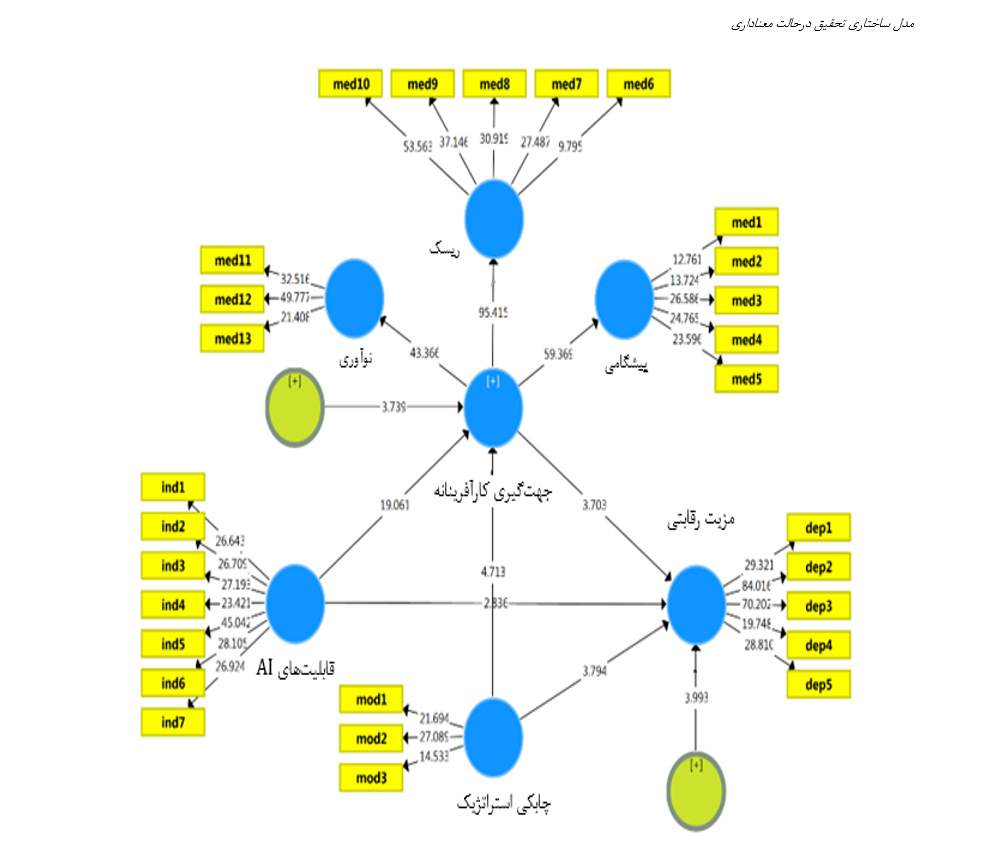
This study aimed to investigate the impact of artificial intelligence capabilities on the competitive advantage of fintech startups in international markets, considering the mediating role of entrepreneurial orientation and the moderating role of strategic agility. This applied research adopted a descriptive-survey design and collected field data from managers and senior experts working in fintech startups located in Tehran. The statistical population consisted of approximately 500 individuals, from which a sample of 215 respondents was selected using Cochran’s formula and random sampling. Data were gathered through a researcher-developed questionnaire measuring four constructs: artificial intelligence capabilities, competitive advantage in international markets, entrepreneurial orientation, and strategic agility. The instrument’s validity was confirmed through face and content validity assessments, while its reliability was supported by a Cronbach’s alpha coefficient of 0.897. Data analysis was conducted using Partial Least Squares Structural Equation Modeling (PLS-SEM) through SmartPLS software. The results indicated that artificial intelligence capabilities had a significant positive effect on entrepreneurial orientation (β = 0.696, t = 19.061, p < .001). Entrepreneurial orientation also exerted a significant positive effect on competitive advantage (β = 0.334, t = 3.703, p < .001). Furthermore, entrepreneurial orientation significantly mediated the relationship between artificial intelligence capabilities and competitive advantage (β = 0.198, t = 3.541, p < .001). Strategic agility significantly moderated the relationship between artificial intelligence capabilities and entrepreneurial orientation (β = 0.221, t = 3.739, p < .001). In addition, strategic agility positively moderated the relationship between artificial intelligence capabilities and competitive advantage (β = 0.235, t = 3.993, p < .001). These findings provide empirical support for all proposed hypotheses. The findings demonstrate that artificial intelligence capabilities represent a strategic resource that enhances competitive advantage both directly and indirectly through entrepreneurial orientation. Moreover, the effectiveness of artificial intelligence capabilities becomes stronger when organizations possess higher levels of strategic agility.
Downloads
References
Agrawal, S., Gupta, R., & Singh, P. (2024). Operational Performance and AI Integration in Industrial Sectors. Journal of Business Research, 78(4), 210-230.
Alizadeh, H., M, K., Saberian, H., & Keramati, M. (2024). Qualitative Study to Propose Digital Marketing Based on Customer Experience: Considering Grounded Theory (GT). Business, Marketing, and Finance Open, 1(6), 86-98. https://doi.org/10.61838/bmfopen.1.6.8
Alizadeh, H., & Nazarpour Kashani, H. (2024). The Impact of Perceived Experience with ChatGPT on Online Consumers' Information Searching Behavior: An Empirical Study of Iranian College Students. Asia Pacific Journal of Marketing and Logistics. https://doi.org/10.1108/APJML-02-2024-0140
Alkhawaja, M. I., Halim, M. S. A., Abumandil, M. S., & Al-Adwan, A. S. (2022). System Quality and Students' Acceptance of the E-Learning System: The Serial Mediation of Perceived Usefulness and Intention to Use. Contemporary Educational Technology, 14(2). https://doi.org/10.30935/cedtech/11525
Alqahtani, M. (2023). Artificial Intelligence and Entrepreneurship Education: A Paradigm in Qatari Higher Education Institutions after the COVID-19 Pandemic. International Journal of Data and Network Science, 7(2), 695-706.
Alzahrani, S., & Bhunia, A. K. (2024). A Serial Mediation Model of the Relationship between Digital Entrepreneurial Education, Alertness, Motivation and Intentions. Sustainability, 16(20), 8858. https://doi.org/10.3390/su16208858
Anwar, I., Ahmad, A., Saleem, I., & Yasin, N. (2023). Role of Entrepreneurship Education, Passion and Motivation in Augmenting Omani Students' Entrepreneurial Intention: A Stimulus-Organism-Response Approach. The International Journal of Management Education, 21(3), 100842. https://doi.org/10.1016/j.ijme.2023.100842
Chen, L., Ifenthaler, D., Yau, J. Y. K., & Sun, W. (2024). Artificial Intelligence in Entrepreneurship Education: A Scoping Review. Education + Training. https://doi.org/10.1108/ET-05-2023-0169
Ersoy, A. B. (2024). Artificial Intelligence Applications Used in Online Retail in China and Their Relationship to Customer Satisfaction and Loyalty. International Journal of Business and Applied Social Science, 8-17. https://doi.org/10.33642/ijbass.v10n3p2
Fossen, F. M., & Sorgner, A. (2021). Digitalization of Work and Entry into Entrepreneurship. Journal of Business Research, 125, 548-563. https://doi.org/10.1016/j.jbusres.2019.09.019
Gardan, I. P., Manu, M. B., Gardan, D. A., Negoita, L. D. L., Pastiu, C. A., Ghita, E., & Zaharia, A. (2025). Adopting AI in Education: Optimizing Human Resource Management Considering Teacher Perceptions. Frontiers in Education, 10, 1488147. https://doi.org/10.3389/feduc.2025.1488147
Gimpel, H., Hall, K., Decker, S., Eymann, T., Lammermann, L., Madche, A., Roglinger, M., Ruiner, C., Schoch, M., & Schoop, M. (2023). Unlocking the Power of Generative AI Models and Systems Such as GPT-4 and ChatGPT for Higher Education: A Guide for Students and Lecturers. https://hdl.handle.net/10419/270970
Ruiz-Rojas, L. I., Salvador-Ullauri, L., & Acosta-Vargas, P. (2024). Collaborative Working and Critical Thinking: Adoption of Generative Artificial Intelligence Tools in Higher Education. Sustainability, 16(13), 5367. https://doi.org/10.3390/su16135367
Seraj, A. H. A., Fazal, S. A., & Alshebami, A. S. (2022). Entrepreneurial Competency, Financial Literacy and Sustainable Performance: Examining the Mediating Role of Entrepreneurial Resilience among Saudi Entrepreneurs. Sustainability, 14(17), 10689. https://doi.org/10.3390/su141710689
Tadokoro, M. (2024). The Strategist's Guide for Startups: Five Perspectives and 23 Frameworks to Drive Success. Diamond.
Taylor, D. W., & Thorpe, R. (2004). Entrepreneurial Learning: A Process of Co-Participation. Journal of Small Business and Enterprise Development, 11(2), 203-211. https://doi.org/10.1108/14626000410537146
Terblanche, N. H. D., & Tau, T. (2025). Exploring the Use of a Goal-Attainment, Artificial Intelligence (AI) Chatbot Coach to Support First-Time Graduate Employees. Industry and Higher Education, 39(3), 1-12. https://doi.org/10.1177/09504222231153837
Yamaguchi, T., Iwata, K., & Sugiyama, Y. (2024). Do Accelerator Supports Vary According to the Growth Phase and Type of Startups? A Discussion and Empirical Analysis Using RBV. Japan Academy of Business Administration Journal, 56, 3-15.
Zewe, A. (2023). Explained: Generative AI. https://news.mit.edu/2023/explained-generative-ai-1109
Downloads
Publication Timeline
- Submitted
- Revised
- Accepted
Issue
Section
License
Copyright (c) 2025 Sadaf Saeidi (Author); Hamid Alizadeh

This work is licensed under a Creative Commons Attribution-NonCommercial 4.0 International License.