A Conceptual Framework for Developing Organizational Capacities for Human Resource Smartization Based on the Seventh Development Plan in the Ministry of Petroleum: A Qualitative Study
Keywords:
Intelligent Human Resource Management, Organizational Capacity Development, Seventh Development Plan, Ministry of Petroleum, Digital Transformation, Thematic AnalysisAbstract
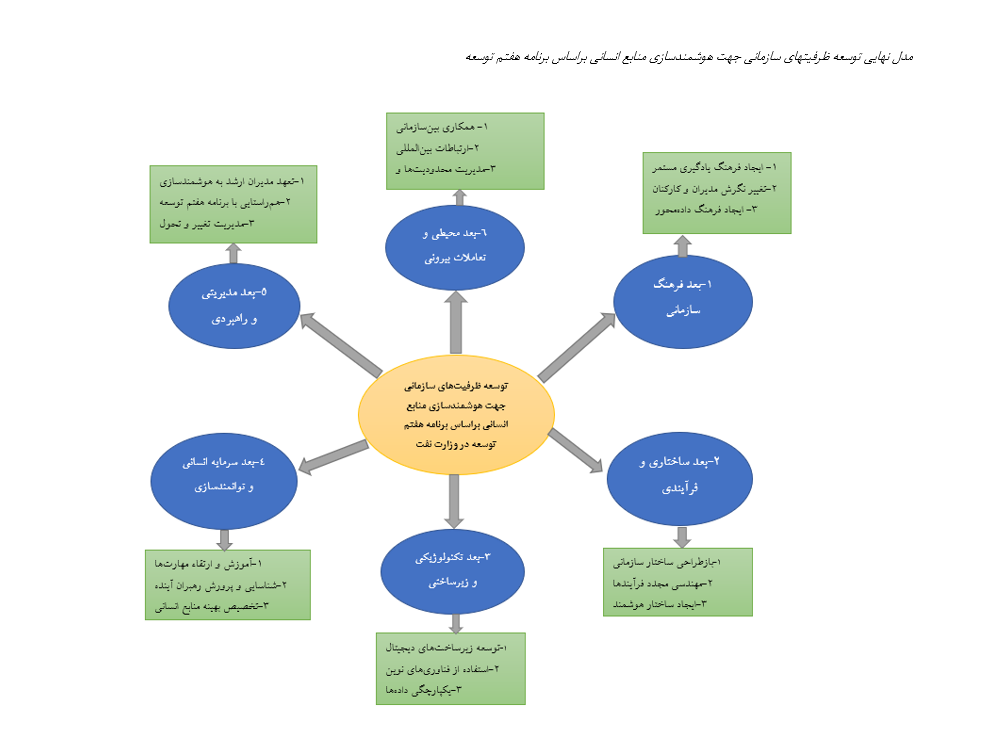
This study aimed to develop a conceptual framework for identifying and explaining the organizational capacities required for smart human resource management in the Ministry of Petroleum based on the requirements of the Seventh Development Plan and to provide a foundation for digital transformation policies in human resource management. This applied, exploratory, qualitative study employed thematic analysis as its methodological approach. Data were collected through semi-structured interviews with 12 senior and middle managers of the Ministry of Petroleum, human resource experts, information technology specialists, and university scholars. Participants were selected using purposive and snowball sampling methods, and data collection continued until theoretical saturation was achieved. The interview data were analyzed using MAXQDA software through open, axial, and selective coding procedures. The findings revealed that human resource smartization in the Ministry of Petroleum should be viewed as a multidimensional organizational transformation process rather than a purely technological initiative. Successful implementation depends on the simultaneous development of six interrelated organizational capacities: technological and infrastructural capacity, human capital capacity, structural and process capacity, cultural capacity, managerial and strategic capacity, and environmental-institutional capacity. The results further indicated that deficiencies in any of these capacities could undermine the effectiveness of digital investments. Data-driven culture, transformational leadership, data governance, digital competency development, and organizational process redesign emerged as critical enablers of sustainable smartization. A comprehensive conceptual model was developed to explain the dynamic interaction among these six capacity domains as prerequisites for intelligent human resource management. The study concludes that human resource smartization in the Ministry of Petroleum extends beyond the adoption of advanced technologies and requires the balanced development of both hard and soft organizational capacities. The proposed framework offers a practical roadmap for policymakers and managers seeking to enhance digital transformation, organizational agility, productivity, and sustainable human capital development within the petroleum sector.
Downloads
References
Abdullah, N. A. S., Noor, N. L. M., & Ibrahim, E. N. M. (2013). Resilient Organization: Modelling the Capacity for Resilience. 2013 International Conference on Research and Innovation in Information Systems (ICRIIS),
Afshari, M., & Karimi, A. (2021). Investigating the Challenges and Barriers of Human Resource Smartization in Governmental Organizations. Human Resource Management Quarterly, 13(3), 75-98.
Aggarwal, V. A., Posen, H. E., & Workiewicz, M. (2017). Adaptive Capacity to Technological Change: A Microfoundational Approach. Strategic management journal, 38(6), 1212-1231. https://doi.org/10.1002/smj.2584
Al-Faouri, E. H., Abu Huson, Y., Aljawarneh, N. M., & Alqmool, T. J. (2024). The Role of Smart Human Resource Management in the Relationship between Technology Application and Innovation Performance. Sustainability, 16(11), 4747. https://doi.org/10.3390/su16114747
Alaerts, G. J., & Kaspersma, J. M. (2009). Progress and Challenges in Knowledge and Capacity Development. In Capacity Development for Improved Water Management (Vol. 3, pp. 3-30). https://doi.org/10.1201/b10532-1
Asrif, M. I., Handayani, P. W., & Harahap, N. C. (2026). Indonesian organization digital innovation: the influence of business process management capabilities. Business Process Management Journal, 1-26.
Bayat, G. (2021). The Necessity of Smartizing Human Resource Management toward Productivity. Proceedings of the 9th International Conference on Financial Management, Business, Banking, Economics and Accounting,
De Alwis, A. C., Andrlić, B., & Šostar, M. (2022). The Influence of E-HRM on Modernizing the Role of HRM Context. Economies, 10(8), 181. https://doi.org/10.3390/economies10080181
Hamidi, R., & Rahimi, K. (2022). Designing a Conceptual Model for Human Resource Smartization. Strategic Human Resources Quarterly.
Kazemi, S., & Soltani, M. (2021). Investigating Digital Transformation Models in the Human Resources of the Ministry of Petroleum. Human Resources in Petroleum Industry Quarterly.
Khoshhal, F., Sargolzaei, A., & Vazifeh, Z. (2023). Designing and Explaining a Human Resource Empowerment Model Based on Organizational Intelligence Capabilities and Interpersonal Relationships Using a Mixed-Method Approach. https://dor.isc.ac/dor/20.1001.1.22516069.1402.14.4.3.9
Legge, K. (2014). Human Resource Management: A Critical Analysis. In New Perspectives on Human Resource Management (pp. 19-40). Routledge. https://www.taylorfrancis.com/chapters/edit/10.4324/9781315740560-2/human-resource-management-critical-analysis-karen-legge
Lengnick-Hall, M. L., Neely, A. R., & Stone, C. B. (2018). Human Resource Management in the Digital Age: Big Data, HR Analytics and Artificial Intelligence. In Management and Technological Challenges in the Digital Age (pp. 1-30). CRC Press. https://doi.org/10.1201/9781351238922-1
Liao, Q., Li, D., Zhang, K., & Chang, H. (2023). Applications of Artificial Intelligence in the Oil and Gas Industry. Frontiers in Environmental Science, 11, 1163593. https://doi.org/10.3389/feart.2023.1163593
Sarfarazi, M., Hashemzadeh, S. F., & Motamed, M. J. (2023). Designing a Human Resource Excellence Model in Smart Organizations. Proceedings of the 10th National Conference on Modern Studies and Research in Humanities, Management and Entrepreneurship of Iran, Tehran.
Sharifi, H., & Rezaei, P. (2022). The Effect of Organizational Culture on the Adoption of Emerging Technologies in Human Resource Management. Organizational Culture and Innovation Quarterly.
Soveydi, A., Mohammadi, M., Rezaeifar, H., & Mahmoudzadeh, M. (2024). Presenting a Human Resource Development Model toward Organizational Excellence in the National Iranian Drilling Company. http://iieshrm.ir/article-1-1653-fa.html
Stelmaszak, M., Joshi, M., & Constantiou, I. (2025). Artificial Intelligence as an Organizing Capability Arising From Human‐Algorithm Relations. Journal of Management Studies. https://doi.org/10.1111/joms.70003
Tenggono, E., Soetjipto, B. W., & Sudhartio, L. (2025). Dynamic Managerial Capabilities In action: Advancing Strategic Agility and Digital Readiness in Healthcare Organizations. Journal of Organizational Change Management. https://doi.org/10.1108/jocm-12-2024-0772
Tran, M. N. (2025). Fostering Organizational Innovation Capability Through Transformational Leadership and Creativity in Public Educational Institutions: Moderating Roles of AI-enabled Job Complexity and Innovation Climate. International Journal of Educational Management, 1-17. https://doi.org/10.1108/ijem-12-2024-0851
Zacca, R. (2026). Leveraging Network Capability for Small Enterprise Success: The Critical Roles of Organizational Capability and Alertness. Journal of Small Business Management, 64(1), 287-310. https://doi.org/10.1080/00472778.2025.2478448
Downloads
Publication Timeline
- Submitted
- Revised
- Accepted
Issue
Section
License
Copyright (c) 1405 Mohammad Mahdi Hadi Goshayesh (Author); Mashallah Valikhani Dehaghani; Hassan Amiri (Author)

This work is licensed under a Creative Commons Attribution-NonCommercial 4.0 International License.