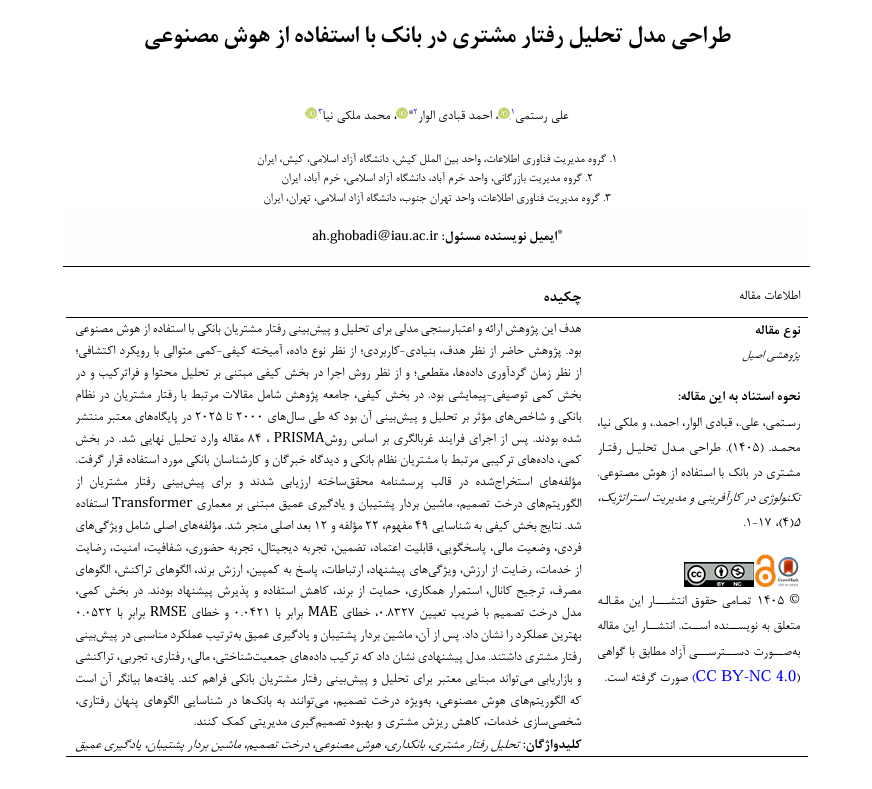
Designing a Model for Customer Behavior Analysis in Banking Using Artificial Intelligence
DOI:
https://doi.org/10.61838/kman.jtesm.485Keywords:
Customer behavior analysis, artificial intelligence, decision tree, support vector machine, deep learningAbstract
This study aimed to develop and validate a model for analyzing and predicting bank customers’ behavior using artificial intelligence. This research was basic-applied in terms of purpose, sequential exploratory mixed-methods in terms of data type, cross-sectional in terms of data collection time, and based on content analysis and meta-synthesis in the qualitative phase and descriptive-survey procedures in the quantitative phase. In the qualitative phase, the statistical population included all studies related to customer behavior in banking systems and the factors and indicators affecting its analysis and prediction, published in valid databases between 2000 and 2025. After screening through the PRISMA procedure, 84 studies were selected for final analysis. Extracted concepts were classified into components and broader dimensions. In the quantitative phase, combined data from banking customers, along with the views of banking experts and customer-relationship specialists, were used. A researcher-made questionnaire derived from the qualitative phase was applied to assess the model components. Customer behavior prediction was performed using decision tree, support vector machine, and deep learning based on Transformer architecture. The qualitative findings led to the identification of 49 concepts, 22 components, and 12 main dimensions. The identified components included individual characteristics, financial status, responsiveness, reliability, assurance, digital experience, in-person experience, transparency, security, service satisfaction, value satisfaction, offer characteristics, communications, campaign response, brand value, transaction patterns, consumption patterns, channel preference, cooperation continuity, brand advocacy, reduced use, and offer acceptance. In the quantitative phase, the decision tree model showed the strongest predictive performance, with an R² of 0.8327, MAE of 0.0421, and RMSE of 0.0532. The support vector machine model ranked second, followed by the deep learning model, although all three algorithms demonstrated acceptable predictive capability. The proposed model demonstrated that integrating demographic, financial, behavioral, experiential, transactional, and marketing-related data can provide a valid basis for analyzing and predicting bank customers’ behavior. The findings indicate that artificial intelligence algorithms, particularly decision trees, can support banks in identifying hidden behavioral patterns, personalizing services, reducing customer churn, improving campaign effectiveness, and strengthening managerial decision-making in customer relationship management.
Downloads
References
Abrardi, L., Cambini, C., & Rondi, L. (2022). Artificial Intelligence, Firms and Consumer Behavior: A Survey. Journal of Economic Surveys, 36(4), 969-991. https://doi.org/10.1111/joes.12455
Alizadeh, H., Nazarpour Kashani, H., Jalali Filshour, M., & Pourjabbari Khameneh, A. H. (2023). Evaluation of Consumer Behavior Prediction Based on Artificial-Intelligence-Based Marketing.
Amirhasankhani, H., Tolouei Ashlaghi, A., Radfar, R., & PourEbrahimi, A. (2021). Presenting a Two-Stage Data-Mining-Based Model for Evaluating the Performance of Joint Bank and Insurance Customers.
Aneja, A. (2023). Artificial Intelligence-Based Customer Behavioral Analysis: Techniques, Applications, and Business Insights.
Anna, K. (2024). Artificial Intelligence in Consumer Behavior Analysis: Trends and Prospects.
Ashrafuzzaman, M., Parveen, R., Sumiya, M. A., & Rahman, A. (2025). AI-Powered Personalization in Digital Banking: A Review of Customer Behavior Analytics and Engagement. American Journal of Interdisciplinary Studies, 6(1), 40-71. https://doi.org/10.63125/z9s39s47
Azad, N., Soleimani, M. H., & Sedighi, S. (2022). The Effect of Trust and Perceived Value on Customer Intention as well as Customer Reasons and Experience in Artificial Intelligence.
Bashkouh, A., & Mohammadkhani. (2023). Designing a Model for Implementing Business-to-Business Digital Marketing with Emphasis on Artificial-Intelligence-Based Customer Relationship Management. Modern Marketing Research, 13(3), 133-158.
Ghorbani Ghader, A., Hashemi Nasab, M., & Hedayati, M. S. (2024). Designing a Model for Predicting Customer Behavior Using Artificial Intelligence Algorithms and Neural Networks. Intelligent Strategic Management, 3(2), 39-56.
Hosseini, S. M., Sadeghi Lavasani-Nia, N., & Niroumand, L. (2024). Public Relations and Artificial Intelligence: Requirements and Effects of Artificial Intelligence on Public Relations of Bank Saderat Iran. Society, Culture, Media, 13(53), 299-335.
Jiang, H., Cheng, Y., Yang, J., & Gao, S. (2022). AI-Powered Chatbot Communication with Customers: Dialogic Interactions, Satisfaction, Engagement, and Customer Behavior. Computers in human Behavior, 134, 107329. https://doi.org/10.1016/j.chb.2022.107329
Kumar, M. S., Srivastava, V., Behera, B. B., Savariapitchai, M., Sahu, S., Mahajan, R., & George, A. S. (2025). IoE and AI in Real-Time Customer Behavior Analysis. In Role of Internet of Everything (IOE), VLSI Architecture, and AI in Real-Time Systems (pp. 241-256). https://doi.org/10.4018/979-8-3693-7367-5.ch017
Mahmoudi, M. H. (2020). Examining the Effect of Customer Relationship Management on Customer Behavior. Management and Accounting in the Third Millennium, 1(1), 18-27.
Mirshafiei, A. a.-S., Taleghani, M., & Saberi Haghayegh, R. A. (2024). Identifying and Analyzing Key Factors Affecting Behavioral Patterns of Customers in the Banking System. Technology in Entrepreneurship and Strategic Management, 3(5), 70-86.
Okeleke, P. A., Ajiga, D., Folorunsho, S. O., & Ezeigweneme, C. (2024). Predictive Analytics for Market Trends Using AI: A Study in Consumer Behavior. International Journal of Engineering Research Updates, 7(1), 36-49. https://doi.org/10.53430/ijeru.2024.7.1.0032
Perez-Vega, R., Kaartemo, V., Lages, C. R., Razavi, N. B., & Mannisto, J. (2021). Reshaping the Contexts of Online Customer Engagement Behavior via Artificial Intelligence: A Conceptual Framework. Journal of Business Research, 129, 902-910. https://doi.org/10.1016/j.jbusres.2020.11.002
Pouya, B., Hadi, Hosseinzadeh, & Fakharian. (2021). Analysis of Corporate Customers' Attitudes and Behavior in the Banking Industry. Business Management Explorations, 14(27), 47-70.
Rahman, M., Ming, T. H., Baigh, T. A., & Sarker, M. (2023). Adoption of Artificial Intelligence in Banking Services: An Empirical Analysis. International Journal of Emerging Markets, 18(10), 4270-4300. https://doi.org/10.1108/IJOEM-06-2020-0724
Rajasekaran, R. T., & Selvam, M. (2025). AI-Powered Behaviour Analysis in Financial Services.
Rana, M. N. U. (2024). Revolutionizing Banking Decision-Making: A Deep Learning Approach to Predicting Customer Behavior. Journal of Business and Management Studies, 6(3), 21. https://doi.org/10.32996/jbms.2024.6.3.3
Sahut, J. M., & Laroche, M. (2025). Using Artificial Intelligence (AI) to Enhance Customer Experience and to Develop Strategic Marketing: An Integrative Synthesis. Computers in human Behavior, 170, 108684. https://doi.org/10.1016/j.chb.2025.108684
Downloads
Publication Timeline
- Submitted
- Revised
- Accepted
Issue
Section
License
Copyright (c) 2025 Ali Rostami (Author); Ahmad Ghobadi Alvar; Mohammad Malekinia (Author)

This work is licensed under a Creative Commons Attribution-NonCommercial 4.0 International License.