Developing a Comprehensive Smart Technology-Based HSE Risk Management Model for Container Ports Using Network Analysis and Multi-Criteria Decision-Making: A Case Study of Shahid Rajaee Port
DOI:
https://doi.org/10.61838/kman.jtesm.490Keywords:
HSE risk management, smart technology, container port, fuzzy DEMATEL, analytic network process, fuzzy VIKOR, Shahid Rajaee PortAbstract
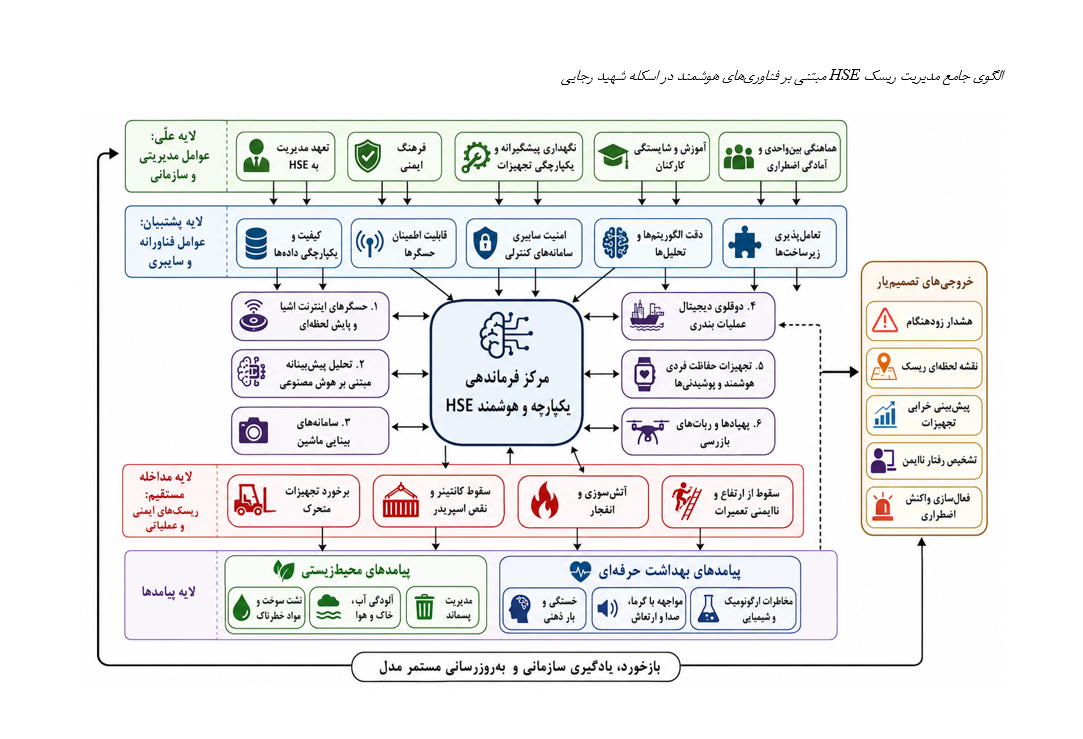
This study aimed to develop and validate a comprehensive smart technology-based health, safety, and environmental risk management model for Shahid Rajaee Port using network analysis and multi-criteria decision-making. This applied and developmental study employed an exploratory sequential mixed-methods design. The study population consisted of HSE, container operations, information technology, automation, environmental management, firefighting, and crisis management specialists working at Shahid Rajaee Port. Twenty-four experts were selected through purposive and snowball sampling. Data were collected through document review, semi-structured interviews, fuzzy Delphi questionnaires, fuzzy DEMATEL matrices, analytic network process pairwise comparisons, and technology evaluation matrices. The data were analyzed using thematic analysis, fuzzy Delphi, fuzzy DEMATEL, the analytic network process, and fuzzy VIKOR. Qualitative analysis identified 20 indicators within five dimensions: safety and operational, managerial and organizational, technological and cybersecurity, environmental, and occupational health risks. Kendall’s coefficient of concordance in the second Delphi round was 0.71 and statistically significant. Fuzzy DEMATEL identified the managerial and organizational dimension as the strongest causal factor, with a net influence value of 1.15. The analytic network process assigned weights of 0.286, 0.243, and 0.203 to the safety and operational, managerial and organizational, and technological and cybersecurity dimensions, respectively. Mobile equipment collisions, container drops, and weak safety culture were the three highest-priority indicators. Fuzzy VIKOR ranked the integrated intelligent HSE command center, Internet of Things sensor networks, and artificial intelligence-based predictive analytics as the leading technological alternatives. Effective HSE risk management in container ports requires a network-based, proactive, and data-driven approach in which managerial and organizational reforms are integrated with the phased implementation of smart technologies and an integrated HSE command center.
Downloads
References
Ashoori, H., Doosti, M., & Alavi, S. H. (2025). Effective Intervention Conditions on the Health and Safety System of School Sports in Iran. Educational Management - Health Sciences, 2(3), 19-28. https://www.eduhealthsci.ir/article_229292.html
Baker, L., Nguyen, T., & Patel, R. (2023). Job clarity and safety performance: A study of sports facility staff. Human Resource Management Review, 33(2), 100851. https://doi.org/10.1016/j.hrmr.2022.100851
Baroun, A. E. (2025). Challenges in Implementing Safety Procedures: Examining Kuwait’s Labor Law Article 83 Impact on Employee Performance. International Journal of Law and Management. https://doi.org/10.1108/ijlma-11-2024-0411
Bryce, C., & Dowling, M. (2024). The road to olympic failure is paved in poor risk management. Safety Science, 169, 106331. https://doi.org/10.1016/j.ssci.2023.106331
Carter, N., Nalbant, G., Chahal, P., & Chattopadhyay, K. (2024). Effectiveness and Safety of Self-Management Interventions for Improving Glycemic Control and Health-Related Quality of Life Among Adults with Type 2 Diabetes Mellitus in Sub-Saharan Africa: A Systematic Review and Meta-Analysis. JBI Evidence Synthesis, 22(9), 1715-1788. https://doi.org/10.11124/JBIES-23-00273
Doukari, O., Wakefield, J., Martinez, P., & Kassem, M. (2024). An ontology-based tool for safety management in building renovation projects. Journal of Building Engineering, 84. https://doi.org/10.1016/j.jobe.2024.108609
Fadhel, R., & Alqurs, A. (2025). Enhancing Occupational Health and Safety through Strategic Leadership: The Mediating Role of Total Quality Management in Hodeida Hospitals, Yemen. Risk Management and Healthcare Policy, 823-842. https://doi.org/10.2147/RMHP.S506296
Fisher, K. L., & Rosikiewicz, B. L. (2025). Implementing Psychological Safety in the Online Graduate Management Classroom. Management Teaching Review. https://doi.org/10.1177/23792981251326887
Gholamhoseinpour, M., Rahbari Najafabadi, S., & Aghahosseini, T. (2025). Investigating the relationship between health, safety, and environment management system performance and error acceptance culture among nurses: The mediating role of human error probability Naghsh Jahan Institute of Higher Education, Isfahan, Department of Industrial Engineering].
Glebova, E. V., Volokhina, А. Т., & Vikhrov, A. E. (2023). Assessment of the Efficiency of Occupational Safety Culture Management in Fuel and Energy Companies. Journal of Mining Institute, 259, 68-78. https://doi.org/10.31897/pmi.2023.12
Hao, F. (2025). Research on Safety Risk Management Standards for the Power Industry Based on Topic Mining and Knowledge Graph. Ieej Transactions on Electrical and Electronic Engineering. https://doi.org/10.1002/tee.70021
Hussein, A., & Akhtar, S. (2023). Psychological Safety and Self-Regulation among Public Sector Employees: The Moderating Effect of Organizational Justice. Public Personnel Management, 52(2), 245-268. https://doi.org/10.1177/00910260221098765
Jamil, Z., Nordin, S. M., Miraj, M., Alqahtani, M., Shaik, R. A., Akhter, S., & Isha, A. S. N. (2025). Sustainable Safety Practices and Hazard Management in the Oil and Gas Industry: An HSE Perspective. Frontiers in Public Health, 13. https://doi.org/10.3389/fpubh.2025.1611106
Jiang, W., Nazarudin, M. N., & Mazalan, N. S. (2024). Enhancing Safety and Quality in College Sports Management Through Big Data and Artificial Intelligence (AI). Journal of Information Systems Engineering & Management, 9(3), 24782. https://doi.org/10.55267/iadt.07.14849
Ketelaars, E., Gaudin, C., Flandin, S., & Poizat, G. (2024). Resilience training for critical situation management. An umbrella and a systematic literature review. Safety Science, 170, 106311. https://doi.org/10.1016/j.ssci.2023.106311
Kılıç, Y., & Vayvay, Ö. (2025). Integrating Occupational Health and Safety Into Enterprise Risk Management: A Structural Evaluation. Frontiers in Public Health, 13. https://doi.org/10.3389/fpubh.2025.1608227
Mendes, N., Vieira, J. G. V., & Mano, A. P. (2022). Risk Management in Aviation Maintenance: A Systematic Literature Review. Safety Science, 153, 105810. https://doi.org/10.1016/j.ssci.2022.105810
Mohy, A. A., Bassioni, H. A., Elgendi, E. O., & Hassan, T. M. (2024). Innovations in Safety Management for Construction Sites: The Role of Deep Learning and Computer Vision Techniques. Construction Innovation. https://doi.org/10.1108/CI-04-2023-0062
Mutegi, T. M., Joshua, P. M., & Maina, J. K. (2023). Workplace Safety, Employee Safety Attitudes and Employee Productivity of Manufacturing Firms. Sa Journal of Human Resource Management. https://doi.org/10.4102/sajhrm.v21i0.1989
Oyewole, A. T., Okoye, C. C., Ofodile, O. C., Odeyemi, O., Adeoye, O. B., Addy, W. A., & Ololade, Y. J. (2024). Human resource management strategies for safety and risk mitigation in the oil and gas industry: a review. International Journal of Management & Entrepreneurship Research, 6(3), 623-633. https://doi.org/10.51594/ijmer.v6i3.875
Rabbi, A. B. K., Jeelani, Idris. (2024). AI integration in construction safety: Current state, challenges, and future opportunities in text, vision, and audio based applications. Automation in Construction, 164, 105443. https://doi.org/10.1016/j.autcon.2024.105443
Yazdi, M., Zarei, E., Adumene, S., & Beheshti, A. (2024). Navigating the Power of Artificial Intelligence in Risk Management: A Comparative Analysis. Safety, 10(2), 42. https://doi.org/10.3390/safety10020042
Zong, Z., Long, T., Ou, Y., & Zhang, S. (2025). Dual-path influence of risk perception on construction workers’ safety participation and the moderating role of mindfulness. Journal of Construction Engineering and Management, 151(1), 04024194. https://ascelibrary.org/doi/abs/10.1061/JCEMD4.COENG-15534
Downloads
Publication Timeline
- Submitted
- Revised
- Accepted
Issue
Section
License
Copyright (c) 2025 Kambiz Karimi zadeh

This work is licensed under a Creative Commons Attribution-NonCommercial 4.0 International License.