تحلیل اقتصادسنجی عوامل مؤثر بر بهرهوری در صنعت سیمان با رویکرد فناوریمحور در کارآفرینی و مدیریت استراتژیک
DOI:
https://doi.org/10.61838/kman.jtesm.495کلمات کلیدی:
بهرهوری نیروی کار, صنعت سیمان, فناوریمحوری, کارآفرینی سازمانی, مدیریت استراتژیک, تحلیل اقتصادسنجیچکیده
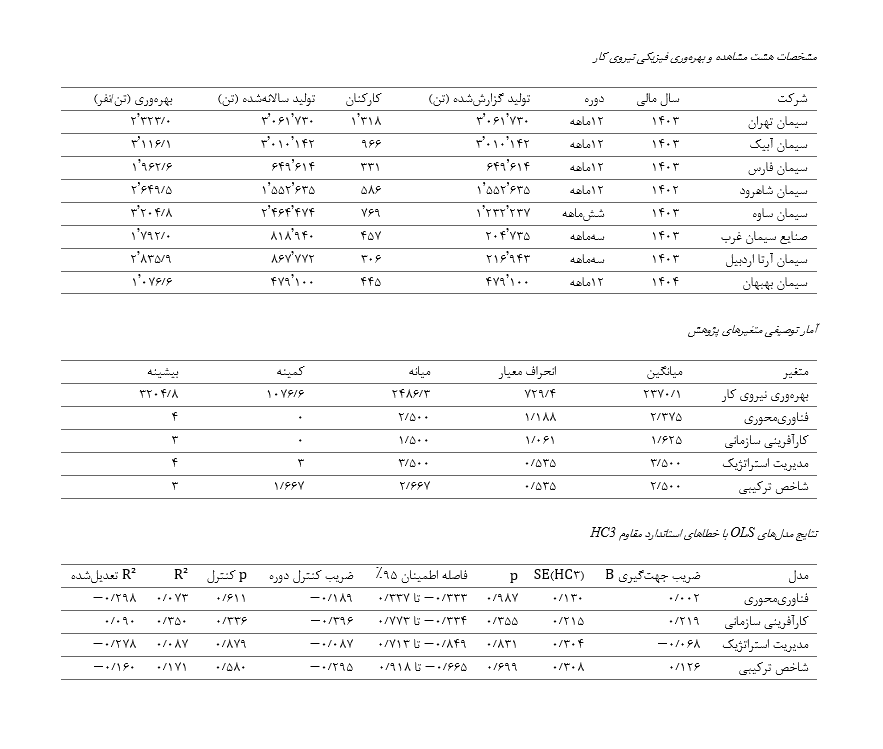
پژوهش حاضر با هدف تحلیل روابط فناوریمحوری، کارآفرینی سازمانی، مدیریت استراتژیک و شاخص ترکیبی این عوامل با بهرهوری فیزیکی نیروی کار در شرکتهای صنعت سیمان ایران انجام شد. این پژوهش از نظر هدف کاربردی و از نظر روش، اسنادی، همبستگی و اقتصادسنجی بود. جامعه پژوهش را شرکتهای تولیدکننده سیمان پذیرفتهشده در بورس اوراق بهادار تهران و فرابورس ایران در سالهای مالی ۱۴۰۲ تا ۱۴۰۴ تشکیل دادند. نمونه بهصورت هدفمند و بر اساس دسترسی همزمان به اطلاعات تولید، تعداد کارکنان و شواهد مدیریتی انتخاب شد و شامل هشت مشاهده شرکت–دوره بود. بهرهوری نیروی کار از تقسیم تولید سالانهشده سیمان بر تعداد کارکنان محاسبه شد. فناوریمحوری، کارآفرینی سازمانی و مدیریت استراتژیک بر اساس شواهد مستند اقدامات اجراشده یا در حال اجرا در گزارشهای رسمی شرکتها، در دامنه صفر تا چهار امتیازدهی شدند. برای تحلیل دادهها از همبستگی اسپیرمن و مدلهای جداگانه حداقل مربعات معمولی با کنترل نوع دوره گزارش استفاده شد. خطاهای استاندارد مقاوم HC3 و توزیع t با درجات آزادی باقیمانده نیز برای استنباط آماری به کار رفتند. ضریب همبستگی بهرهوری با فناوریمحوری، کارآفرینی سازمانی، مدیریت استراتژیک و شاخص ترکیبی بهترتیب برابر با ۰٫۱۲۵، ۰٫۲۲۲، ۰٫۲۱۸− و ۰٫۲۳۵ بود و هیچیک معنادار نبودند. در مدلهای رگرسیونی، ضرایب استانداردشده فناوریمحوری، کارآفرینی سازمانی، مدیریت استراتژیک و شاخص ترکیبی بهترتیب ۰٫۰۰۲، ۰٫۲۱۹، ۰٫۰۶۸− و ۰٫۱۲۶ به دست آمدند. مقادیر احتمال متناظر برابر با ۰٫۹۸۷، ۰٫۳۵۵، ۰٫۸۳۱ و ۰٫۶۹۹ بودند؛ بنابراین هیچیک از فرضیهها در سطح ۰٫۰۵ تأیید نشدند. تحلیل حساسیت نیز وابستگی نتایج به ترکیب نمونه، نوع دوره گزارش و مشاهدات اثرگذار را نشان داد. شواهد موجود برای تأیید اثر قطعی عوامل مدیریتی بر بهرهوری نیروی کار کافی نبود؛ بااینحال، نتایج نشان دادند که ارزیابی آثار فناوری، کارآفرینی و مدیریت استراتژیک مستلزم دادههای پنلی گستردهتر، کنترل ویژگیهای فنی شرکتها و لحاظ وقفه زمانی اجرای پروژههاست.
دانلودها
مراجع
Andrijevskaja, J., & Volkova, A. (2025). Industrial Energy Use, Efficiency, and Savings: Methods for Quantitative Analysis. Energy Efficiency, 18, 76. https://doi.org/10.1007/s12053-025-10367-5
Bansal, S., Filippini, M., & Srinivasan, S. (2026). Market-Based Energy Policy Instruments and Total Factor Productivity in Developing Countries: Evidence from the Cement Industry in India. Energy Economics, 157, 109287. https://doi.org/10.1016/j.eneco.2026.109287
Barba-Sanchez, V., Meseguer-Martinez, A., Gouveia-Rodrigues, R., & Raposo, M. L. (2024). Effects of Digital Transformation on Firm Performance: The Role of IT Capabilities and Digital Orientation. Heliyon, 10(6), e27725. https://doi.org/10.1016/j.heliyon.2024.e27725
Cantini, A., Leoni, L., De Carlo, F., Martini, C., Salvio, M., & Martini, F. (2021). Technological Energy Efficiency Improvements in Cement Industries. Sustainability, 13(7), 3810. https://doi.org/10.3390/su13073810
Chang, W., Whang, J. B., & Lee, J. H. (2026). The Strategic Use of Digital Transformation Capability: A Meta-Analytic Approach. European Journal of Innovation Management, 29(5), 1535-1560. https://doi.org/10.1108/EJIM-06-2025-0836
Dana, L. P., Salamzadeh, A., Mortazavi, S., & Hadizadeh, M. (2022). Investigating the Impact of International Markets and New Digital Technologies on Business Innovation in Emerging Markets. Sustainability, 14(2), 983. https://doi.org/10.3390/su14020983
Eghbalian, P., Ghobadian, V., & Mahmoudi Zarandi, M. (2024). Increasing Energy Productivity and Reducing Pollution in the Design of Cement Factories in Iran: A LEED-Based Approach. Armanshahr Architecture and Urban Development, 17(47), 145-157. https://doi.org/10.22034/AAUD.2024.421739.2833
Eskandari, N., & Mohammadi-Nasab, M. (2023). Strategic Analysis of the Cement Industry for Realizing the Vision of the Industry's Strategic Document on the 2025 Horizon. Business Reviews, 21(122), 105-134. https://doi.org/10.22034/BS.2023.1988675.2737
Ige, O. E., & Kabeya, M. (2025). Decarbonizing the Cement Industry: Technological, Economic, and Policy Barriers to CO2 Mitigation Adoption. Clean Technologies, 7(4), 85. https://doi.org/10.3390/cleantechnol7040085
Jang, S. H., & Lee, C. W. (2025). Digital Entrepreneurial Orientation, Technology Absorptive Capacity, and Digital Innovation on Business Performance. Systems, 13(4), 300. https://doi.org/10.3390/systems13040300
Kaidpour, F., Sayadmanesh, S., Salmani, Y., & Sadeghi, Z. (2020). Measuring the Efficiency and Productivity of Cement Industry Companies Listed on the Tehran Stock Exchange Using Data Envelopment Analysis and the Malmquist Productivity Index in a Grey Environment. Innovation Management and Operational Strategies, 1(4), 363-382. https://doi.org/10.22105/IMOS.2021.276467.1038
Kindermann, B., Beutel, S., Garcia de Lomana, G., Strese, S., Bendig, D., & Brettel, M. (2021). Digital Orientation: Conceptualization and Operationalization of a New Strategic Orientation. European Management Journal, 39(5), 645-657. https://doi.org/10.1016/j.emj.2020.10.009
Mahnashi, I., Salah, B., & Ragab, A. E. (2023). Industry 4.0 Framework Based on Organizational Diagnostics and Plan-Do-Check-Act Cycle for the Saudi Arabian Cement Sector. Sustainability, 15(14), 11261. https://doi.org/10.3390/su151411261
Nassani, A. A., Grigorescu, A., Yousaf, Z., Condrea, E., Javed, A., & Haffar, M. (2023). Does Technology Orientation Determine Innovation Performance Through Digital Innovation? A Glimpse of the Electronic Industry in the Digital Economy. Electronics, 12(8), 1854. https://doi.org/10.3390/electronics12081854
Santos Junior, E. d., da Silva, D. C., Spitzeck, H. H., de Sousa, P. R., de Carvalho, R. B., & da Veiga, C. P. (2026). Sustainability Maturity Assessment: Benchmarking in Brazilian Cement Plants Using Fuzzy Multi-Criteria Methods. Process Integration and Optimization for Sustainability. https://doi.org/10.1007/s41660-026-00788-9
Taghizadeh, H., & Pourrabi, M. (2013). Evaluation of Energy Efficiency of Companies Listed on the Tehran Stock Exchange: Case Study of the Cement Industry. Financial Knowledge of Securities Analysis, 20(6).
Tsai, W. H., & Lin, W. H. (2024). Production Decision Model for the Cement Industry in Pursuit of Carbon Neutrality: Analysis of the Impact of Carbon Tax and Carbon Credit Costs. Sustainability, 16(6), 2251. https://doi.org/10.3390/su16062251
Tu, H., Dai, W., & Xiao, X. (2022). Study on the Environmental Efficiency of the Chinese Cement Industry Based on the Undesirable Output DEA Model. Energies, 15(9), 3396. https://doi.org/10.3390/en15093396
دانلودها
گاهشمار انتشار
- ارسال
- بازنگری
- پذیرش
شماره
نوع مقاله
مجوز
حق نشر 2025 Reza Bakhtiari (Author); Arshad Farahmandian; Mohammad Hasan Abdollahi (Author)

این پروژه تحت مجوز بین المللی Creative Commons Attribution-NonCommercial 4.0 می باشد.