طراحی مدل استراتژیک همافزایی انسان و عاملهای هوشمند خودمختار برای توسعه قابلیتهای کارآفرینی و نوآوری سازمانی در کسبوکارهای دانشبنیان
DOI:
https://doi.org/10.61838/kman.jtesm.534کلمات کلیدی:
همافزایی انسان و هوش مصنوعی, عاملهای هوشمند خودمختار, قابلیتهای کارآفرینی, نوآوری سازمانی, کسبوکارهای دانشبنیان, هوش مصنوعیچکیده
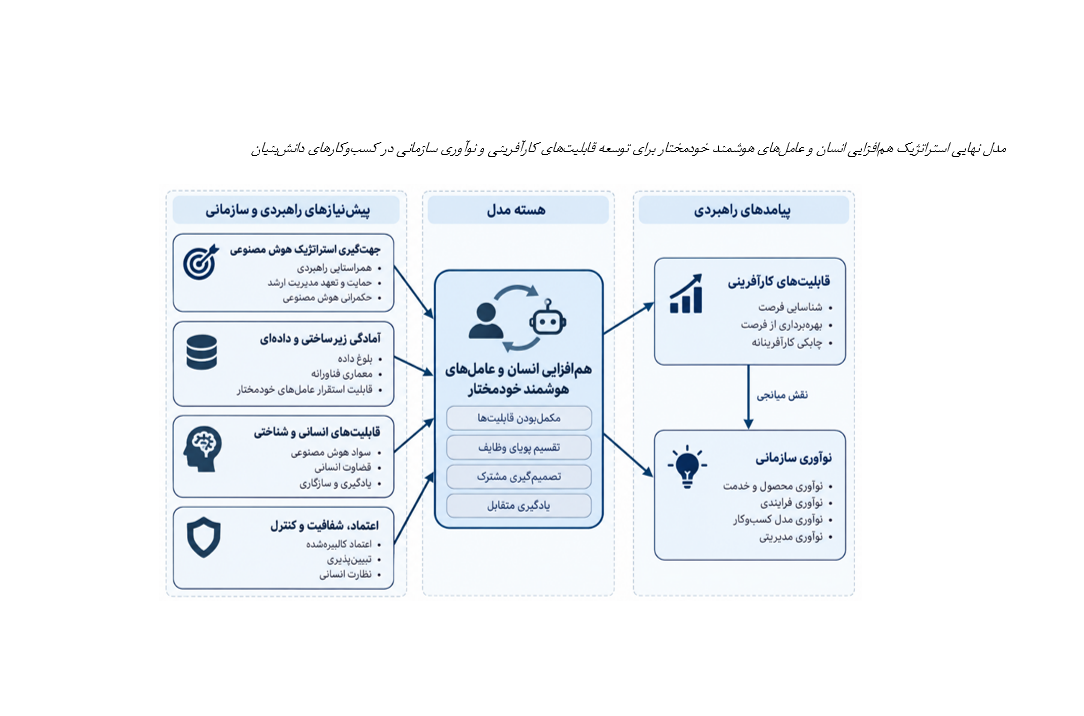
هدف پژوهش حاضر طراحی و اعتبارسنجی مدل استراتژیک همافزایی انسان و عاملهای هوشمند خودمختار برای توسعه قابلیتهای کارآفرینی و نوآوری سازمانی در کسبوکارهای دانشبنیان بود. این پژوهش از نظر هدف کاربردی ـ توسعهای و از نظر روش، آمیخته با طرح اکتشافی متوالی بود. در بخش کیفی، 18 نفر از خبرگان دانشگاهی و حرفهای شهر تهران در حوزههای مدیریت استراتژیک، هوش مصنوعی، تحول دیجیتال، کارآفرینی، نوآوری و مدیریت کسبوکارهای دانشبنیان با روش نمونهگیری هدفمند انتخاب شدند و دادهها از طریق مصاحبه نیمهساختاریافته تا دستیابی به اشباع نظری گردآوری و با استفاده از MAXQDA تحلیل شدند. در بخش کمی، پرسشنامه محققساخته مبتنی بر یافتههای کیفی در میان 384 نفر از مدیران و کارشناسان کسبوکارهای دانشبنیان شهر تهران اجرا شد. تحلیل دادهها با SPSS و مدلسازی معادلات ساختاری مبتنی بر حداقل مربعات جزئی در SmartPLS انجام گرفت. نتایج نشان داد جهتگیری استراتژیک هوش مصنوعی (β=0.24، t=5.31، p<0.001)، آمادگی زیرساختی و دادهای (β=0.21، t=4.78، p<0.001)، قابلیتهای انسانی و شناختی (β=0.27، t=5.94، p<0.001) و اعتماد، شفافیت و کنترل (β=0.23، t=5.17، p<0.001) اثر مثبت و معناداری بر همافزایی انسان و عامل هوشمند داشتند. همافزایی انسان و عامل هوشمند بر قابلیتهای کارآفرینی (β=0.61، t=15.42، p<0.001) و نوآوری سازمانی (β=0.46، t=10.87، p<0.001) اثر مثبت و معنادار داشت و قابلیتهای کارآفرینی نیز نوآوری سازمانی را پیشبینی کرد (β=0.34، t=7.91، p<0.001). اثر غیرمستقیم همافزایی بر نوآوری سازمانی از طریق قابلیتهای کارآفرینی نیز معنادار بود (β=0.21، t=6.38، p<0.001). همافزایی انسان و عاملهای هوشمند خودمختار زمانی به توسعه قابلیتهای کارآفرینی و نوآوری سازمانی منجر میشود که در بستری از جهتگیری استراتژیک، زیرساخت دادهای و فناورانه مناسب، قابلیتهای انسانی و سازوکارهای اعتماد، شفافیت و کنترل شکل گیرد.
دانلودها
مراجع
Akter, S., Hossain, M. A., Sajib, S., Sultana, S., Rahman, M., Vrontis, D., & McCarthy, G. (2023). A Framework for AI-Powered Service Innovation Capability: Review and Agenda for Future Research. Technovation, 125, 102768. https://doi.org/10.1016/j.technovation.2023.102768
An, M., Lin, J., & Luo, X. R. (2024). The Impact of Human AI Skills on Organizational Innovation: The Moderating Role of Digital Organizational Culture. Journal of Business Research, 182, 114786. https://doi.org/10.1016/j.jbusres.2024.114786
Bustinza, O. F., Vendrell-Herrero, F., Pérez-Arostegui, M. N., & Parry, G. (2019). Technological Capabilities, Resilience Capabilities and Organizational Effectiveness. The International Journal of Human Resource Management, 30(8), 1370-1392. https://doi.org/10.1080/09585192.2016.1216878
Crossan, M. M., & Apaydin, M. (2010). A Multi-Dimensional Framework of Organizational Innovation: A Systematic Review of the Literature. Journal of Management Studies, 47(6), 1154-1191. https://doi.org/10.1111/j.1467-6486.2009.00880.x
Daryani, M. A., Mohammadabadi, T. A., & Samadkhodari, K. (2020). Designing a Model for the Development of Dynamic Capabilities in Startups: A Case Study of Information Technology Businesses. Entrepreneurship Development, 13(2), 161-180.
Dellermann, D., Ebel, P., Söllner, M., & Leimeister, J. M. (2019). Hybrid Intelligence. Business & Information Systems Engineering, 61, 637-643. https://doi.org/10.1007/s12599-019-00595-2
Duong, C. D., & Nguyen, T. H. (2024). How ChatGPT Adoption Stimulates Digital Entrepreneurship: A Stimulus-Organism-Response Perspective. The International Journal of Management Education, 22, 101019. https://doi.org/10.1016/j.ijme.2024.101019
El Manouar, A., & El Hilali, W. (2020). Creating Shared Value Through Information Technologies. In. Springer. https://doi.org/10.1007/978-3-030-34269-2_5
Haefner, N., Wincent, J., Parida, V., & Gassmann, O. (2021). Artificial Intelligence and Innovation Management: A Review, Framework, and Research Agenda. Technological Forecasting and Social Change, 162, 120392. https://doi.org/10.1016/j.techfore.2020.120392
Hitt, M. A., Ireland, R. D., Sirmon, D. G., & Trahms, C. A. (2011). Strategic Entrepreneurship: Creating Value for Individuals, Organizations, and Society. Academy of Management Perspectives, 25(4), 57-75. https://doi.org/10.5465/amp.2011.63686422
Hossein-Nia, G., Yaghoubi-Farani, E., & Rousta, P. (2016). Investigating the Role of Value Co-Creation in New Product Development in Knowledge-Based Companies in Fars Province. Business Reviews, 14(79), 66-80.
Ireland, R. D., & Webb, J. W. (2007). Strategic Entrepreneurship: Creating Competitive Advantage Through Streams of Innovation. Business Horizons, 50(1), 49-59. https://doi.org/10.1016/j.bushor.2006.06.002
Jarrahi, M. H. (2018). Artificial Intelligence and the Future of Work: Human-AI Symbiosis in Organizational Decision Making. Business Horizons, 61(4), 577-586. https://doi.org/10.1016/j.bushor.2018.03.007
Kajouri, H. R., Mirabi, V. R., & Safarzadeh, H. (2021). Presenting a Customer Value Creation Model in Banks within the Brand Value Co-Creation Process: A Case Study of Shahr Bank. Business Management Quarterly, 13(49), 202-226.
Ketchen, D. J., Ireland, R. D., & Snow, C. C. (2007). Strategic Entrepreneurship, Collaborative Innovation, and Wealth Creation. Strategic Entrepreneurship Journal, 1(3-4), 371-385. https://doi.org/10.1002/sej.20
Khaleghi, F., & Zarandi, M. A. M. (2021). Identifying and Ranking the Challenges of Business and Information Technology Alignment: A Solution for Strategic Alignment, A Case Study of South Steel Company. Business Management Quarterly, 13(49), 242-260.
Kraus, S., Kauranen, I., & Reschke, C. H. (2011). Identification of Domains for a New Conceptual Model of Strategic Entrepreneurship Using the Configuration Approach. Management Research Review, 34(1), 58-74. https://doi.org/10.1108/01409171111096478
Mascareño, J., Wörtler, B., Przegalińska, A., & Ciechanowskie, L. (2026). When Proximal Collaboration with AI Hinders Innovation: The Moderating Role of Idea Originality and Reliance on AI. Computers in Human Behavior Reports, 22, 101054. https://doi.org/10.1016/j.chbr.2026.101054
Mechman Slima, A., Siti Sarah, O., Kadhim, K. G., Jamal Ali, B., Mohammed Hammooda, A., & Othman, B. (2021). The Effect of Information Technology Business Alignment Factors on Performance of SMEs. Management Science Letters, 11(3), 833-842. https://doi.org/10.5267/j.msl.2020.10.019
Minerbo, C., Kleinaltenkamp, M., & Ledur Brito, L. A. (2021). Unpacking Value Creation and Capture in B2B Relationships. Industrial Marketing Management, 92, 163-177. https://doi.org/10.1016/j.indmarman.2020.11.011
Mubarik, M. S., Bontis, N., Mubarik, M., & Mahmood, T. (2022). Intellectual Capital and Supply Chain Resilience. Journal of Intellectual Capital, 23(3), 713-738. https://doi.org/10.1108/JIC-06-2020-0206
Newbert, S. L. (2008). Value, Rareness, Competitive Advantage, and Performance: A Conceptual-Level Empirical Investigation of the Resource-Based View of the Firm. Strategic management journal, 29(7), 745-768. https://doi.org/10.1002/smj.686
Parida, V., Sjödin, D., & Reim, W. (2019). Reviewing Literature on Digitalization, Business Model Innovation, and Sustainable Industry: Past Achievements and Future Promises. Sustainability, 11(2), 391. https://doi.org/10.3390/su11020391
Ployhart, R. E. (2021). Resources for What? Understanding Performance in the Resource-Based View and Strategic Human Capital Resource Literatures. Journal of Management, 47(7), 1771-1786. https://doi.org/10.1177/01492063211003138
Raisch, S., & Krakowski, S. (2021). Artificial Intelligence and Management: The Automation-Augmentation Paradox. Academy of Management Review, 46(1), 192-210. https://doi.org/10.5465/amr.2018.0072
Ranjbar, M. S., Elyasi, M., & Tavakoli, G. R. (2017). A Review of the Concept of Technology Intelligence: Definitions, Structures, Process, Actors, Methods, and Tools. Industrial Technology Development, 15(30), 47-58.
Schöneseiffen, A., Aksoy, M., Bohnsack, R., & Schnellbächer, B. (2024). A New Opportunity for Opportunity Recognition? Academy of Management Proceedings,
Simón, C., Revilla, E., & Sáenz, M. J. (2024). Integrating AI in Organizations for Value Creation Through Human-AI Teaming: A Dynamic-Capabilities Approach. Journal of Business Research, 182, 114783. https://doi.org/10.1016/j.jbusres.2024.114783
Sirmon, D. G., Hitt, M. A., Ireland, R. D., & Gilbert, B. A. (2011). Resource Orchestration to Create Competitive Advantage: Breadth, Depth, and Life Cycle Effects. Journal of Management, 37(5), 1390-1412. https://doi.org/10.1177/0149206310385695
Sjödin, D., Parida, V., Kohtamäki, M., & Wincent, J. (2023). An AI-Enabled Circular Business Model for Industrial Manufacturers: Dynamic Capabilities and Business Model Innovation. Industrial Marketing Management.
Tahaian, S. K., & Ghasim, B. (2013). Technology Intelligence, Learning, and Technological Performance: A Case Study of a Defense Industrial Organization. Scientific-Promotional Quarterly of Standard and Quality Management, 3(9), 56-71.
Teece, D. J. (2007). Explicating Dynamic Capabilities: The Nature and Microfoundations of (Sustainable) Enterprise Performance. Strategic management journal, 28(13), 1319-1350. https://doi.org/10.1002/smj.640
Toorajipour, R., Sohrabpour, V., Nazarpour, A., Oghazi, P., & Fischl, M. (2021). Artificial Intelligence in Supply Chain Management: A Systematic Literature Review. Journal of Business Research, 122, 502-517. https://doi.org/10.1016/j.jbusres.2020.09.009
Ueshima, A., Jones, M. I., & Christakis, N. A. (2024). Simple Autonomous Agents Can Enhance Creative Semantic Discovery by Human Groups. Nature Communications, 15, 5212. https://doi.org/10.1038/s41467-024-49528-y
دانلودها
گاهشمار انتشار
- ارسال
- بازنگری
- پذیرش
شماره
نوع مقاله
مجوز
حق نشر 2025 Mohammad Hossein Khodabakhshi

این پروژه تحت مجوز بین المللی Creative Commons Attribution-NonCommercial 4.0 می باشد.