Designing a Strategic Model of Human–Autonomous Intelligent Agent Synergy for Developing Entrepreneurial Capabilities and Organizational Innovation in Knowledge-Based Businesses
DOI:
https://doi.org/10.61838/kman.jtesm.534Keywords:
Human-AI synergy, autonomous intelligent agents, entrepreneurial capabilities, organizational innovation, knowledge-based businesses, artificial intelligenceAbstract
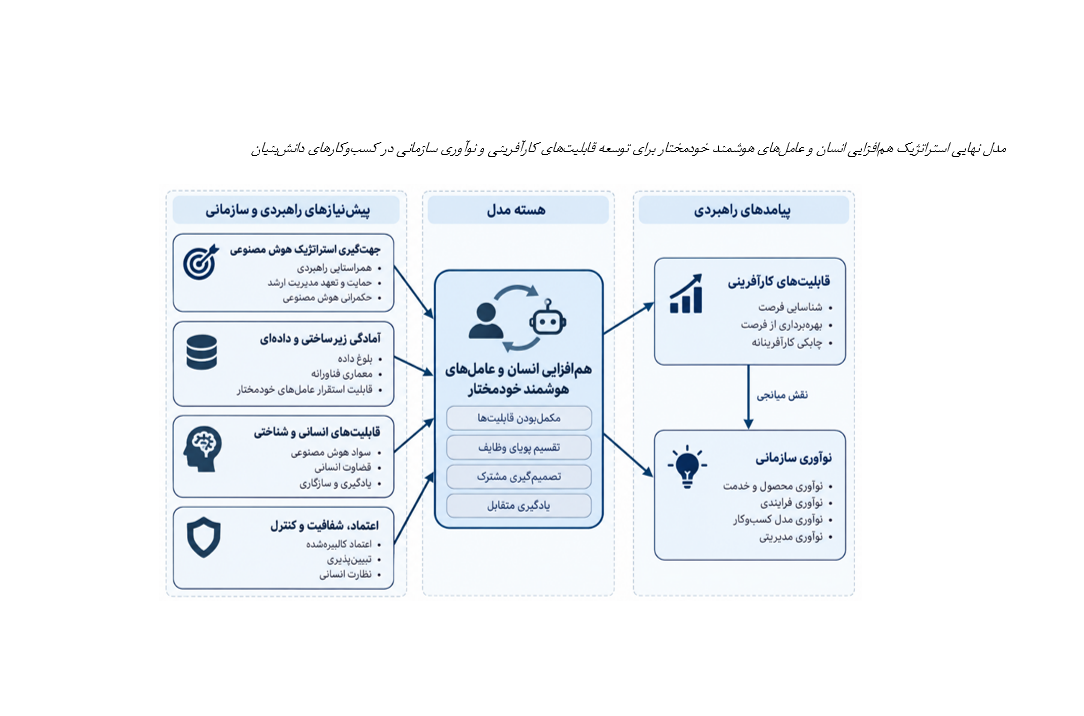
The present study aimed to design and validate a strategic model of human–autonomous intelligent agent synergy for developing entrepreneurial capabilities and organizational innovation in knowledge-based businesses. This applied-developmental study employed an exploratory sequential mixed-methods design. In the qualitative phase, 18 academic and professional experts from Tehran with expertise in strategic management, artificial intelligence, digital transformation, entrepreneurship, innovation, and knowledge-based business management were selected through purposive sampling. Data were collected through semi-structured interviews until theoretical saturation and analyzed using MAXQDA. In the quantitative phase, a researcher-developed questionnaire derived from the qualitative findings was administered to 384 managers and experts working in knowledge-based businesses in Tehran. Data were analyzed using SPSS and partial least squares structural equation modeling in SmartPLS. Strategic AI orientation (β=0.24, t=5.31, p<0.001), data and infrastructure readiness (β=0.21, t=4.78, p<0.001), human and cognitive capabilities (β=0.27, t=5.94, p<0.001), and trust, transparency, and control (β=0.23, t=5.17, p<0.001) had significant positive effects on human-autonomous intelligent agent synergy. Synergy significantly predicted entrepreneurial capabilities (β=0.61, t=15.42, p<0.001) and organizational innovation (β=0.46, t=10.87, p<0.001). Entrepreneurial capabilities also significantly predicted organizational innovation (β=0.34, t=7.91, p<0.001). The indirect effect of synergy on organizational innovation through entrepreneurial capabilities was significant (β=0.21, t=6.38, p<0.001). Human-autonomous intelligent agent synergy can strengthen entrepreneurial capabilities and organizational innovation when it is supported by strategic AI orientation, adequate technological and data infrastructure, strong human capabilities, and effective mechanisms of trust, transparency, and human control.
Downloads
References
Akter, S., Hossain, M. A., Sajib, S., Sultana, S., Rahman, M., Vrontis, D., & McCarthy, G. (2023). A Framework for AI-Powered Service Innovation Capability: Review and Agenda for Future Research. Technovation, 125, 102768. https://doi.org/10.1016/j.technovation.2023.102768
An, M., Lin, J., & Luo, X. R. (2024). The Impact of Human AI Skills on Organizational Innovation: The Moderating Role of Digital Organizational Culture. Journal of Business Research, 182, 114786. https://doi.org/10.1016/j.jbusres.2024.114786
Bustinza, O. F., Vendrell-Herrero, F., Pérez-Arostegui, M. N., & Parry, G. (2019). Technological Capabilities, Resilience Capabilities and Organizational Effectiveness. The International Journal of Human Resource Management, 30(8), 1370-1392. https://doi.org/10.1080/09585192.2016.1216878
Crossan, M. M., & Apaydin, M. (2010). A Multi-Dimensional Framework of Organizational Innovation: A Systematic Review of the Literature. Journal of Management Studies, 47(6), 1154-1191. https://doi.org/10.1111/j.1467-6486.2009.00880.x
Daryani, M. A., Mohammadabadi, T. A., & Samadkhodari, K. (2020). Designing a Model for the Development of Dynamic Capabilities in Startups: A Case Study of Information Technology Businesses. Entrepreneurship Development, 13(2), 161-180.
Dellermann, D., Ebel, P., Söllner, M., & Leimeister, J. M. (2019). Hybrid Intelligence. Business & Information Systems Engineering, 61, 637-643. https://doi.org/10.1007/s12599-019-00595-2
Duong, C. D., & Nguyen, T. H. (2024). How ChatGPT Adoption Stimulates Digital Entrepreneurship: A Stimulus-Organism-Response Perspective. The International Journal of Management Education, 22, 101019. https://doi.org/10.1016/j.ijme.2024.101019
El Manouar, A., & El Hilali, W. (2020). Creating Shared Value Through Information Technologies. In. Springer. https://doi.org/10.1007/978-3-030-34269-2_5
Haefner, N., Wincent, J., Parida, V., & Gassmann, O. (2021). Artificial Intelligence and Innovation Management: A Review, Framework, and Research Agenda. Technological Forecasting and Social Change, 162, 120392. https://doi.org/10.1016/j.techfore.2020.120392
Hitt, M. A., Ireland, R. D., Sirmon, D. G., & Trahms, C. A. (2011). Strategic Entrepreneurship: Creating Value for Individuals, Organizations, and Society. Academy of Management Perspectives, 25(4), 57-75. https://doi.org/10.5465/amp.2011.63686422
Hossein-Nia, G., Yaghoubi-Farani, E., & Rousta, P. (2016). Investigating the Role of Value Co-Creation in New Product Development in Knowledge-Based Companies in Fars Province. Business Reviews, 14(79), 66-80.
Ireland, R. D., & Webb, J. W. (2007). Strategic Entrepreneurship: Creating Competitive Advantage Through Streams of Innovation. Business Horizons, 50(1), 49-59. https://doi.org/10.1016/j.bushor.2006.06.002
Jarrahi, M. H. (2018). Artificial Intelligence and the Future of Work: Human-AI Symbiosis in Organizational Decision Making. Business Horizons, 61(4), 577-586. https://doi.org/10.1016/j.bushor.2018.03.007
Kajouri, H. R., Mirabi, V. R., & Safarzadeh, H. (2021). Presenting a Customer Value Creation Model in Banks within the Brand Value Co-Creation Process: A Case Study of Shahr Bank. Business Management Quarterly, 13(49), 202-226.
Ketchen, D. J., Ireland, R. D., & Snow, C. C. (2007). Strategic Entrepreneurship, Collaborative Innovation, and Wealth Creation. Strategic Entrepreneurship Journal, 1(3-4), 371-385. https://doi.org/10.1002/sej.20
Khaleghi, F., & Zarandi, M. A. M. (2021). Identifying and Ranking the Challenges of Business and Information Technology Alignment: A Solution for Strategic Alignment, A Case Study of South Steel Company. Business Management Quarterly, 13(49), 242-260.
Kraus, S., Kauranen, I., & Reschke, C. H. (2011). Identification of Domains for a New Conceptual Model of Strategic Entrepreneurship Using the Configuration Approach. Management Research Review, 34(1), 58-74. https://doi.org/10.1108/01409171111096478
Mascareño, J., Wörtler, B., Przegalińska, A., & Ciechanowskie, L. (2026). When Proximal Collaboration with AI Hinders Innovation: The Moderating Role of Idea Originality and Reliance on AI. Computers in Human Behavior Reports, 22, 101054. https://doi.org/10.1016/j.chbr.2026.101054
Mechman Slima, A., Siti Sarah, O., Kadhim, K. G., Jamal Ali, B., Mohammed Hammooda, A., & Othman, B. (2021). The Effect of Information Technology Business Alignment Factors on Performance of SMEs. Management Science Letters, 11(3), 833-842. https://doi.org/10.5267/j.msl.2020.10.019
Minerbo, C., Kleinaltenkamp, M., & Ledur Brito, L. A. (2021). Unpacking Value Creation and Capture in B2B Relationships. Industrial Marketing Management, 92, 163-177. https://doi.org/10.1016/j.indmarman.2020.11.011
Mubarik, M. S., Bontis, N., Mubarik, M., & Mahmood, T. (2022). Intellectual Capital and Supply Chain Resilience. Journal of Intellectual Capital, 23(3), 713-738. https://doi.org/10.1108/JIC-06-2020-0206
Newbert, S. L. (2008). Value, Rareness, Competitive Advantage, and Performance: A Conceptual-Level Empirical Investigation of the Resource-Based View of the Firm. Strategic management journal, 29(7), 745-768. https://doi.org/10.1002/smj.686
Parida, V., Sjödin, D., & Reim, W. (2019). Reviewing Literature on Digitalization, Business Model Innovation, and Sustainable Industry: Past Achievements and Future Promises. Sustainability, 11(2), 391. https://doi.org/10.3390/su11020391
Ployhart, R. E. (2021). Resources for What? Understanding Performance in the Resource-Based View and Strategic Human Capital Resource Literatures. Journal of Management, 47(7), 1771-1786. https://doi.org/10.1177/01492063211003138
Raisch, S., & Krakowski, S. (2021). Artificial Intelligence and Management: The Automation-Augmentation Paradox. Academy of Management Review, 46(1), 192-210. https://doi.org/10.5465/amr.2018.0072
Ranjbar, M. S., Elyasi, M., & Tavakoli, G. R. (2017). A Review of the Concept of Technology Intelligence: Definitions, Structures, Process, Actors, Methods, and Tools. Industrial Technology Development, 15(30), 47-58.
Schöneseiffen, A., Aksoy, M., Bohnsack, R., & Schnellbächer, B. (2024). A New Opportunity for Opportunity Recognition? Academy of Management Proceedings,
Simón, C., Revilla, E., & Sáenz, M. J. (2024). Integrating AI in Organizations for Value Creation Through Human-AI Teaming: A Dynamic-Capabilities Approach. Journal of Business Research, 182, 114783. https://doi.org/10.1016/j.jbusres.2024.114783
Sirmon, D. G., Hitt, M. A., Ireland, R. D., & Gilbert, B. A. (2011). Resource Orchestration to Create Competitive Advantage: Breadth, Depth, and Life Cycle Effects. Journal of Management, 37(5), 1390-1412. https://doi.org/10.1177/0149206310385695
Sjödin, D., Parida, V., Kohtamäki, M., & Wincent, J. (2023). An AI-Enabled Circular Business Model for Industrial Manufacturers: Dynamic Capabilities and Business Model Innovation. Industrial Marketing Management.
Tahaian, S. K., & Ghasim, B. (2013). Technology Intelligence, Learning, and Technological Performance: A Case Study of a Defense Industrial Organization. Scientific-Promotional Quarterly of Standard and Quality Management, 3(9), 56-71.
Teece, D. J. (2007). Explicating Dynamic Capabilities: The Nature and Microfoundations of (Sustainable) Enterprise Performance. Strategic management journal, 28(13), 1319-1350. https://doi.org/10.1002/smj.640
Toorajipour, R., Sohrabpour, V., Nazarpour, A., Oghazi, P., & Fischl, M. (2021). Artificial Intelligence in Supply Chain Management: A Systematic Literature Review. Journal of Business Research, 122, 502-517. https://doi.org/10.1016/j.jbusres.2020.09.009
Ueshima, A., Jones, M. I., & Christakis, N. A. (2024). Simple Autonomous Agents Can Enhance Creative Semantic Discovery by Human Groups. Nature Communications, 15, 5212. https://doi.org/10.1038/s41467-024-49528-y
Downloads
Publication Timeline
- Submitted
- Revised
- Accepted
Issue
Section
License
Copyright (c) 2025 Mohammad Hossein Khodabakhshi

This work is licensed under a Creative Commons Attribution-NonCommercial 4.0 International License.