A Comprehensive Blockchain-Based Risk Management Model for Construction Project Portfolios
DOI:
https://doi.org/10.61838/kman.jtesm.479Keywords:
Risk Management, Project Portfolio, Blockchain Technology, Construction ProjectsAbstract
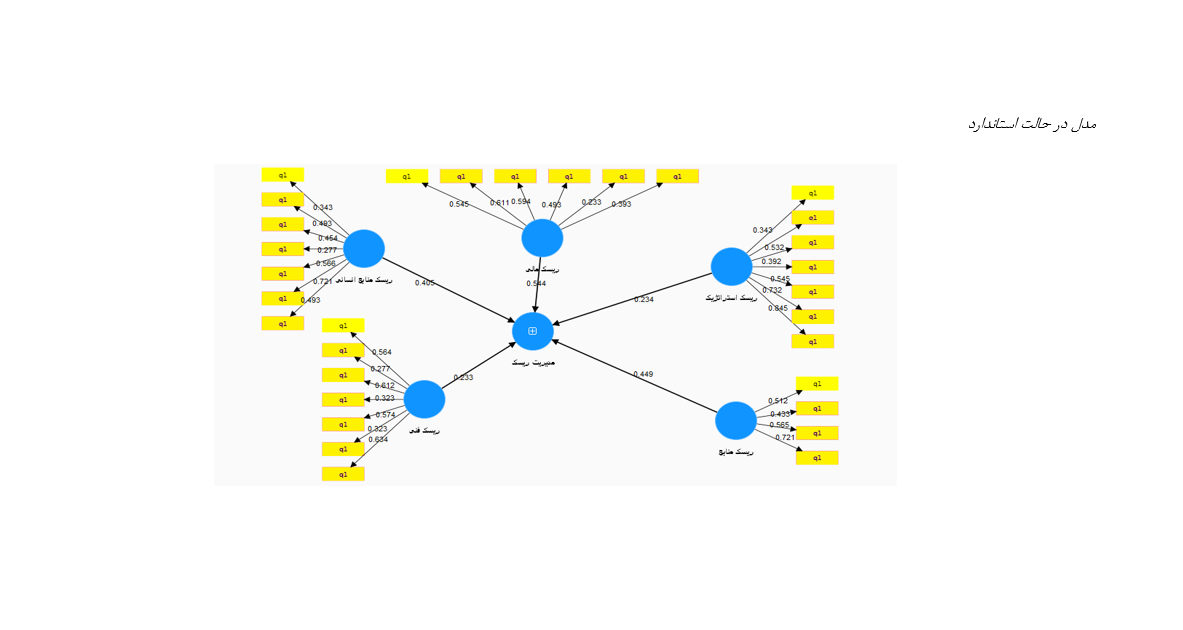
This study aimed to develop and validate a comprehensive blockchain-based risk management model for construction project portfolios. This applied study used a descriptive field design and a mixed qualitative–quantitative approach. In the qualitative phase, data were collected through in-depth interviews with 25 experts familiar with project portfolio risk management and blockchain technology, selected based on theoretical saturation. The qualitative data were analyzed using thematic analysis to identify the main dimensions and subcomponents of the proposed model. In the quantitative phase, the statistical population consisted of construction project managers, from whom 267 participants were selected through simple random sampling based on Cochran’s formula. Data were collected using a researcher-made questionnaire. Content validity was confirmed by expert judgment, and reliability was verified using Cronbach’s alpha. Quantitative data were analyzed through exploratory factor analysis, structural equation modeling, and PLS software. Exploratory factor analysis identified 37 subcomponents classified into five main dimensions: human resource risk, technical risk, financial risk, strategic risk, and resource risk. These five factors explained 90.33% of the total variance. Cronbach’s alpha, composite reliability, rho_A, and average variance extracted exceeded the recommended thresholds for all constructs, confirming internal consistency and convergent validity. The HTMT values were below one, indicating acceptable discriminant validity. The path coefficients for human resource risk, technical risk, financial risk, strategic risk, and resource risk were 0.405, 0.233, 0.544, 0.234, and 0.449, respectively, and all paths were statistically significant. The coefficient of determination was 0.760, indicating that the identified components explained 76% of the variance in the blockchain-based risk management model. The redundancy index was 0.566, and the GOF value was 0.65, demonstrating strong overall model fit. Additional fit indices, including X²/df = 1.34, RMSEA = 0.03, GFI = 0.94, AGFI = 0.91, CFI = 0.95, IFI = 0.93, NFI = 0.92, and NNFI = 0.96, confirmed the adequacy of the model. The findings indicate that blockchain technology can provide an effective foundation for construction project portfolio risk management by improving transparency, traceability, information reliability, resource integration, and the control of human, technical, financial, strategic, and resource-related risks.
Downloads
References
Altuntas, S., & Dereli, T. (2015). A novel approach based on DEMATEL method and patent citation analysis for prioritizing a portfolio of investment projects. Expert Systems with Applications, 42(3), 1003-1012. https://doi.org/10.1016/j.eswa.2014.09.018
Alvarez-Garcia, B., & Fernandez-Castro, A. (2018). A comprehensive approach for the selection of a portfolio of interdependent projects: An application to subsidized projects in Spain. Computers & Industrial Engineering, 1-23. https://doi.org/10.1016/j.cie.2018.02.025
Bai, L. B., Shi, H. J., Kang, S. Y., & Zhang, B. B. (2021). Project portfolio risk analysis with the consideration of project interdependencies. Engineering, Construction and Architectural Management. https://doi.org/10.1108/ECAM-06-2021-0555
Cevikbas, M., Okudan, O., & Isik, Z. (2024). Identification and assessment of disruption claim management risks in construction projects: A life cycle-based approach. Engineering, Construction and Architectural Management, 31(1), 1-27. https://doi.org/10.1108/ECAM-05-2022-0470
De Bakker, K., Boonstra, A., & Wortmann, H. (2011). Risk management affecting IS/IT project success through communicative action. Project Management Journal, 42, 75-90. https://doi.org/10.1002/pmj.20242
Ebekozien, A., Aigbavboa, C., Samsurijan, M. S., Ahmed, M. A. H., Akinradewo, O., & Omoh-Paul, I. (2024). Managing construction project risks in turbulent times: A stakeholders perspective. International Journal of Building Pathology and Adaptation, 42(7), 35-54. https://doi.org/10.1108/IJBPA-01-2024-0003
Ghab, M. (2023). Risk response in construction project: A review study. Journal of Engineering, 29(08), 121-137. https://doi.org/10.31026/j.eng.2023.08.09
Ghanbari, M., Olaikhan, A. A. J., & Skitmore, M. (2024). Enhancing project portfolio selection for construction holding firms: A multi-objective optimization framework with risk analysis. Engineering, Construction and Architectural Management, 1-24. https://doi.org/10.1108/ECAM-05-2023-0532
Hofman, M., Spalek, S., & Grela, G. (2017). Shedding new light on project portfolio risk management. Sustainability, 9, 1798. https://doi.org/10.3390/su9101798
Huang, X., Zhao, T., & Kudratova, S. (2016). Uncertain mean-variance and mean-semivariance models for optimal project selection and scheduling. Knowledge-Based Systems, 93, 1-11. https://doi.org/10.1016/j.knosys.2015.10.030
Khalil-Oliwa, O., & Jonek-Kowalska, I. (2024). Determinants of the effectiveness of risk management in the project portfolio in the FinTech industry. Risks, 12, 111. https://doi.org/10.3390/risks12070111
Komaki, F., Fallahnejad, R., Hosseinzadeh Lotfi, F., & Rostami Malkhalifeh, M. (2024). Evaluation and ranking of market risks in infrastructure investment projects using a hybrid DEA/AHP technique. Investment Knowledge, 13(51), 119-136.
Maier, S., Polak, J., & Gann, D. (2018). Valuing portfolios of interdependent real options using influence diagrams and simulation-and-regression: A multi-stage stochastic integer programming approach. Computers and Operations Research, 000(1), 1-14.
Mican, C., Fernandes, G., & Araujo, M. (2020). Project portfolio risk management: A structured literature review with future directions for research. International Journal of Information Systems and Project Management, 8(3). https://doi.org/10.12821/ijispm080304
Mirjalili, S., Lorak, A., & Aminnejad, B. (2023). Risk assessment in construction project portfolio management using the CRITIC multi-criteria decision-making method. Structural Engineering and Construction, 10(12), 5-17.
Motamedi, M., & Darvish Motavalli, M. H. (2025). Designing a Dynamic Model for Evaluating Construction Investment Projects Using a System Dynamics Approach. Economic Research (Sustainable Growth and Development), 25(1), 291-318. https://mcej.modares.ac.ir/article-18-74581-en.html
Nada, N., & Othman, A. A. E. (2025). Smart Contracts Towards Reducing Disputes in Construction Projects in Egypt IOP Conference Series: Earth and Environmental Science,
Nakhai Nejad, M., & Momenshad, N. (2020). Project portfolio selection based on triple interactions among projects. Research in Production and Operations Management, 11(1), 1-22.
Pajares, J., & Lopez, A. (2014). New methodological approaches to project portfolio management: The role of interactions within projects and portfolios. Procedia - Social and Behavioral Sciences, 119, 645-652. https://doi.org/10.1016/j.sbspro.2014.03.072
Project Management, I. (2021). A Guide to the Project Management Body of Knowledge (PMBOK Guide) (7th ed.). Project Management Institute.
Relich, M., & Pawlewski, P. (2017). A fuzzy weighted average approach for selection portfolio of new product development projects. Neurocomputing, 231, 19-27. https://doi.org/10.1016/j.neucom.2016.05.104
Roland, J., Figueira, J. R., & De Smet, Y. (2016). Finding compromise solutions in project portfolio selection with multiple experts by inverse optimization. Computers & Operations Research, 66, 19-22. https://doi.org/10.1016/j.cor.2015.07.006
Rostami, Z. (2023). Investment risk management in projects. Civil Engineering and Project Journal, 5(3), 60-69.
Sharifi Qazvini, M., Ghazavati, V., Makoui, A., & Raeisi, S. (2018). Presenting a conceptual model for optimal project portfolio selection using a hybrid efficiency-risk approach based on the non-dominated sorting multi-objective genetic algorithm. Research in Production and Operations Management, 9(2), 139-157.
Tamimi, S., & Farhang. (2025). Management of Construction and Creation of an Intelligent Energy Production System for Buildings Utilizing Available Renewable Resources. Pars Project Management, 1(1), 124-150. https://jpm.pu.ac.ir/article_721751.html
Testorelli, R., Tiso, A., & Verbano, C. (2024). Value creation with project risk management: A holistic framework. Sustainability, 16, 753. https://doi.org/10.3390/su16020753
Wu, Y., Xu, C., Ke, Y., Li, X., & Li, L. (2019). Portfolio selection of distributed energy generation projects considering uncertainty and project interaction under different enterprise strategic scenarios. Applied Energy, 236, 444-464. https://doi.org/10.1016/j.apenergy.2018.12.009
Yazdi, M. (2014). Risk Management with a Multi-Criteria Decision-Making Approach: Expert Judgment and Fuzzy Logic. Fanavaran Publishing.
Zahedi, M., Khalilzadeh, M., & Javanshir, H. (2020). Presenting a novel fuzzy expert system for project portfolio risk management: Case study of a Mobile Telecommunication Company of Iran holding. Innovation Management and Operational Strategies, 1(4), 403-421.
Zhang, B., Bai, L., & Kang, S. (2022). Risk response strategies selection over the life cycle of project portfolio. Buildings, 12, 2191. https://doi.org/10.3390/buildings12122191
Zhang, R., Fu, Y., Chen, Y., Du, B., & Ma, D. (2025). Configurations for High Outsourcing Performance in Construction Projects: An Integrated Perspective of Transaction Costs and Capabilities. International Journal of Managing Projects in Business, 18(1), 209-240. https://doi.org/10.1108/ijmpb-07-2024-0163
Zhang, X. (2024). Analysis on research hotspots of project risk management based on CiteSpace. Highlights in Science, Engineering and Technology, 106, 478-486. https://doi.org/10.54097/8kcsr694
Downloads
Publication Timeline
- Submitted
- Revised
- Accepted
Issue
Section
License
Copyright (c) 2025 Seyed Rasoul Mohammadi (Author); Mohammad Sediq Sabeti ; Adel Fatemi (Author)

This work is licensed under a Creative Commons Attribution-NonCommercial 4.0 International License.