Designing a Business Intelligence Model for Enhancing Brand Performance in the Food Industry of Tehran Province: A Grounded Theory Approach
DOI:
https://doi.org/10.61838/kman.jtesm.500Keywords:
Intelligence, Business Intelligence, Brand, Brand Performance, Food IndustryAbstract
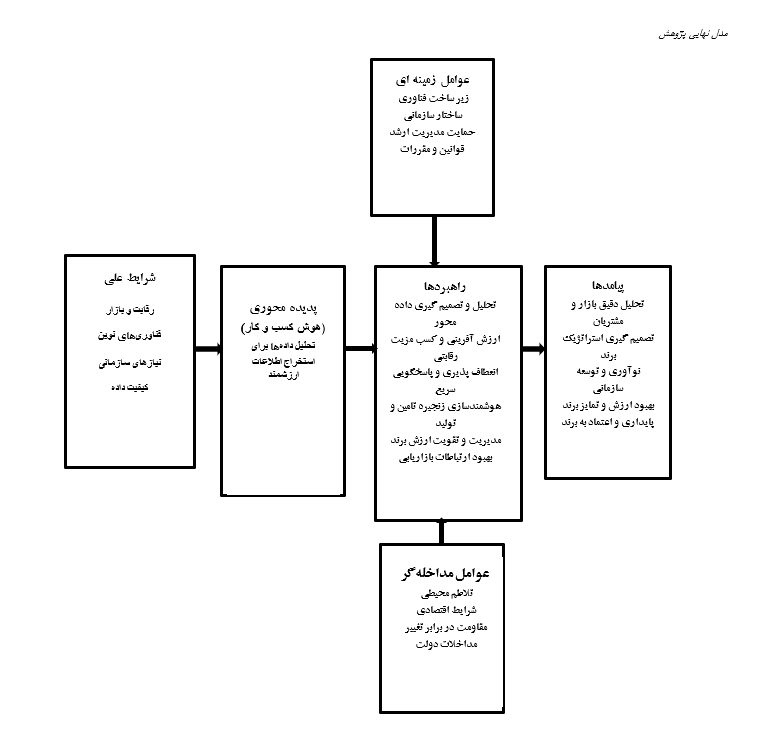
This study aimed to design and explain a context-specific business intelligence model for enhancing the brand performance of companies operating in the food industry of Tehran Province. This applied and exploratory qualitative study was conducted using the grounded theory methodology. The research population comprised senior managers and experts working in the food industry of Tehran Province, who were selected through purposive and judgmental sampling. Data were collected through in-depth, directed interviews with 12 participants who possessed relevant managerial experience and expertise in marketing, commercial planning, and the food industry. The data were analyzed according to the systematic approach of Strauss and Corbin through open, axial, and selective coding. Participant feedback and peer review were employed to establish the credibility of the findings. Recoding was also performed to assess reliability, producing an intercoder test–retest reliability coefficient of 0.83. The findings indicated that market competition, emerging technologies, organizational needs, and data quality constituted the causal conditions underlying the development of business intelligence. The central phenomenon was the analysis of data to generate valuable information, encompassing data collection, storage, analysis, application, and the monitoring of key performance indicators. Technological infrastructure, organizational structure, top management support, and regulatory requirements were identified as contextual conditions facilitating model implementation. Environmental turbulence, economic conditions, resistance to change, and government interventions functioned as intervening conditions. The principal strategies included data-driven analysis and decision-making, value creation and competitive advantage, organizational flexibility and responsiveness, intelligent supply-chain and production management, brand-value enhancement, and improved marketing communications. These strategies resulted in more accurate market and customer analysis, strategic brand decision-making, organizational innovation, greater brand value and differentiation, and enhanced brand sustainability and customer trust. Business intelligence represents a strategic and dynamic organizational capability through which market and organizational data are transformed into actionable knowledge. Its effective implementation can strengthen evidence-based decision-making, organizational adaptability, customer trust, brand differentiation, and sustainable competitive advantage in the food industry.
Downloads
References
Agaba, M., & Kalu, E. (2019). Brand Equity and Competitive Advantage in Alcoholic Beverage Products. International Journal of Management and Network Economics, 4(3), 246-262. https://doi.org/10.1504/IJMNE.2019.105869
Bahrami, M., & Nejad, K. (2021). Business Intelligence in Local Enterprises: A Study of Barriers and Implementation Strategies. Iranian Journal of Management Studies, 9(2), 110-125.
Borissova, D., Cvetkova, P., Garvanov, I., & Garvanova, M. (2020). A Framework of Business Intelligence System for Decision Making in Efficiency Management. In. https://doi.org/10.1007/978-3-030-47679-3_10
Bozic, K., & Dimovski, V. (2021). Business Intelligence and Analytics Use, Innovation Ambidexterity, and Firm Performance: A Dynamic Capabilities Perspective. The Journal of Strategic Information Systems, 28(4), 101578. https://doi.org/10.1016/j.jsis.2019.101578
Bui, M., & Le, L. (2023). Digital Capability and Creative Capability to Boost Firm Performance and Formulate Differentiated CSR-Based Strategy. Heliyon, 9(3), e14241. https://doi.org/10.1016/j.heliyon.2023.e14241
Champa, S. S., & Segall, R. S. (2026). Integrated Data Analytics, Business Intelligence, and Machine Learning Architecture for SMEs. International Journal of Business Analytics, 13(1), 1-38. https://doi.org/10.4018/ijban.409371
Chen, Y., & Liu, Q. (2022). The Role of Business Intelligence in Strategic Decision-Making and Brand Performance in the Asian Food Industry. Asia Pacific Journal of Marketing and Logistics, 34(2), 98-120.
Esmaili, R., & Mohammadi, S. (2021). Data Security and Business Intelligence in the Food Industry: Risks and Solutions. Journal of Business and Management, 25(1), 50-67.
Gonzalez, R., & Fernandez, M. (2023). Business Intelligence and Innovation Strategies: Their Impact on Brand Performance in European SMEs. European Journal of Innovation Management, 26(1), 77-95.
Hamad, F., Al-Aamr, R., Jabbar, S. A., & Fakhuri, H. (2021). Business Intelligence in Academic Libraries in Jordan: Opportunities and Challenges. Ifla Journal, 47(1). https://doi.org/10.1177/0340035220931882
Hashemi, Z., & Alizadeh, H. (2022). A Theoretical Framework for Business Intelligence and Its Impact on Brand Loyalty in the Iranian Market. International Journal of Brand Management, 18(3), 180-195.
Hosseingoli, A., & Khadem Hojjati, T. (2022). The Effect of Business Intelligence in Marketing on Increasing Sales in Manufacturing Companies. Accounting and Management Outlook Quarterly, 5(59).
Huang, Z.-X., Savita, K. S., & Jiang, Z.-J. (2022). The Business Intelligence Impact on the Financial Performance of Start-Ups. Information Processing & Management, 59, 102761. https://doi.org/10.1016/j.ipm.2021.102761
Khatibi Shahkhali, S. (2022). Investigating the Effect of Business Intelligence, Business Digitalization, and Information Technology Capability on Financial Performance Based on the Role of Innovation: A Study of Employees of Bank Melli in Guilan Province Rahbord Shomal Institute of Higher Education].
Lee, J., & Lee, S. (2023). Impact of Business Intelligence on Brand Performance through Big Data Analytics in the Food Industry. Journal of Business Intelligence Research, 15(1), 45-67.
Matlabbi, A., Hosseini, S., & Faryabi, M. (2024). Identifying the Fundamental Dimensions and Components Affecting the Success of Business Intelligence Systems Using a Meta-Synthesis Approach. Science and Technology Policy Letters Quarterly, 14(3).
Nguyen, T., & Tran, P. (2022). The Effects of Business Intelligence on Digital Marketing Strategies and Brand Performance in the Southeast Asian Food and Beverage Industry. Journal of Marketing Analytics, 10(2), 123-144.
Pourgholi, A., Eydi, H., & Keshavarz, F. (2025). Explaining the Key Factors Influencing Business Intelligence in Online Sports Enterprises. Sports Marketing Studies, 6(1), 32-44. https://gsmsmr.uok.ac.ir/article_63526_en.html?lang=fa
Rahimi, M., & Ajoudani, M. (2023). The Effect of Marketing Intelligence on the Supply Chain with the Mediating Role of Product Innovation Performance: A Study of Kalleh Company in Tehran Province First National Conference on New Approaches to Management, Economics, Global Trade, Accounting, and Banking in the Third Millennium, Ahvaz. https://civilica.com/doc/1894768
Rajabzadeh, A., & Hosseini, M. (2023). Challenges in Implementing Business Intelligence in the Iranian Food Industry: A Focus on Brand Performance. Journal of Iranian Industrial Management, 14(3), 180-195.
Rajala, A., & Tidstrom, A. (2021). Examining the Effects of a Coopetitive Mindset on SME Performance: The Moderating Role of Growth. Industrial Marketing Management, 105, 351-358. https://doi.org/10.1016/j.indmarman.2022.06.012
Rashidi Chefakhour, H., & Rezaeian, A. (2021). The Role of Brand Equity and Creativity in the Effect of Business Intelligence on Financial Performance: A Study of Private Banks in Khuzestan Province First International Conference on the Advancement of Management, Economics, and Accounting Sciences, Sari.
Rouhani, S., & Rabiei Savoji, S. (2016). A Model for Evaluating the Success of Business Intelligence Tools. Journal of Information Technology Management Studies, 4(15).
Rumanti, A. F., Rizana, F., & Achmad, F. (2023). Exploring the Role of Organizational Creativity and Open Innovation in Enhancing SMEs Performance. Journal of Open Innovation: Technology, Market, and Complexity, 9, 100045-100041-100015. https://doi.org/10.1016/j.joitmc.2023.100045
Sartipzade, S., Rastgar, A., & vishlaghi, M. (2025). The Impact of Business Intelligence on Performance with Emphasis on the mediating role of Innovation Ambidexterity and Dynamic Capabilities. Journal of Advertising and Sales Management, 6(1), 276-297. https://www.magiran.com/paper/2844361/the-impact-of-business-intelligence-on-performance-with-emphasis-on-the-mediating-role-of-innovation-ambidexterity-and-dynamic-capabilities?lang=en
Shuvo, S. A., Tabassum, M., Tafannum, N., & Chadni, S. (2025). Machine learning in business intelligence: From data mining to strategic insights. Review of Applied Science and Technology, 4(2), 339-369. https://doi.org/10.63125/drb8py41
Smith, K., & Johnson, L. (2020). Business Intelligence and Its Role in Strategic Decision-Making and Brand Performance in the U.S. Food Industry. Journal of Strategic Management, 28(4), 189-207.
Solomon, O., Emmanuel, F., Simon, J., & Mendez, D. (2025). Leveraging Data Analytics, Business Intelligence, Artificial Intelligence, and Predictive Modeling to Foster Innovation, Strengthen Startups, Mitigate Operational Risks, and Accelerate Economic Growth in the United States. Ijfei, 2(4), 85-97. https://doi.org/10.54660/ijfei.2025.2.4.85-97
Tian, W. (2025). Enhancing Financial Decision-Making Through Automated Business Intelligence Systems. International Journal of E-Collaboration, 21(1), 1-20. https://doi.org/10.4018/ijec.367575
Trieu, P., Van Nguyen, T. T. M., Nguyen, H. M., Vu, K., & Tran, K. (2023). Information Technology Capabilities and Organizational Ambidexterity Facilitating Organizational Resilience and Firm Performance of SMEs. Asia Pacific Management Review, 28(4), 544-555. https://doi.org/10.1016/j.apmrv.2023.03.004
Vafaei Basir, H., & Farajpour, S. (2022). Investigating the Effect of Business Intelligence on Marketing with Emphasis on Business Innovation: A Study of Food Industry Companies in Hamadan Province Ninth Scientific Research Conference on the Development and Promotion of Management and Accounting Sciences in Iran, Tehran. https://civilica.com/doc/1681577
Valamanesh, M. (2015). Investigating the Effect of Business Intelligence on the Brand Equity of Export Products of Food Industry Companies Urmia University].
Williams, D., & Scott, T. (2021). Business Intelligence Systems and Their Impact on Financial and Brand Performance in North American Food Companies. Journal of Business Economics and Management, 22(3), 311-329.
Downloads
Publication Timeline
- Submitted
- Revised
- Accepted
Issue
Section
License
Copyright (c) 2025 Arezoo Havaie (Author); Seyed Ahmad Ghasemi; Nader Khalesi (Author)

This work is licensed under a Creative Commons Attribution-NonCommercial 4.0 International License.