Identification of the Dimensions, Components, and Indicators of Organizational Leadership for the Implementation and Management of Emerging Technologies in the National Iranian Oil Company
DOI:
https://doi.org/10.61838/kman.jtesm.503Keywords:
Organizational leadership, implementation of new technologies, technology management, National Iranian Oil Company, meta-synthesis, interpretive structural modeling, structural equation modeling, digital transformationAbstract
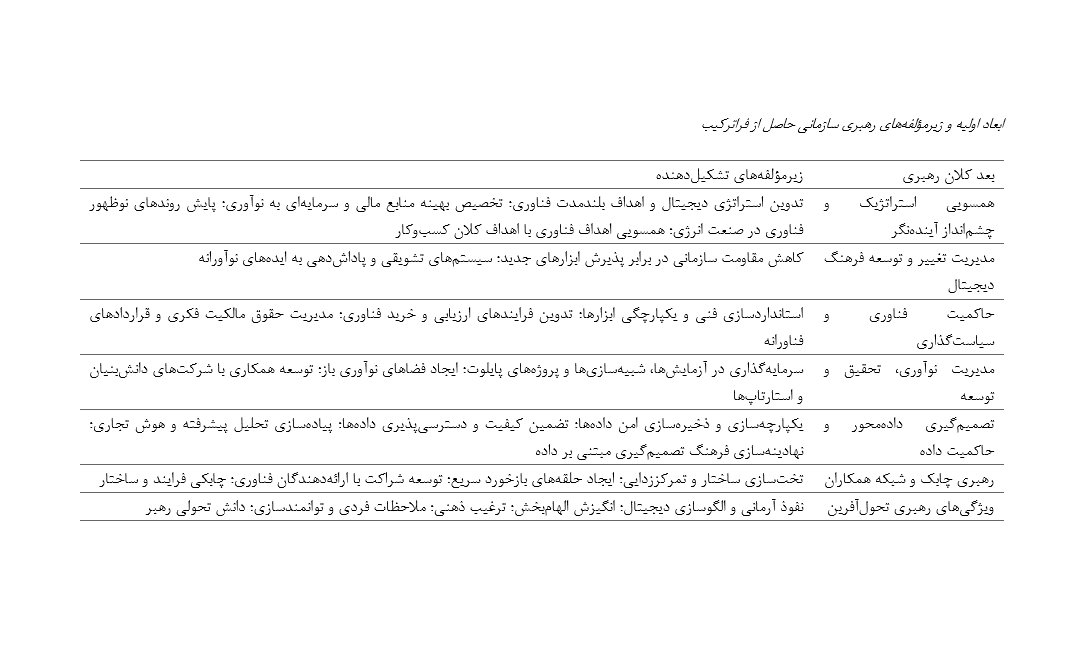
This study aimed to identify and explain the dimensions, components, and indicators of organizational leadership required for the implementation and management of emerging technologies in the National Iranian Oil Company. This applied qualitative study was conducted in two sequential phases. First, a qualitative meta-synthesis was performed on scientific studies published between 2000 and 2025. Relevant sources were retrieved from major Iranian and international databases. Of 110 initially identified studies, 75 met the inclusion and quality criteria and were analyzed. Second, semi-structured interviews were conducted with managers and experts from the National Iranian Oil Company to refine and contextualize the literature-based findings. Participants were selected through purposive and snowball sampling until theoretical saturation was reached. Interview data were analyzed using directed content analysis. Indicator validity was assessed through the content validity ratio, while coding reliability was examined using Cohen’s kappa. The meta-synthesis generated 58 open codes and 26 axial codes. Integration of documentary and interview findings resulted in 9 major dimensions and 33 subcomponents. The final dimensions were strategic alignment and future-oriented vision, change management and digital culture development, technology governance and policymaking, competency development and employee empowerment, innovation and research and development management, data-driven decision-making and data governance, operational integration of information technology and operational technology, agile leadership and partner ecosystems, and transformational leadership characteristics. Cohen’s kappa was 0.75 for study evaluation and 0.72 for interview coding. The content validity values of the retained indicators generally ranged from 0.83 to 1.00. Successful implementation of emerging technologies in the oil industry requires a multidimensional leadership framework that simultaneously coordinates strategy, culture, human capabilities, data, innovation, technology governance, organizational agility, and operational integration.
Downloads
References
Amor, A. M., Vázquez, J. P. A., & Faíña, J. A. (2020). Transformational Leadership and Work Engagement: Exploring the Mediating Role of Structural Empowerment. European Management Journal, 38(1), 169-178. https://doi.org/10.1016/j.emj.2019.06.007
Binandeh Dehaghani, A. A. (2022). The Impact of Transformational Leadership on the Engagement of Talented Human Resources with Consideration of Information Technology Management. Second National Conference on Organizational and Business Improvement and Reconstruction, Tehran, Iran.
Bolatan, G. I. S., Giadedi, A., & Daim, T. (2022). Innovation Leadership through Technology Transfer: The Case of Turkish Industry. Technology in Society, 68, 101909. https://doi.org/10.1016/j.techsoc.2022.101909
Brown, J. A., Ward, A., & Duane, J. N. (2024). Data Privacy, Ethics and Strategic Leadership. In Handbook of Research on Strategic Leadership in the Fourth Industrial Revolution (pp. 330-347). Edward Elgar Publishing. https://doi.org/10.4337/9781802208818.00022
de Araujo, L. M., Priadana, S., Paramarta, V., & Sunarsi, D. (2021). Digital Leadership in Business Organizations. International Journal of Educational Administration, Management, and Leadership, 45-56. https://doi.org/10.51629/ijeamal.v2i1.18
Haber, L., & Carmeli, A. (2023). Leading the Challenges of Implementing New Technologies in Organizations. Technology in Society, 74, 102300. https://doi.org/10.1016/j.techsoc.2023.102300
Hosseini, S. M., Khorani, S., & Kamali Zenozi, M. (2023). The Impact of Transformational Leadership on Information Technology Innovation Adoption with the Roles of Shared Leadership and Innovation Management. Second National Conference on Industrial and Organizational Psychology, Tehran, Iran.
Malek, M. A., & Almarri, K. (2023). The Role of Adaptive and Transformational Leadership in the Successful Adoption and Implementation of New Technologies and Innovations in Organizations. In European, Mediterranean, and Middle Eastern Conference on Information Systems (pp. 120-132). Springer. https://doi.org/10.1007/978-3-031-56481-9_9
Northouse, P. G. (2021). Leadership: Theory and Practice. SAGE Publications.
Nowak, R. M. (2023). How Resistance to Change Impairs Innovation. Journal of Strategy and Management, 16(4), 609-629. https://doi.org/10.1108/JSMA-08-2022-0144
Romeo, E., & Lacko, J. (2025). Adoption and Integration of AI in Organizations: A Systematic Review of Challenges and Drivers toward Future Research Directions. Kybernetes. https://doi.org/10.1108/K-07-2024-2002
Schmidt, D. H., Van Dierendonck, D., & Weber, U. (2023). The Data-Driven Leader: Developing a Big Data Analytics Leadership Competency Framework. Journal of Management Development, 42(4), 297-326. https://doi.org/10.1108/JMD-12-2022-0306
Seidl, M. (2020). Digital Leadership. In Liquid Legal: Towards a Common Legal Platform (pp. 177-204). Springer. https://doi.org/10.1007/978-3-030-48266-4_9
Șișu, J. A. (2023). Digital Leadership Competencies: A Systematic Literature Review. Revista de Management Comparat Internațional, 24(1), 69-77.
Solberg, E., Traavik, L. E., & Wong, S. I. (2020). Digital Mindsets: Recognizing and Leveraging Individual Beliefs for Digital Transformation. California Management Review, 62(4), 105-124. https://doi.org/10.1177/0008125620931839
Venkatesh, D. A. N. (2020). Leadership 4.0: Leadership Strategies for Industry 4.0. Solid State Technology, 63(6).
Vrontis, D., Christofi, M., Pereira, V., Tarba, S., Makrides, A., & Trichina, E. (2023). Artificial Intelligence, Robotics, Advanced Technologies and Human Resource Management: A Systematic Review. In Artificial Intelligence and International HRM (pp. 172-201). https://doi.org/10.4324/9781003377085-7
Weber, E., Krehl, E. H., & Büttgen, M. (2022). The Digital Transformation Leadership Framework: Conceptual and Empirical Insights into Leadership Roles in Technology-Driven Business Environments. Journal of Leadership Studies, 16(1), 6-22. https://doi.org/10.1002/jls.21810
Yue, C. A., Men, L. R., & Ferguson, M. A. (2019). Bridging Transformational Leadership, Transparent Communication, and Employee Openness to Change: The Mediating Role of Trust. Public Relations Review, 45(3), 101779. https://doi.org/10.1016/j.pubrev.2019.04.012
Zuraik, A., & Kelly, L. (2019). The Role of CEO Transformational Leadership and Innovation Climate in Exploration and Exploitation. European Journal of Innovation Management, 22(1), 84-104. https://doi.org/10.1108/EJIM-10-2017-0142
Downloads
Publication Timeline
- Submitted
- Revised
- Accepted
Issue
Section
License
Copyright (c) 2025 Esmail Abbasi Chenari (Author); saber Khandan Alamdari; Alireza Mir Arab (Author)

This work is licensed under a Creative Commons Attribution-NonCommercial 4.0 International License.