Developing an Interpretive Structural Model of Agile Human Resources Using a Soft Capabilities Approach to Digital Transformation
Keywords:
Agile Human Resources, Digital Transformation, Soft Capabilities, Digital Transformational Leadership, Interpretive Structural Modeling, MICMAC, Islamic Republic of Iran RailwaysAbstract
The present study aimed to develop an interpretive structural model of agile human resources using a soft capabilities approach to digital transformation in the Islamic Republic of Iran Railways.
Methods and Materials: This developmental-applied, exploratory-descriptive study employed an exploratory sequential mixed-methods design. In the qualitative phase, 15 experts, senior managers, human resource and information technology specialists, railway industry managers, and university faculty members were selected through purposive and snowball sampling until theoretical saturation was reached. Data were collected through semi-structured interviews and analyzed using MAXQDA 2020 through open, axial, and selective coding. Coding reliability was assessed using Holsti’s agreement coefficient. In the quantitative phase, the same 15 experts completed pairwise comparison checklists for Interpretive Structural Modeling (ISM), and the structural analyses were performed in MATLAB. In addition, 191 railway human resource employees were selected through stratified random sampling and completed a 40-item researcher-developed questionnaire.
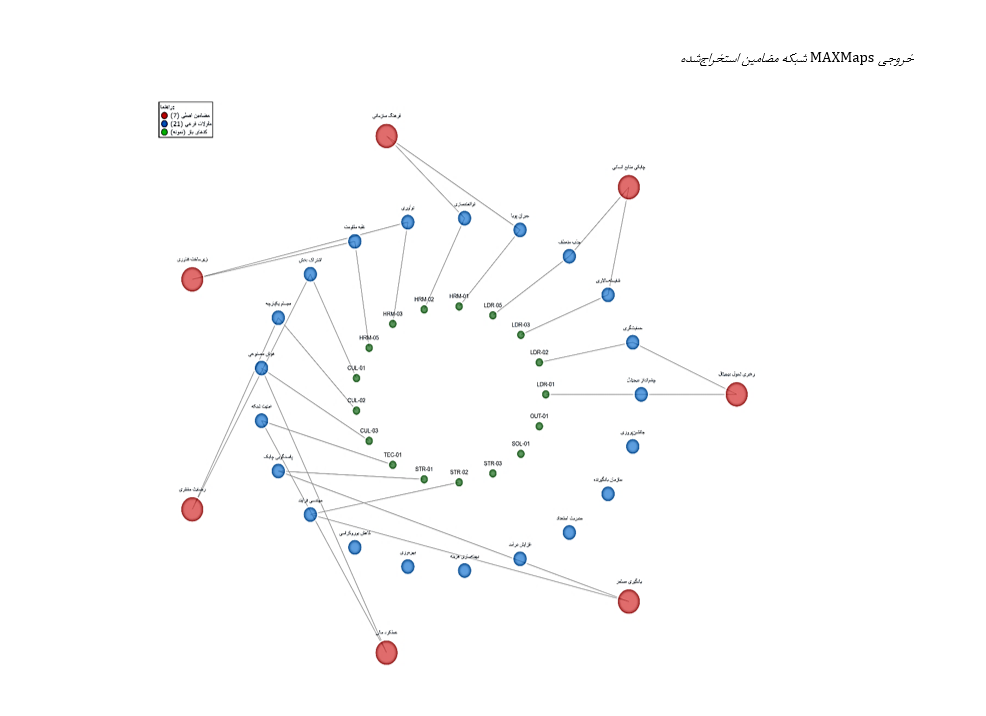
Findings: Qualitative analysis identified seven major dimensions: digital transformation leadership and governance, human resource agility, organizational culture, information technology infrastructure, customer satisfaction and processes, financial and operational performance, and continuous learning and growth. Digital transformational leadership emerged as the core category. Holsti’s agreement coefficient was 0.857. ISM analysis revealed a five-level hierarchical structure. Digital transformation leadership and governance occupied Level V with the highest driving power of 7 and dependence of 1, indicating its fundamental role. Organizational culture was positioned at Level IV. Human resource agility, information technology infrastructure, and continuous learning and growth were placed at Level III. Customer satisfaction and processes occupied Level II, while financial and operational performance represented the final outcome at Level I. MICMAC analysis classified leadership and organizational culture as independent driving variables, the three Level III dimensions as linkage variables, and customer/process and financial/operational outcomes as dependent variables.
Conclusion: The findings indicate that agile human resources in digital transformation are primarily rooted in transformational digital leadership and organizational culture, which activate human, technological, and learning capabilities and ultimately improve organizational processes and financial and operational performance.
Downloads
References
Ali, A., Ziaeddini, M., & Hadavi Nejad, M. (2022). Meta-Analysis of Human Resource Agility. Resource Management in Law Enforcement, 37, 225-253. https://www.magiran.com/paper/2422213/meta-analysis-of-human-resources-agility?lang=en
Althabhawee, A. A. K., & Saeed, Z. M. H. (2024, March). Digital human resources management and its role in enhancing career agility: A research study that analyzes the viewpoints of a sample of employees at many private banks in the Najaf governorate
Bahramian, l., Vedadi, a., & Gholamzadeh, D. (2023). Providing a model of human capital agility in agricultural jihad. Journal of Human Capital Empowerment, 5(4), 307-318. https://jhce.rasht.iau.ir/article_696947.html
https://jhce.rasht.iau.ir/article_696947_e7939871883e521a9b4be37c8c14f728.pdf
Chesnokova, O., Churbanova, S., Molchanov, S., & Markish, O. (2022). The role of social intelligence and creativity as personal resources for coping with uncertainty during primary career self-determination in late adolescence. European Psychiatry, 65(S1), S335-S335. https://doi.org/10.1192/j.eurpsy.2022.852
Ghonim, M. A., Goda, A. E. M. A., Khashaba, N. M., Elsotouhy, M. M., & Khashan, M. A. (2024). Impact of organizational energy on digital transformation in healthcare services: the movement of human resources from inertia to flexibility. Euromed Journal of Business.
Heidari, A., Yazdani, H., Hakim, A., Zarei Matin, H., & Babashahi, J. (2025). Presenting a digital transformation roadmap in human resources with a meta-synthesis approach. Organizational Resources Management Research, 12(4), 97-118.
Jalali, P., Salimi, M., Ninavaei, M., & Irannejad, P. (2024). Validation of a Digital Transformation Leadership Model in Education at Alborz University of Medical Sciences. Human Resources Excellence, 5(2), 78-102.
Jameh Abrishami, S., Mir Mohammad Sadeghi, S. A., & Aliyari, S. (2022). Designing a model for the agility of holy shrines in Iran based on the role of human resources. Studies in Organizational Behavior, 11(4), 125-164.
Jameh Abrishami, S., MirMohammadSadeghi, S. A., & Aliyari, S. (2022). Designing an Agility Model for Holy Shrines in Iran Based on the Role of Human Resources. Organizational Behavior Studies, 11(4), 125-164. https://obs.sinaweb.net/article_701382.html?lang=en
Khaki Vatan, N., Abbasian, H., NavehEbrahim, A., & Arasteh, H. R. (2021). Examining the state of agility in human resources in education. School Management, 9(1), 71-97. https://jsa.uok.ac.ir/article_61862.html
Khakivatan, N., Abbasian, H., navehebrahim, A., & Arasteh, H. R. (2021). Study The Agility of Human Resources in the Education. School administration, 9(1), 97-71.
Mirkhani, K. (2025). Digital Transformation in Human Resources: The Key Role of Artificial Intelligence and Gartner Solutions.
Mohammad Azir, A., Doustar, M., Akbari, M., & Yakideh, K. (2024). A Conceptual Framework for Digital Transformation Based on E-Leadership in the Higher Education System: A Study of the Kurdistan Region of Iraq. Human Resources Studies, 14(3), 88-117.
Mujahidin, A., Zuhad, Z., & Irawanto, B. (2026). Digital Transformation Model for Higher Education Governance: An Integration of Business Processes, Human Resources, and Technology. Priviet Social Sciences Journal, 6(4), 151-163. https://doi.org/10.55942/pssj.v6i4.1129
Reyes-Cornejo, P., Araya-Castillo, L., Moraga-Flores, H., Boada-Grau, J., & Olivares-Brito, C. (2025). Scientometric study of digital transformation and human resources: Collaborations, opportunities, and future research directions. Administrative Sciences, 15(4), 152. https://doi.org/10.3390/admsci15040152
Tiwow, G. M. (2023). Human Resources Management in Trouble Time: Strategy to Increase Organization Agility for Digital Transformation in University. Ijite, 2(4), 99-112. https://doi.org/10.62711/ijite.v2i4.166
Yadnya, I. D. G. S. A., Izaak, F. D. L., & Ausat, A. M. A. (2023). Strategic Engineering of Human Resources Development (HRD) to Respond to the Digital Transformation Era in the Context of Business Information Systems. Polgan Minfo Journal, 12(2), 2584-2591. https://doi.org/10.33395/jmp.v12i2.13319
Downloads
Publication Timeline
- Submitted
- Revised
- Accepted
Issue
Section
License
Copyright (c) 2025 Hassanali Rezaei (Author); Mohammad Reza Dalvi; Alireza Shirvani Jozdani (Author)

This work is licensed under a Creative Commons Attribution-NonCommercial 4.0 International License.