Designing a Strategic Brand Management Model in the Home Appliance Industry Based on Customer Knowledge Management
Keywords:
Strategic Brand Management, Customer Knowledge Management, Thematic Analysis, Home Appliance IndustryAbstract
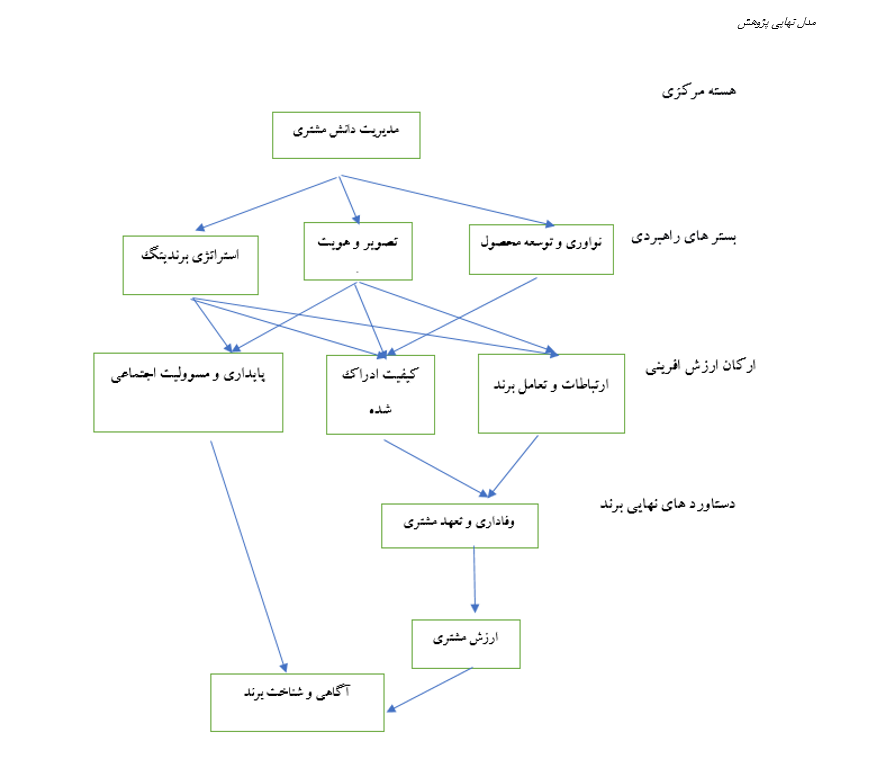
This study aimed to develop an integrated strategic brand management model based on customer knowledge management in the home appliance industry and to explain how knowledge generated through customer interactions can be transformed into strategic brand decisions and actions. This applied qualitative study employed systematic thematic analysis based on Braun and Clarke’s approach. The study population consisted of academic and industry experts with expertise in strategic brand management and customer knowledge management in the Iranian home appliance industry. Participants were selected purposively, and sampling continued until theoretical saturation was achieved. Fifteen in-depth semi-structured interviews were ultimately conducted with eight senior industry managers and seven university faculty members. The data were analyzed through six stages: familiarization with the data, generation of initial codes, searching for themes, reviewing themes, defining and naming themes, and producing the final report. Trustworthiness was enhanced through attention to credibility, transferability, dependability, and confirmability. The thematic analysis yielded 10 overarching themes, 39 organizing themes, and 184 basic themes. The final model comprised four interconnected layers: a central core of customer knowledge management; strategic foundations encompassing branding strategy, brand image and identity, and product innovation and development; value-creation pillars comprising brand communication and interaction, perceived quality, and sustainability and social responsibility; and final outcomes consisting of customer loyalty and commitment, customer value, and brand awareness and recognition. The findings indicated that systematic acquisition, sharing, analysis, and application of customer knowledge provide an essential basis for developing and continuously refining strategic brand decisions. The proposed model positions customer knowledge management as a central infrastructure for strategic brand management. By converting customer data, experiences, preferences, and feedback into actionable insights, organizations can strengthen brand identity, enhance perceived quality, support innovation, improve brand interactions, and create sustainable customer value. The model can therefore serve as a practical roadmap for managers in the home appliance industry seeking to develop and revise customer-oriented brand strategies.
Downloads
References
Ariani, O., Yazdani, H., & Ramezan, M. (2025). Identification and Explanation of the Mechanism for Sharing Employees' Tacit Knowledge in Developing Successors at the University of Tehran. Strategic Management of Organizational Knowledge, 8(2), 105-133. https://jkm.ihu.ac.ir/article_210009.html?lang=en
Bagheri, A., Faraji, O., Arabzadeh, M., & Ghodrati, H. (2025). Investigating the Financial Risk Management Model in Knowledge-Based Startup Companies. Journal of Technology in Entrepreneurship and Strategic Management, 4(2), 13. https://doi.org/10.61838/kman.jtesm.4.2.14
Bagrationi, K., & Tunkevichus, O. (2025). Rethinking Strategic Thinking through the Lens of Strategic Coherence Proceedings of the 25th European Conference on Knowledge Management,
Chen, Y. M., Kao, Y. F., Yan, M. R., & Yen, M. H. (2026). Managing Competitive Advantage in Emerging Knowledge-Based Economies: The Strategic Configuration Perspective. Knowledge Management Research & Practice, Online. https://doi.org/10.1080/14778238.2026.2615351
Darbandi Farahani, S., Zolghi, H., & Moslemi, A. (2025). Modeling the Management of Organizational Inertia in Strategic Management Accounting Implementation: The Roles of Accountability Mechanisms and Corporate Culture. Management Accounting and Auditing Knowledge, 16(61), 353-372.
Heidari, R., Khanifar, H., Naderi Bani, N., & Saberi, A. (2025). Identifying the dimensions and components of the entrepreneurial leadership model with a strategic knowledge management approach in secondary education. Journal of Entrepreneurship and Innovation Research, 4(2), 20-36. https://journal.iransaei.ir/article_218862.html
Khalilpour, M., Ramezani, J., Ebrahimian, J., Fallah, A., & Kordani, H. (2025). Developing Strategic Management Accounting by Applying Accounting Information Systems in Facing Environmental Drivers. Journal of Accounting and Management Auditing Knowledge, 14(55), 193-207.
Khasmafkan-Nezam, M. H. (2025). Harnessing Information System Capabilities to Enhance Organizational Agility: The Interplay of Green Absorptive Capacity, Collaborative Knowledge Creation, And strategic Flexibility. Journal of Enterprise Information Management, 1-35. https://doi.org/10.1108/jeim-02-2025-0080
Lomachinska, I., Dobrodum, O., Ishchuk, O., Patlaichuk, O., Stupak, O., Shnitser, M., & Salo, H. (2025). Digital Citizenship and Knowledge Management in Education: Strategic Pathways to Sustainable Development. European Journal of Sustainable Development, 14(2), 747. https://doi.org/10.14207/ejsd.2025.v14n2p747
Mehrabi, N., Soleimani, B., & Eskandari, F. (2025). Designing a Knowledge Management Framework for Business Sustainability and Long-Term Development Using the Delphi Technique. Strategic Management of Organizational Knowledge, 8(31).
Moghaddaspour, A., Gholipour Souteh, R., & Ansari, M. (2026). Presenting a Model of Data-Driven Marketing Strategies for the Digital Marketing of Knowledge-Based Companies. Technology in Entrepreneurship and Strategic Management, 5(2).
Mohtasham, S. S., Alidoust Zoghi, P., Gholipour Soleimani, A., & Ghanbarian Boroujeni, A. (2026). Presenting a Paradigmatic Model of Entrepreneurial Orientation in Knowledge-Based Companies. Technology in Entrepreneurship and Strategic Management, 5(2), 1-22.
Mubarakh, C., Miswanto, M., Siregar, B., Biyanto, F., & Kartika, F. (2025). The Strategic Role of Knowledge Management in Mediating the Relationship Between Servant Leadership and Organizational Value. International Journal of Research and Innovation in Applied Science, X(I), 335-352. https://doi.org/10.51584/ijrias.2025.1001027
Negarandeh, M., & Rajabpour, E. (2026). The Effect of Strategic Human Resource Management on Organizational Innovation and Digital Transformation with the Mediating Role of Knowledge Sharing in the Petrochemical Industry. Strategic studies in the oil and energy industry, 17(68), 103-122.
Parsakia, K., & Jafari, M. (2023). Strategies for Enhancing Customer Engagement Using Artificial Intelligence Technologies in Online Markets. Journal of Technology in Entrepreneurship and Strategic Management (JTESM), 2(1), 49-69. https://journaltesm.com/index.php/journaltesm/article/view/41
Parsakia, K., Kazemi, S., & Saberi, S. (2023). Strategic Management of Technology in Psychology: Implications for Decision-Making. Health Nexus, 1(3). https://doi.org/10.61838/kman.hn.1.3.12
Siahsarani Kojouri, M. A., & Cheraghali, M. R. (2024). Application of Clustering Technique in Analyzing the Status of Knowledge Management in Golestan University. Strategic Management of Organizational Knowledge, 7(2), 165-187. https://doi.org/10.47176/smok.2024.1697
Soleimani, P., & Bazyar, M. (2025). The impact of knowledge management on the quality of work among primary school teachers in Rostam Education District. Strategic Research in Education Quarterly, 2(37), 179–191. https://civilica.com/doc/2213297/
Voshkaei Nejad, S. S., Doustar, M. A., Yakideh, & Keykhosro. (2024). Designing a Knowledge-Based Governance Model in Executive Agencies. Strategic Management of Organizational Knowledge, 7(2).
Downloads
Publication Timeline
- Submitted
- Revised
- Accepted
Issue
Section
License
Copyright (c) 2026 Alireza Azamnia (Author); Mahmoud Ahmadi Sharif; Seyyed Mahmoud Hashemi, Hassan Ghorbani Dinani (Author)

This work is licensed under a Creative Commons Attribution-NonCommercial 4.0 International License.