طراحی و اعتبارسنجی مدل خطمشیگذاری توسعه کارآفرینی زنان فارغالتحصیل دانشگاهی ایران
کلمات کلیدی:
خطمشیگذاری, توسعه کارآفرینی, زنان کارآفرین, زنان فارغالتحصیل دانشگاهی, مدلسازی معادلات ساختاریچکیده
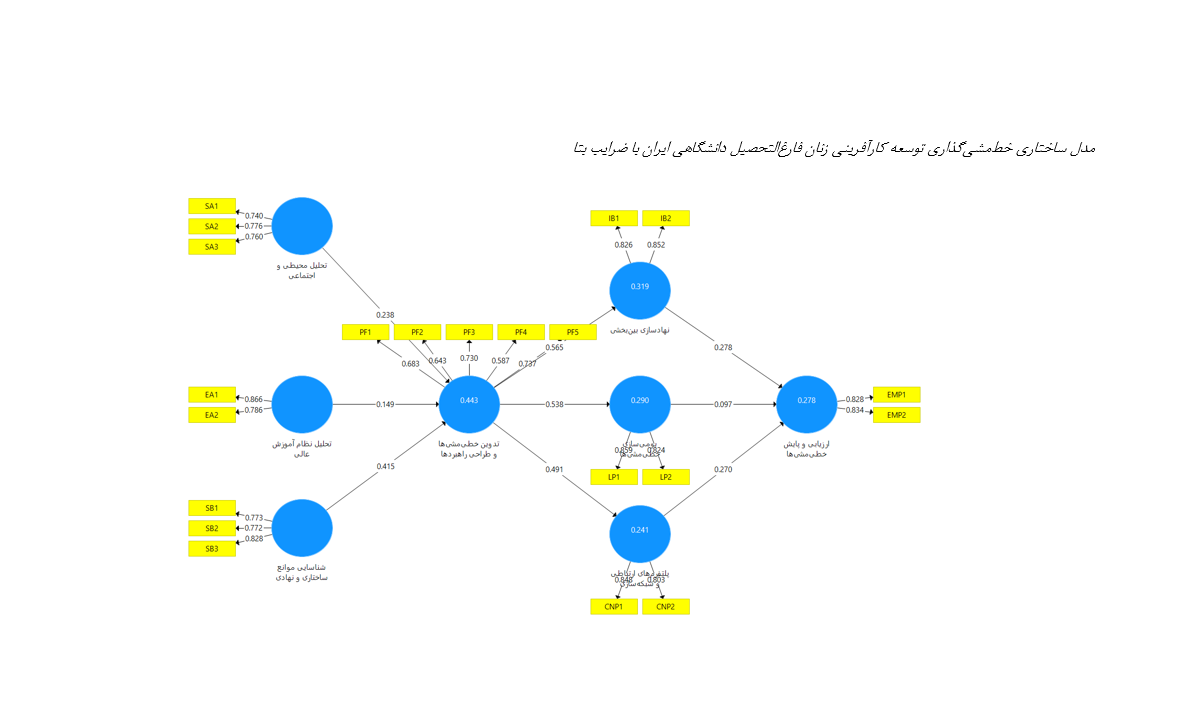
پژوهش حاضر با هدف طراحی و اعتبارسنجی مدل خطمشیگذاری توسعه کارآفرینی زنان فارغالتحصیل دانشگاهی در ایران انجام شد. پژوهش از نظر هدف توسعهای–کاربردی و با رویکرد آمیخته متوالی اکتشافی انجام شد. در بخش کیفی، دادهها از طریق مرور منابع و مصاحبههای نیمهساختاریافته با ۱۴ نفر از خبرگان دانشگاهی و مدیران حوزه کارآفرینی زنان که به روش نمونهگیری هدفمند انتخاب شده بودند، گردآوری و با تحلیل مضمون ششمرحلهای کلارک و براون تحلیل شدند. در بخش کمی، جامعه شامل ۳۱۲ زن کارآفرین فارغالتحصیل دانشگاهی در استان تهران بود که ۱۷۲ نفر براساس فرمول کوکران انتخاب شدند. دادهها با پرسشنامه محققساخته ۳۴ گویهای گردآوری و مدل با استفاده از مدلسازی معادلات ساختاری مبتنی بر حداقل مربعات جزئی در نرمافزار SmartPLS اعتبارسنجی شد. نتایج استنباطی نشان داد تحلیل محیطی و اجتماعی (β=0.238)، تحلیل نظام آموزش عالی (β=0.149) و شناسایی موانع ساختاری و نهادی (β=0.415) اثر مستقیم معناداری بر تدوین خطمشیها و طراحی راهبردها داشتند. تدوین خطمشیها و طراحی راهبردها نیز بهترتیب بر نهادسازی بینبخشی (β=0.565)، بومیسازی خطمشیها (β=0.538) و شکلدهی پلتفرمهای ارتباطی و شبکهسازی (β=0.491) اثر مستقیم معنادار داشت. افزون بر این، نهادسازی بینبخشی (β=0.278) و پلتفرمهای ارتباطی و شبکهسازی (β=0.270) بر ارزیابی و پایش خطمشیها اثر معنادار نشان دادند؛ در حالی که اثر بومیسازی خطمشیها بر ارزیابی و پایش معنادار نبود (β=0.097). شاخص GOF برابر با 0.373 بود که عملکرد کلی مناسب مدل را تأیید کرد. توسعه کارآفرینی زنان فارغالتحصیل دانشگاهی مستلزم خطمشیگذاری یکپارچه، فرایندمحور و مبتنی بر شواهد است که تحلیل زمینه و موانع را به طراحی راهبردها، هماهنگی بینبخشی، شبکهسازی و ارزیابی مستمر پیوند دهد.
دانلودها
مراجع
Alam, M. J., Ogawa, K., Basharat, L., & Ahsan, A. H. M. (2025). Significance of Quality Higher Education in the Advancement of Gender Equality: The Case of Bangladesh. Journal of Applied Research in Higher Education, 17(1), 23-35. https://doi.org/10.1108/JARHE-05-2023-0177
Azhar, T. A. T., Wong, W. W., Zariney, A. A., & Nadisah, Z. (2024). The Impact of Government Support on the Success of Startups Creation in Malaysia. Quantum Journal of Social Sciences and Humanities, 5(3), 170-184. https://doi.org/10.55197/qjssh.v5i3.379
Baral, R., Dey, C., Manavazhagan, S., & Kamalini, S. (2023). Women Entrepreneurs in India: A Systematic Literature Review. International Journal of Gender and Entrepreneurship, 15(1), 94-121. https://doi.org/10.1108/IJGE-05-2021-0079
Begi, M., & Ghorbani, A. (2024). A Longitudinal Analysis of the Changing Landscape of Attitudes toward Gender Equality in Iran. Social Sciences of Ferdowsi University of Mashhad, 21(4), 99-129.
Civera, A., & Meoli, M. (2023). Empowering Female Entrepreneurs through University Affiliation: Evidence from Italian Academic Spinoffs. Small Business Economics, 61(3), 1337-1355. https://doi.org/10.1007/s11187-022-00729-z
Cohen, N. (2025). Policy Entrepreneurs and Agenda Setting. In (pp. 170-184). Edward Elgar Publishing. https://doi.org/10.4337/9781035318513.00023
Corrêa, V. S., Lima, R. M. D., Brito, F. R. D. S., Machado, M. C., & Nassif, V. M. J. (2024). Female Entrepreneurship in Emerging and Developing Countries: A Systematic Review of Practical and Policy Implications and Suggestions for New Studies. Journal of Entrepreneurship in Emerging Economies, 16(2), 366-395. https://doi.org/10.1108/JEEE-04-2022-0115
Cruz-Sandoval, M., Vázquez-Parra, J. C., Alonso-Galicia, P. E., & Carlos-Arroyo, M. (2023). Perceived Achievement of Social Entrepreneurship Competency: The Influence of Age, Discipline, and Gender among Women in Higher Education. Sustainability, 15(13), 9956. https://doi.org/10.3390/su15139956
Dalimunthe, R. F., Zulkarnain, S. H., Siahaan, E., Nauly, M., Nawi, A. S., & Siregar, H. (2023). Empowering Women Entrepreneurs: Enhancing Competency and Capacity through University Education. Tem Journal, 12(4), 2208. https://doi.org/10.18421/TEM124-31
Dana, L. P., Chhabra, M., & Agarwal, M. (2024). A Two-Decade History of Women's Entrepreneurship Research Trajectories in Developing Economies Context: Perspectives from India. Journal of Management History, 30(1), 6-28. https://doi.org/10.1108/JMH-11-2022-0064
Deng, W., Zhou, W., Song, R., Li, J., & Zhang, J. (2025). Female Entrepreneurship: Systematic Literature Review and Research Framework. Chinese Management Studies, 19(6), 1752-1784. https://doi.org/10.1108/CMS-04-2024-0279
Fauzi, M. A., Sapuan, N. M., & Zainudin, N. M. (2023). Women and Female Entrepreneurship: Past, Present, and Future Trends in Developing Countries. Entrepreneurial Business and Economics Review, 11(3), 57-75. https://doi.org/10.15678/EBER.2023.110304
Gartzia, L., Peña-Legazkue, I., Samsami, M., & Schøtt, T. (2026). The Sustainable Impact of Women Entrepreneurs in Rural Communities. Business & Society, 00076503261428783. https://doi.org/10.1177/00076503261428783
Gjini, K. (2023). What Do We Know About Female Entrepreneurship in Albania? Overcoming Challenges and Driving Economic Growth. In (pp. 501-510). Springer Nature Switzerland. https://doi.org/10.1007/978-3-031-42511-0_33
Golshahi, B., & Amirbaglouye Dariani, M. (2026). Design and Validation of a Structural Model of Talent Development Based on Talent Coaching Components. Public Administration Perspective, e106931. https://doi.org/10.48308/jpap.2026.242283.1525
Golshahi, B., & Khoshnevis Zarch, A. (2025). Architecture of Applying Mixed Reality Technology in the Recruitment and Selection Process of Human Capital in the Army of the Islamic Republic of Iran. Intelligent Management of Human Capital, 2(5), 33-62. https://doi.org/10.22034/imhr.2025.548889.1040
Golshahi, B., & Mortezazadeh, A. (2024). Scenario Planning for the Risks of Expanding Artificial Intelligence in Human Capital Management Processes. Intelligent Management of Human Capital, 1(1), 29-60. https://doi.org/10.22034/imhr.2024.480339.1011
Gulvira, A., Ainash, M., Sagynysh, M., Meiramgul, A., & Aliya, K. (2024). The Impact of Female Entrepreneurship on Economic Growth in Developing and Developed Economies. ECONOMICS-Innovative and Economics Research Journal, 12(2), 145-162. https://doi.org/10.2478/eoik-2024-0016
Knox, S., Gok, A., Aydogdu, E., Carter, S., Levie, J., & Shaw, E. (2026). Empowering Women's Entrepreneurship: An Evidence Synthesis of Policy and Practice in Developing Countries. Entrepreneurship & Regional Development, 38(3-4), 410-434. https://doi.org/10.1080/08985626.2025.2503145
Mashapure, R., Nyagadza, B., Chikazhe, L., Mazuruse, G., & Hove, P. (2023). Women Entrepreneurship Development and Sustainable Rural Livelihoods in Zimbabwe. Arab Gulf Journal of Scientific Research, 41(4), 557-584. https://doi.org/10.1108/AGJSR-07-2022-0112
Maurya, S., Chaudhary, R., Kumar, A., Rangnekar, S., Cho, N., & Kim, G. M. (2026). Female Entrepreneurship: A Bibliometric Analysis and Framework Development. Journal of Small Business & Entrepreneurship, 38(1), 26-60. https://doi.org/10.1080/08276331.2025.2542597
Moustafa, A. M. A., Qadri, U. A., & Ghani, M. B. A. (2025). Female Entrepreneurship in Restrictive Environments: A Conditional Model Based on Conservation of Resources Theory. International Journal of Gender and Entrepreneurship, 1-24. https://doi.org/10.1108/IJGE-10-2024-0363
Nevi, G., Ancillai, C., Pascucci, F., & Palladino, R. (2025). Investigating Female Entrepreneurship: A Micro-Perspective of Drivers and Barriers for Aspiring and Experienced Women Entrepreneurs. International Entrepreneurship and Management Journal, 21(1), 11. https://doi.org/10.1007/s11365-024-01012-1
Oliver, M. O., & Slobodan, V. M. (2023). The Influence of Motivation, Communication, and Education on the Development of Female Entrepreneurship. International Review(1-2), 13. https://doi.org/10.5937/intrev2302013M
Raeis al-Sadat, R., Malek al-Sadati, S. S., & Hooshmand, M. (2024). Discrimination in Access to Employment Opportunities for Mothers in Iran's Urban Labor Market. Urban Economics, 9(1), 19-34.
Salamzadeh, A., Rezaei, H., Hadizadeh, M., Yasin, N., & Ansari, G. (2023). The Application of Strategic Foresight in Women's Entrepreneurship Development. Jwee, 16-36. https://doi.org/10.28934/jwee23.pp16-36
Usman, M., & Ab Rahman, A. (2023). Funding Higher Education through Waqf: A Lesson from Malaysia. International Journal of Ethics and Systems, 39(1), 107-125. https://doi.org/10.1108/IJOES-12-2021-0217
Zolfaghari, & Ghanei, Y. (2024). A Meta-Analysis of Barriers to Rural Women's Entrepreneurship in Iran. Local Development (Rural-Urban), 16(1), 167-185.
دانلودها
گاهشمار انتشار
- ارسال
- بازنگری
- پذیرش
شماره
نوع مقاله
مجوز
حق نشر 2025 Mohammad Bagheri (Author); Parvaneh Gelard; Mohammad Reza Ghorbaniyan (Author)

این پروژه تحت مجوز بین المللی Creative Commons Attribution-NonCommercial 4.0 می باشد.