شناسایی و اولویتبندی عوامل مؤثر بر برند کارفرمایی و رفاه ذهنی کارکنان با استفاده از مدلسازی ساختاری–تفسیری
کلمات کلیدی:
برند کارفرمایی, رفاه ذهنی کارکنان, مدلسازی ساختاری–تفسیری, توسعه فردی و سازمانی, فرهنگ سازمانی, ارتباطات داخلی, تحلیل MICMACچکیده
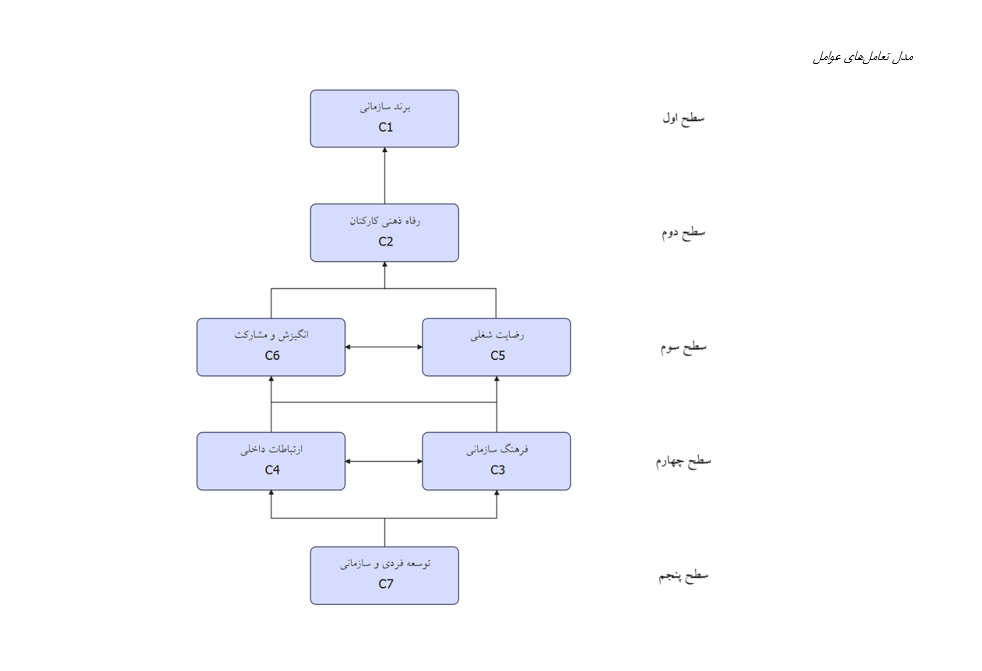
هدف پژوهش حاضر شناسایی، ساختاربندی و اولویتبندی عوامل مؤثر بر برند کارفرمایی و رفاه ذهنی کارکنان و تبیین روابط علّی میان این عوامل در سازمانهای وابسته به سازمان تأمین اجتماعی بود. این پژوهش از نظر ماهیت کیفی و از نظر هدف کاربردی بوده و با بهرهگیری از روش مدلسازی ساختاری–تفسیری (ISM) انجام شد. مشارکتکنندگان شامل خبرگان حوزه مدیریت منابع انسانی، برند کارفرمایی و رفاه کارکنان بودند که از طریق نمونهگیری هدفمند و گلولهبرفی انتخاب شدند. گردآوری دادهها از طریق مطالعه ادبیات نظری و انجام مصاحبههای نیمهساختاریافته عمیق تا دستیابی به اشباع نظری صورت گرفت. پس از استخراج عوامل، روابط میان متغیرها بر اساس قضاوت خبرگان تعیین و با تشکیل ماتریس خودتعاملی ساختاری، ماتریس دسترسی اولیه و نهایی محاسبه شد. سپس سطحبندی عوامل و تحلیل قدرت نفوذ و وابستگی متغیرها با استفاده از تحلیل MICMAC انجام گرفت تا ساختار سلسلهمراتبی مدل نهایی مشخص شود. نتایج تحلیل استنباطی نشان داد که عوامل مؤثر بر برند کارفرمایی و رفاه ذهنی کارکنان در قالب هفت بعد اصلی سازماندهی میشوند. توسعه فردی و سازمانی بهعنوان متغیر مستقل و زیربنایی دارای بیشترین قدرت نفوذ شناخته شد و نقش محرک اصلی سیستم را ایفا کرد. فرهنگ سازمانی و ارتباطات داخلی در سطح پیوندی قرار گرفتند و بهعنوان عوامل انتقالی، اثرات توسعه سازمانی را به پیامدهای رفتاری منتقل کردند. رضایت شغلی، انگیزش و مشارکت کارکنان بهعنوان متغیرهای میانی، نقش واسطهای در تبدیل شرایط سازمانی به پیامدهای روانشناختی ایفا نمودند. رفاه ذهنی کارکنان بهعنوان پیشنیاز شکلگیری برند کارفرمایی شناسایی شد و برند سازمانی در جایگاه متغیر وابسته نهایی با بیشترین وابستگی و کمترین نفوذ قرار گرفت. تحلیل MICMAC نشان داد سیستم دارای وابستگی متقابل بالا و پویایی ساختاری قابل توجه است و تغییر در متغیرهای پایه میتواند کل شبکه روابط سازمانی را تحت تأثیر قرار دهد. یافتههای پژوهش نشان میدهد شکلگیری برند کارفرمایی پایدار بیش از آنکه نتیجه اقدامات تبلیغاتی بیرونی باشد، حاصل فرایندهای درونی سازمان از جمله توسعه مستمر کارکنان، فرهنگ سازمانی حمایتی، ارتباطات اثربخش و ارتقای رفاه ذهنی است. بنابراین سازمانها برای تقویت برند کارفرمایی باید رویکردی سیستمی اتخاذ کرده و سرمایهگذاری راهبردی خود را از توسعه فردی و سازمانی آغاز نمایند تا از طریق ارتقای انگیزش، رضایت شغلی و سلامت روان کارکنان، تصویر برند سازمانی بهصورت پایدار تقویت شود.
دانلودها
مراجع
Afjeh, S. A. A., & Alizadehfar, Z. (2017). The relationship between employer brand perception and employees' job attitudes. Management Studies (Improvement and Transformation), 26(84), 73-96. https://www.sid.ir/fa/VEWSSID/J_pdf/4004513968404.pdf
Asanlu, B., & Khodami, S. (2015). The impact of customers' emotional attachment on brand equity emphasizing the mediating role of relationship quality and brand citizenship behavior in the industrial market. Brand Management Quarterly, 2(4), 97-124. https://journal.alzahra.ac.ir/article_2580.html
Barrow, S., & Mosley, R. (2005). The employer brand: Bringing the best of brand management to people at work. John Wiley & Sons. https://books.google.com/books?hl=en&lr=&id=Pu3XEAAAQBAJ&oi=fnd&pg=PR11&dq=Barrow,+S.+and+R.+Mosley+(2005).+The+employer+brand:+Bringing+the+best+of+brand+management+to+people+at+work,+John+Wiley+%26+Sons.+%09&ots=HgVYWwQhSC&sig=XdngzFAtnVYdIkjvAolWB7nSd2A
Benraiss-Noailles, L., & Viot, C. (2021). Employer brand equity effects on employees well-being and loyalty. Journal of Business Research, 126, 605-613. https://doi.org/10.1016/j.jbusres.2020.02.002
Bozorgi, Z., Khodadad Hosseini, S. H., & Ahmadi, P. (2021). Investigating how employer brand equity affects employee performance with attention to the role of employee well-being and loyalty (Case study: Dana Insurance). Proceedings of the 18th International Management Conference, Tehran.
Chiang, H. H., & Yu, S. Y. (2021). Employer branding and employee-based brand equity: The mediating and moderating effects in multilevel models. Management Comments, 40(1), 131-154. https://www.management-review.org/uploads/pdf/paper/mr_2021_01_jan_03.pdf.pdf
Choudhary, S., & Joshi, R. (2025). Unveiling the power of employer branding: enhancing talent retention through organizational advocacy. Asia-Pacific Journal of Business Administration, 17(4), 1093-1114. https://doi.org/10.1108/APJBA-04-2024-0225
Devito, L., Brown, A., Bannister, B., Cianci, M., & Mujtaba, B. (2016). Employee motivation based on the hierarchy of needs, expectancy and the two-factor theories applied with higher education employees. International Journal of Advances in Management, Economics and Entrepreneurship, 3. https://nova.elsevierpure.com/en/publications/employee-motivation-based-on-the-hierarchy-of-needs-expectancy-an-2
Dziedzic, J. (2024). From Organizational Identity to Impact: Employer Branding Strategies for Talent Attraction. Strategiczne zarządzanie w przedsiębiorstwach i administracji publicznej, 23. https://www.ceeol.com/search/article-detail?id=1342436
Elufioye, O. A., Ndubuisi, N. L., Daraojimba, R. E., Awonuga, K. F., Ayanponle, L. O., & Asuzu, O. F. (2024). Reviewing employee well-being and mental health initiatives in contemporary HR Practices. International Journal of Science and Research Archive, 11(1), 828-840. https://doi.org/10.30574/ijsra.2024.11.1.0153
Fernandez-Lores, S., Gavilan, D., Avello, M., & Blasco, F. (2016). Affective commitment to the employer brand: Development and validation of a scale. BRQ Business Research Quarterly, 19(1), 40-54. https://doi.org/10.1016/j.brq.2015.06.001
Goyal, R., & Kaur, G. (2023). Identifying the impact of employer branding in the retention of nurses: the mediating role of organizational culture and career development. Humanities and Social Sciences Communications, 10(1), 1-10. https://doi.org/10.1057/s41599-023-01794-9
Heide, M., Schröder, S., Wittemann, N., & Don, P. (2024). Employer branding-employer attractiveness as a new mindset in the healthcare sector. Management Dynamics in the Knowledge Economy, 12(1), 70-85. https://doi.org/10.2478/mdke-2024-0005
Hein, A. Z., Elving, W. J., Koster, S., & Edzes, A. (2024). Is your employer branding strategy effective? The role of employee predisposition in achieving employer attractiveness. Corporate Communications: An International Journal, 29(7), 1-20. https://doi.org/10.1108/CCIJ-07-2022-0070
Hoppe, D. (2018). Linking employer branding and internal branding: Establishing perceived employer brand image as an antecedent of favourable employee brand attitudes and behaviours. Journal of Product & Brand Management, 27(4), 452-467. https://doi.org/10.1108/JPBM-12-2016-1374
Lievens, F., & Slaughter, J. E. (2016). Employer image and employer branding: What we know and what we need to know. Annual Review of Organizational Psychology and Organizational Behavior, 3(1), 407-440. https://doi.org/10.1146/annurev-orgpsych-041015-062501
Mishra, S., & Kumar, S. P. (2019). E-recruitment and training comprehensiveness: untapped antecedents of employer branding. Industrial and Commercial Training, 51(2), 125-136. https://doi.org/10.1108/ICT-12-2017-0106
Moroko, L., & Uncles, M. D. (2008). Characteristics of successful employer brands. Journal of Brand Management, 16(3), 160-175. https://doi.org/10.1057/bm.2008.4
Nazari, M., Karimi, F., & Ahmdpour, S. (2018). The impact of employer brand on human resource productivity with the mediating role of talent management. Quarterly Journal of Organizational Management, 9(3), 33-58. https://www.noormags.ir/view/fa/articlepage/1502276/
Park, J., & Kim, J. (2024). Exploring the relationships among internal branding, work engagement, and turnover intention in public sports organizations after the pandemic. Sustainability, 16(3), 1342. https://doi.org/10.3390/su16031342
Rahimian, A. (2013). Employer brand: A new strategy for human capital management. Human Resource Management Research, 5(2), 127-150. https://hrmj.ihu.ac.ir/article_5052_146704a67b2dc99fa96b5a37d51fab75.pdf
Raj, A. B., & Goute, A. K. (2025). Internal branding and technostress among employees - the mediation role of employee wellbeing and moderating effects of digital internal communication. Acta Psychologica, 255, 104943. https://doi.org/10.1016/j.actpsy.2025.104943
Reis, I., Sousa, M. J., & Dionísio, A. (2021). Employer branding as a talent management tool: A systematic literature revision. Sustainability, 13(19), 10698. https://doi.org/10.3390/su131910698
Rita, P., António, N., & Raminhos, V. (2026). Using employee feedback to build effective employer branding strategies: a mixed method approach. International Journal of Organizational Analysis, 34(1), 256-282. https://doi.org/10.1108/IJOA-04-2024-4469
Ronda, L., Valor, C., & Abril, C. (2018). Are they willing to work for you? An employee-centric view to employer brand attractiveness. Journal of Product & Brand Management, 27(5), 573-596. https://doi.org/10.1108/JPBM-07-2017-1522
Sandeepanie, M. H. R., Gamage, P., Perera, G. D. N., & Sajeewani, T. L. (2023). The role of talent management and employee psychological contract on employer branding: a pragmatic conceptual model. Management Research Review, 46(2), 196-222. https://doi.org/10.1108/MRR-02-2021-0136
Shah, M. (2011). Talent Retention through Employer Branding. Journal of Marketing & Communication, 6(3). https://search.ebscohost.com/login.aspx?direct=true&profile=ehost&scope=site&authtype=crawler&jrnl=09732330&asa=Y&AN=80241250&h=f3NaIAtJ6OAL0HO3NYaqawpEyrEIbzdzhu0kJQC2IAfpNeWZYCgZw0R9dczIIh4JtuPJxsUXfEIo6%2BF3Z6CCCA%3D%3D&crl=c
Shoghi Lord, A., Akbari, N., & Sadeghi, R. (2019). A comparison of employer brand attractiveness in Iran's public and private sectors. Human Resource Management Studies, 10(1), 55-78. https://www.jipas.ir/article_84221.html
Sokro, E. (2012). Impact of employer branding on employee attraction and retention. http://digitalrepository.cipmlk.org/handle/1/847

دانلود
چاپ شده
ارسال
بازنگری
پذیرش
شماره
نوع مقاله
مجوز
حق نشر 2025 Karim Abedikhah, Ali Pirzad, Hassan Soltani (Author)

این پروژه تحت مجوز بین المللی Creative Commons Attribution-NonCommercial 4.0 می باشد.