A Model for Data-Driven Marketing Strategies in the Digital Marketing of Knowledge-Based Companies
Keywords:
Data-driven marketing, digital marketing, marketing strategy, knowledge-based companies, data analysis, data-driven decision-makingAbstract
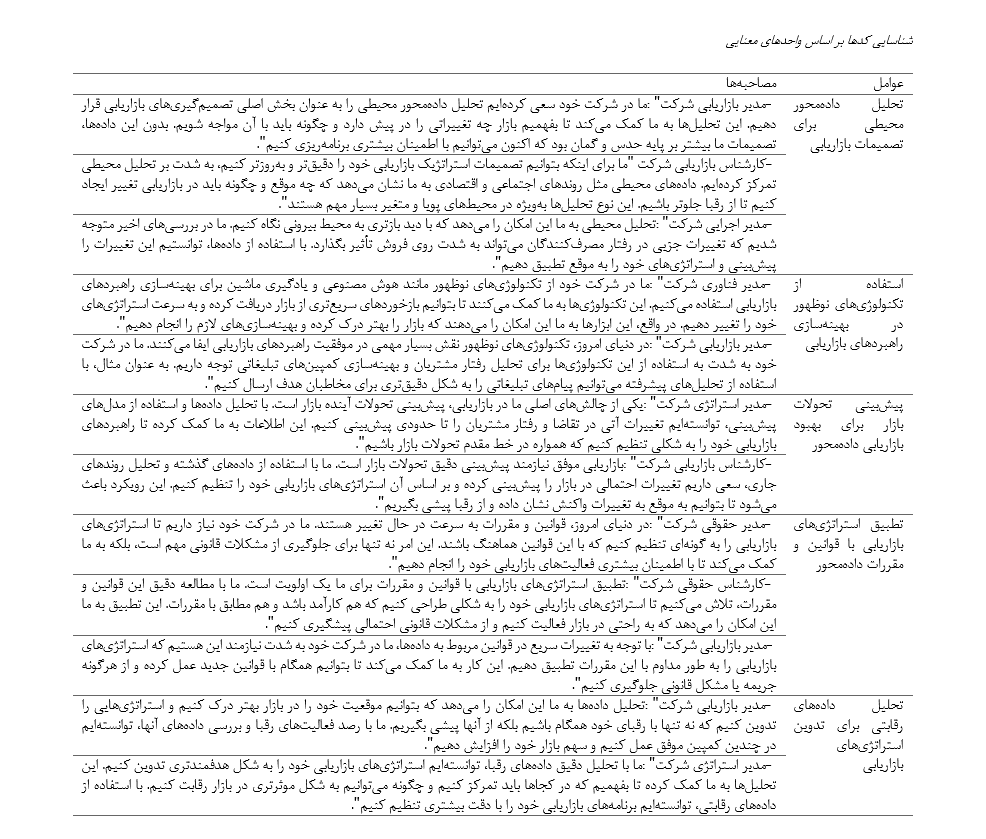
The purpose of this study was to design and explain a model of data-driven marketing strategies in the digital marketing of knowledge-based companies with emphasis on contextual, behavioral, and structural dimensions as well as the implementation stages of data-driven strategies. This study was conducted using a qualitative approach within an interpretivist paradigm. The research population consisted of experts, managers, and specialists active in knowledge-based companies with at least five years of experience in digital marketing and data-driven marketing. Participants were selected through snowball sampling, and the sample size was determined based on theoretical saturation. Data were collected through semi-structured interviews and analyzed using directed content analysis and MAXQDA software. To assess the validity of the extracted subcategories, the Content Validity Ratio (CVR) was calculated with the participation of 10 experts. Ultimately, 43 subcategories were identified and classified into five main categories, including contextual factors, behavioral factors, structural factors, strategy implementation stages, and strategy outcomes. The findings indicated that contextual factors such as environmental data-driven analysis, utilization of emerging technologies, competitive data analysis, and development of information technology infrastructure played a significant role in shaping data-driven marketing strategies. Behavioral factors including managers’ data-oriented skills, human resource expertise, data-driven organizational culture, and cross-functional collaboration facilitated effective implementation of these strategies. Structural dimensions such as data-based workflow design, system integration, data management, and internal policy development were also identified as critical elements. Furthermore, the implementation process of data-driven marketing was conceptualized as a six-stage operational cycle consisting of data-driven research, data cleansing and analysis, campaign design, customer acquisition, performance evaluation, and campaign optimization. The outcomes of these strategies included accurate customer targeting, increased conversion rates, enhanced customer loyalty, improved customer experience, and higher return on investment. The results demonstrated that data-driven marketing in knowledge-based companies is not solely dependent on technology, but rather emerges from the interaction of contextual, behavioral, and structural organizational factors. The proposed model can serve as a practical framework for guiding digital marketing decision-making and improving the effectiveness of marketing strategies in knowledge-based companies.
Downloads
References
Bossow-Thies, S., Hofmann-Stolting, C., & Jochims, H. (2020). Data-driven Marketing. Springer. https://doi.org/10.1007/978-3-658-29995-8
Chaffey, D., & Ellis-Chadwick, F. (2019). Digital Marketing. Pearson UK.
Chakraborti, J., Dutta, A., & Jana, B. (2022). An empirical investigation into why startups resist use of digital marketing. Journal of Content, Community and Communication, 15(8), 69-83. https://doi.org/10.31620/JCCC.06.22/06
Dolnicar, S. (2002). A review of unquestioned standards in using cluster analysis for data-driven market segmentation. https://doi.org/10.1300/J073v12n01_01
Gabelaia, I. (2022). The applicability of artificial intelligence marketing for creating data-driven marketing strategies. Journal of Marketing Research and Case Studies, 2022, 466404.
Heidarimoghadam, R., Mohammadfam, I., Babamiri, M., Soltanian, A. R., Khotanlou, H., & Sohrabi, M. S. (2020). Study protocol and baseline results for a quasi-randomized control trial: An investigation on the effects of ergonomic interventions on work-related musculoskeletal disorders, quality of work-life and productivity in knowledge-based companies. International Journal of Industrial Ergonomics, 80, 103030. https://doi.org/10.1016/j.ergon.2020.103030
Jung, S. H., & Jeong, Y. J. (2020). Twitter data analytical methodology development for prediction of start-up firms' social media marketing level. Technology in Society, 63, 101409. https://doi.org/10.1016/j.techsoc.2020.101409
Liu, W., Yan, X., Li, X., & Wei, W. (2020). The impacts of market size and data-driven marketing on the sales mode selection in an Internet platform based supply chain. Transportation Research Part E: Logistics and Transportation Review, 136, 101914. https://doi.org/10.1016/j.tre.2020.101914
Lotfi, M., Yousefi, A., & Jafari, S. (2018). The effect of emerging green market on green entrepreneurship and sustainable development in knowledge-based companies. Sustainability, 10(7), 2308. https://doi.org/10.3390/su10072308
Martin-de Castro, G. (2015). Knowledge management and innovation in knowledge-based and high-tech industrial markets: The role of openness and absorptive capacity. Industrial Marketing Management, 47, 143-146. https://doi.org/10.1016/j.indmarman.2015.02.032
Nadler, A., & McGuigan, L. (2018). An impulse to exploit: The behavioral turn in data-driven marketing. Critical Studies in Media Communication, 35(2), 151-165. https://doi.org/10.1080/15295036.2017.1387279
Nupponen, M. (2019). Sitra's Recent Survey Probes the Secret Life of Data Collected About Us. https://www.sitra.fi/en/news/sitras-recent-survey-probes-the-secret-life-of-data-collected-about-us/
Prabhu, J. J. (2019). A study of digital marketing and digital boom for creating brand awareness: The importance and suggestions for creating a successful startup. International Journal of Advance Research and Innovative Ideas In Education, 5(2), 2237-2242.
Samus, P., Shvets, A., & Сілічова, Т. (2025). Strategic Marketing Guidelines in Start-Up Entrepreneurship Under Conditions of Digital Technology Diffusion. Problems of Systemic Approach in the Economy(2(99)). https://doi.org/10.32782/2520-2200/2025-2-23
Santoso, R. E., Oganda, F. P., Harahap, E. P., & Permadi, N. I. (2021). Pemanfaatan Penggunaan Hyperlocal Marketing bagi Startup Bidang Kuliner di Tangerang. Adi Bisnis Digital Interdisiplin Jurnal, 2(2), 60-65. https://doi.org/10.34306/abdi.v2i2.564
Sheth, J., & Kellstadt, C. H. (2021). Next frontiers of research in data driven marketing: Will techniques keep up with data tsunami? Journal of Business Research, 125, 780-784. https://doi.org/10.1016/j.jbusres.2020.04.050
Silva, M. J., Farias, S. A., Grigg, M. K., & Barbosa, M. D. (2019). Online engagement and the role of digital influencers in product endorsement on Instagram. Journal of Relationship Marketing, 73(1), 1-31.
Strycharz, J., & Smit, E. (2019). Contrasting Perspectives: Practitioner's Viewpoint on Personalised Marketing Communication. European Journal of Marketing, 53(4), 635-660. https://doi.org/10.1108/EJM-11-2017-0896
Sunarjo, R. A., Baedowi, H., Rahardja, U., Ilham, M., & Parker, J. (2025). Digitalization of Business and Marketing Strategies to Increase Brand Awareness in the 4.0 Era. Adi Bisnis Digital Interdisiplin Jurnal, 6(1), 55-65. https://doi.org/10.34306/abdi.v6i1.1240
Sundari, H., Rajeshkumar, P., Santhanalakshmi, K., & K.N, H. (2025). Artificial Intelligence in Digital Marketing: A Systematic Review and Strategic Framework for AI-Augmented Marketing. International Research Journal on Advanced Engineering and Management (IRJAEM), 3(8), 2595-2611. https://doi.org/10.47392/IRJAEM.2025.0410
Sundsoy, P., Bjelland, J., Iqbal, A. M., Pentland, A. S., & de Montjoye, Y. A. (2014). Big data-driven marketing: How machine learning outperforms marketers' gut-feeling. In Social Computing, Behavioral-Cultural Modeling and Prediction: 7th International Conference, SBP 2014, Washington, DC, USA, April 1-4, 2014, Proceedings (pp. 367-374). Springer International Publishing. https://doi.org/10.1007/978-3-319-05579-4_45
Sutisna, F., Lutfiani, N., Anderson, E., Danang, D., & Syaidina, M. O. (2025). E-Commerce and Digital Marketing Strategies: Their Impact on Startupreneur Performance Using PLS-SEM. Iaic Transactions on Sustainable Digital Innovation (Itsdi), 6(2), 215-223. https://doi.org/10.34306/itsdi.v6i2.695
Taimour Faisal Ahmad Al, S., & Zhang, S. (2025). The Paradox of Digital Marketing: Sustainable Framework for Effective Strategies and Regulatory Challenges. Information Development, 41(2), 529-545. https://doi.org/10.1177/02666669241303451
Tam, F. Y., & Lung, J. (2025). Digital marketing strategies for luxury fashion brands: A systematic literature review. International Journal of Information Management Data Insights, 5(1), 100254. https://doi.org/10.1016/j.jjimei.2024.100309
Tubalawony, J. (2025). The Role of Entrepreneurial Mindset, Digital Marketing Strategies, Social Capital, and Business Model Innovation in Enhancing Startup Growth in Indonesia. West Science Interdisciplinary Studies, 3(05), 848-859. https://doi.org/10.58812/wsis.v3i05.1934
Wilson, L. (2019). Data-driven Marketing Content: A Practical Guide. Emerald Publishing Limited. https://doi.org/10.1108/9781789738179
Downloads
Publication Timeline
- Submitted
- Revised
- Accepted
Issue
Section
License
Copyright (c) 2025 Ehsan Moghadaspour (Author); Rahmatollah Gholipor Souteh; Manouchehr Ansari (Author)

This work is licensed under a Creative Commons Attribution-NonCommercial 4.0 International License.