Examining the Interaction between Marketing Intuition and Market Intelligence in Enhancing Digital Marketing Performance: Evidence from Iran’s Pharmaceutical Distribution Industry
Keywords:
Marketing Acumen, Market Intelligence, Digital Marketing Performance, Thematic Analysis, Pharmaceutical Distribution, IranAbstract
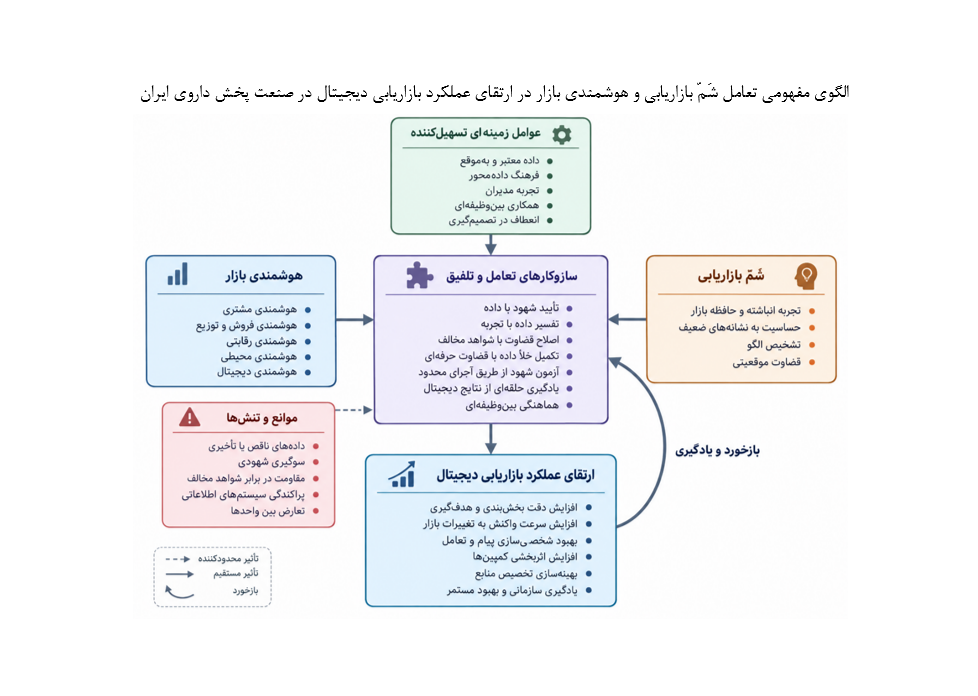
This study aimed to examine and explain how marketing intuition interacts with market intelligence to enhance digital marketing performance in Iran’s pharmaceutical distribution industry. This applied qualitative study employed an exploratory design. Participants included 18 managers and specialists working in marketing, sales, digital marketing, market research, business development, and commercial planning in pharmaceutical distribution companies located in Tehran. Participants were selected through purposive sampling with maximum variation. Data were collected through in-depth semi-structured interviews, and interviewing continued until theoretical saturation was reached. The data were analyzed using thematic analysis with MAXQDA software. Member checking, peer review, constant comparison, and documentation of analytic decisions were employed to enhance credibility and dependability. The analysis yielded 264 initial codes, 96 final codes, 23 subthemes, and six major themes. The major themes were experiential and cognitive foundations of marketing intuition, market-intelligence infrastructures and processes, mechanisms for integrating intuition and market intelligence, facilitating conditions, decision barriers and tensions, and consequences for digital marketing performance. The principal mechanisms of interaction included validating intuition with data, interpreting data through experience, revising judgments in response to contradictory evidence, filling informational gaps with professional judgment, testing intuitive decisions through limited implementation, and learning iteratively from digital outcomes. This interaction was associated with more accurate targeting, faster market response, improved personalization, greater campaign effectiveness, more efficient resource allocation, and stronger organizational learning. The effective integration of marketing intuition and market intelligence represents a dynamic organizational capability through which professional experience and analytical evidence jointly improve the quality and speed of digital marketing decisions. Establishing feedback-based and continuous learning mechanisms can strengthen this synergy in pharmaceutical distribution firms.
Downloads
References
Ahmadnejad, M. (2024). The Role of Marketing in the Pharmaceutical Business Market in Iran. Modern Research Approaches in Management and Accounting, 8(29), 1289-1302. https://www.majournal.ir/index.php/ma/article/view/2749
Alvani, S. M., Hamidizadeh, A., & Boustani Rad, M. (2020). What Are the Components of Human Resource Soft Skills? A Systematic Review. Scientific Quarterly of Skill Training, 9(33), 25-50.
Cao, G., Duan, Y., & El Banna, A. (2019). A Dynamic Capability View of Marketing Analytics: Evidence from UK Firms. Industrial Marketing Management, 76, 72-83. https://doi.org/10.1016/j.indmarman.2018.08.002
Chen, C., Ishfaq, M., Ashraf, F., Sarfaraz, A., & Wang, K. (2022). Mediating Role of Optimism Bias and Risk Perception between Emotional Intelligence and Decision Making. Frontiers in psychology, 13, 914649. https://doi.org/10.3389/fpsyg.2022.914649
Cioppi, M., Curina, I., Francioni, B., & Savelli, E. (2023). Digital Transformation and Marketing: A Systematic and Thematic Literature Review. Italian Journal of Marketing, 2023(1-2), 207-288. https://doi.org/10.1007/s43039-023-00067-2
Creswell, J. W. (2018). Research Design: Qualitative, Quantitative, and Mixed Methods Approaches. SAGE Publications.
Cristofaro, M., Giardino, P. L., Malizia, A. P., & Mastrogiorgio, A. (2022). Affect and Cognition in Managerial Decision Making: A Systematic Literature Review of Neuroscience Evidence. Frontiers in psychology, 13, 762993. https://doi.org/10.3389/fpsyg.2022.762993
Dwivedi, Y. K., Hughes, L., Ismagilova, E., Aarts, G., Coombs, C., Crick, T., Duan, Y., Dwivedi, R., Edwards, J., Eirug, A., Galanos, V., Ilavarasan, P. V., Janssen, M., Jones, P., Kar, A. K., Kizgin, H., Kronemann, B., Lal, B., Lucini, B., . . . Williams, M. D. (2021). Artificial Intelligence (AI): Multidisciplinary Perspectives on Emerging Challenges, Opportunities, and Agenda for Research, Practice, and Policy. International Journal of Information Management, 57, 101994. https://doi.org/10.1016/j.ijinfomgt.2019.08.002
Horani, O. M., Al Adwan, A. S., Al Rahmi, W. M., & Alkhalifah, A. (2026). Enabling Innovation with Big Data Analytics Capabilities: The Moderating Role of Organizational Learning Culture. Data Science and Management, 9, 100158. https://doi.org/10.1016/j.dsm.2025.06.006
Khoshlafz, M. R., Amiri, M., Hasangholipour, T., & Alaei, H. (2022). Identifying the Impact of Behavioral Components on Sales Force Performance with an Emotional Intelligence Development Approach: A Case Study of Refah Chain Stores. Business Management, 14(1), 114-148. https://sid.ir/paper/1032681/fa
Mauro, M., Noto, G., Prenestini, A., & Sarto, F. (2024). Digital Transformation in Healthcare: Assessing the Role of Digital Technologies for Managerial Support Processes. Technological Forecasting and Social Change, 209, 123781. https://doi.org/10.1016/j.techfore.2024.123781
Mehrnia, A. (2023). Examining the Impact of Marketing Skills on Marketing Performance with the Mediating Role of Market Response and the Moderating Role of Competitive Intensity: A Case Study of Goldiran Marketing Personnel. Eighth International and National Conference on Management, Accounting, and Law,
Mohammadzadeh, A., & Sotoudeh Gharabagh, R. (2018). Soft Skills for Students and Graduates of Engineering Disciplines. Iranian Journal of Engineering Education, 20(80), 1-29.
Polakova, M., Suleimanova, J., Madzik, P., Copus, L., Molnarova, I., & Polednova, J. (2023). Soft Skills and Their Importance in the Labour Market under the Conditions of Industry 5.0. Heliyon, 9(4), e18670. https://doi.org/10.1016/j.heliyon.2023.e18670
Rahimpour, A., & Rouhbakhsh, A. (2017). A Study of Skills and Specialized Areas of Marketing Knowledge with a Comparative Approach among Managers, University Professors, and Marketing Students. Educational Scientific-Research Quarterly, 12(52), 113-126.
Stefia, C. M., Haryanto, B., Wahyudi, L., & Setiawan, A. I. (2024). Dynamic Marketing Capabilities and Firm Performance: A Systematic Review of Empirical Literature. Migration Letters, 21(5), 711-716.
Yoo, W. (2024). The Impact of Artificial Intelligence on Marketing Strategies. International Journal of Science and Research Archive, 13(1), 3211-3223. https://doi.org/10.30574/ijsra.2024.13.1.2042
Ziabari, F., & Hajipour, A. (2018). The Effect of Emotional Intelligence on Marketing Effectiveness in Service Organizations. Iranian Business Management Research, 10(3), 45-66.
Downloads
Publication Timeline
- Submitted
- Revised
- Accepted
Issue
Section
License
Copyright (c) 2025 Masoud Tabaeh Emamieh (Author); Mohammad Reza Dalvi; Esmaeil Bagheri (Author)

This work is licensed under a Creative Commons Attribution-NonCommercial 4.0 International License.