Designing a Model to Explain the Role of Social Media and Influencers in Customer Relationship Management and Branding in the Beauty Industry
DOI:
https://doi.org/10.61838/kman.jtesm.536Keywords:
Social media, influencers, customer relationship management, branding, beauty industryAbstract
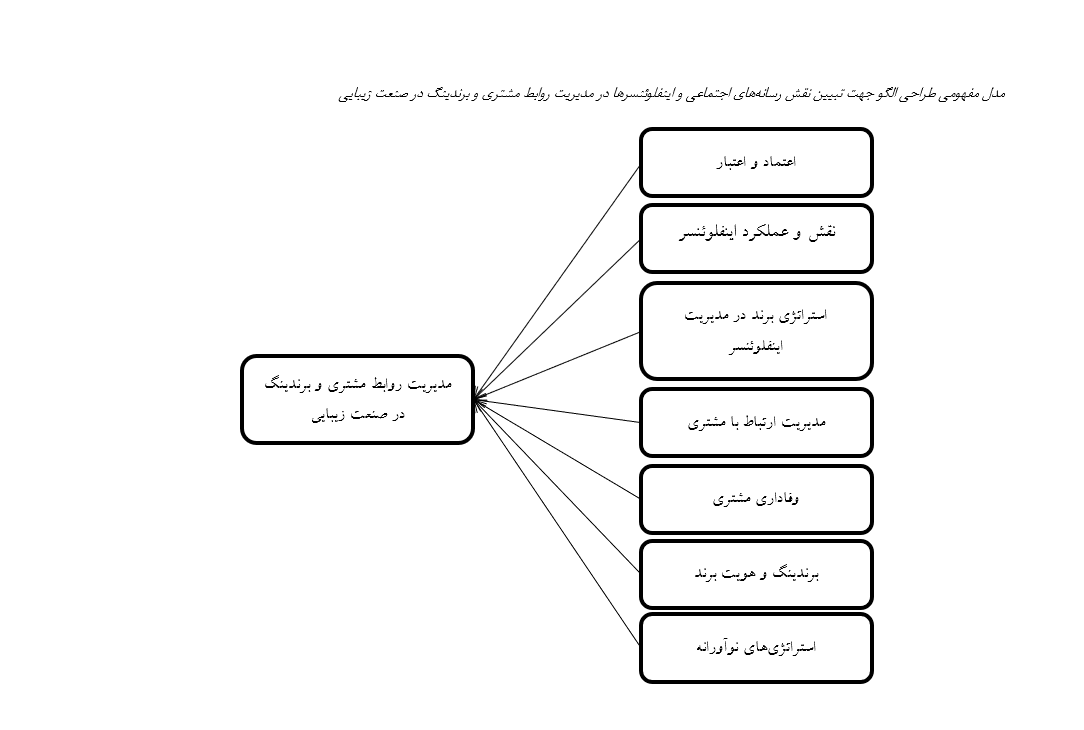
This study aimed to design and validate a model explaining the role of social media and influencers in customer relationship management and branding in the beauty industry. This applied study employed an exploratory mixed-methods design incorporating qualitative and quantitative phases. In the qualitative phase, thematic analysis was conducted following Braun and Clarke’s six-stage approach. Data were collected through semi-structured interviews with 12 theoretical and practical experts in business management, marketing, customer relationship management, and social media, selected through purposive sampling and theoretical judgment. The qualitative analysis identified seven major themes: trust and credibility, influencer role and performance, brand strategy for influencer management, customer relationship management, customer loyalty, branding and brand identity, and innovative strategies. In the quantitative phase, the statistical population consisted of marketing experts, specialists, and managers working in the beauty industry, and 384 participants were included. Data were collected using a questionnaire and analyzed through partial least squares structural equation modeling (PLS-SEM). Convergent and discriminant validity, composite reliability, and Cronbach’s alpha were also assessed and confirmed. Inferential results indicated that all seven structural paths were positive and statistically significant (t>2.58, p<0.01). Customer relationship management demonstrated the strongest effect on customer relationship management and branding (β=0.553), followed by customer loyalty (β=0.542), trust and credibility (β=0.422), influencer role and performance (β=0.369), innovative strategies (β=0.362), brand strategy for influencer management (β=0.308), and branding and brand identity (β=0.267). The model explained 62.1% of the variance in the dependent construct (R²=0.621). The predictive relevance index was Q²=0.390, while the overall goodness-of-fit index was 0.655, indicating strong explanatory and predictive performance. The findings indicate that the effectiveness of social media and influencers in the beauty industry depends on the integrated contribution of relationship-oriented, trust-based, loyalty-building, branding, and innovative mechanisms. Customer relationship management, customer loyalty, and trust and credibility emerged as the most influential dimensions. Accordingly, beauty brands can strengthen their market position by integrating customer relationship management with influencer marketing strategies and developing personalized, credible, and interactive relationships with consumers.
Downloads
References
Abate, Y. A., Ukpabi, D. C., & Karjaluoto, H. (2025). Eco-Influencers: A Cross-Generational Investigation on the Role of Social Media Influencer Marketing on Green Destination Image. Tourism Recreation Research, 1-21. https://doi.org/10.1080/02508281.2025.2450813
Ashrafi, F., Moghar, M., & Shirkhodaei, M. (2025). Influencer Marketing: Developing a Comprehensive Professional Ethics Model for Social Media Influencers. Business Management.
Basalamah, R. A. M., Umayah, A., & Wismiarsi, T. (2025). Effect of Social Media Engagement and Beauty Influencers on Purchase Intentions of Indonesian Beauty Products. JEMSI (Jurnal Ekonomi, Manajemen, Dan Akuntansi), 11(1), 619-629. https://doi.org/10.35870/jemsi.v11i1.3756
Bui, M. T., Ngo, T. H., Pham, M. H., Nguyen, T. T. A., Nguyen, B. C., & Do, M. T. (2025). The Impact of Influencers on the Continuance Buying Decisions on Beauty E-Commerce Platforms. In International Conference on Emerging Challenges: Sustainable Strategies in the Data-driven Economy (ICECH 2024) (pp. 316-331). Atlantis Press. https://doi.org/10.2991/978-94-6463-694-9_22
Ceylan, M., & Hayran, C. (2025). Social Media Influencer Marketing: The Role of Influencer Type, Brand Popularity, and Consumers' Need for Uniqueness. International Journal of Advertising, 1-28. https://doi.org/10.1080/02650487.2024.2449311
Ekinci, Y., Dam, S., & Buckle, G. (2025). The Dark Side of Social Media Influencers: A Research Agenda for Analysing Deceptive Practices and Regulatory Challenges. Psychology & Marketing, 42, 1201-1214. https://doi.org/10.1002/mar.22173
Farrokhi, M., Amiri, Z., & Emadi, P. (2024). The Impact of Congruence between Influencers and Their Audiences on Purchase Intention with the Mediating Role of Customer Citizenship Behavior and Customer Participation Behavior.
Karami, S. (2023). Regulating Social Media Influencers with Emphasis on the Advertising Domain. Interdisciplinary Studies in Media and Culture, 13(2), 237-255.
Lee, J., & Lee, H. K. (2024). Exploring Direct and Indirect Cultural Experiences: A Study of Global Consumers' Hanbok Experience and Engagement Mediated via YouTube. Fashion and Textiles, 11(1), 19. https://doi.org/10.1186/s40691-024-00385-9
Mirshakari, M. A. (2025). The Moderating Role of Parasocial Relationships and the Mediating Effects of Co-Creation Behavior in the Evolutionary Process of the Impact of Congruence between Influencers and Their Audiences on Customer Value Co-Creation Behavior.
Ozay, D., Jahanbakht, M., Shoomal, A., & Wang, S. (2024). Artificial Intelligence (AI)-Based Customer Relationship Management (CRM): A Comprehensive Bibliometric and Systematic Literature Review with Outlook on Future Research. Enterprise Information Systems, 18(7), 2351869. https://doi.org/10.1080/17517575.2024.2351869
Pourdalan, N., Rahimnia, F., Behboudi, O., & Sheikholeslami, Z. (2024). Examining the Impact of Social Media Content Generated by Influencers and Users on the Purchase Intention of Low-Income Customers: Application of the SOR Model. Media Management Reviews, 3(2).
Wang, C. L. (2021). New Frontiers and Future Directions in Interactive Marketing: Inaugural Editorial. Journal of Research in Interactive Marketing. https://doi.org/10.1108/JRIM-03-2021-270
Wulandari, S. H., Ambulani, N., & Astuti, M. T. (2025). Customer Relationship Management Communication Strategy to Increase Customers via Livin' by Mandiri. Jurnal Pustaka Komunikasi, 8(2), 418-428. https://doi.org/10.32509/pustakom.v8i2.5389
Zarei, G., & Akbari Arbatan, G. (2024). Presenting a Model for Sustainable Influencer-Based Marketing in Social Media. New Media Studies, 10(38), 225-260.
Downloads
Publication Timeline
- Submitted
- Revised
- Accepted
Issue
Section
License
Copyright (c) 2025 Zahra Katebi Amiri (Author); Seyyed Vahid Jabbarzade; Shiba Masoumi (Author)

This work is licensed under a Creative Commons Attribution-NonCommercial 4.0 International License.