Designing a Policy Implementation Model for Administrative System Reform under Iran’s Seventh Development Plan in Government Organizations
Keywords:
Administrative System Reform, Policy Implementation, Seventh Development Plan, Network Governance, Change Management, Structural Equation ModelingAbstract
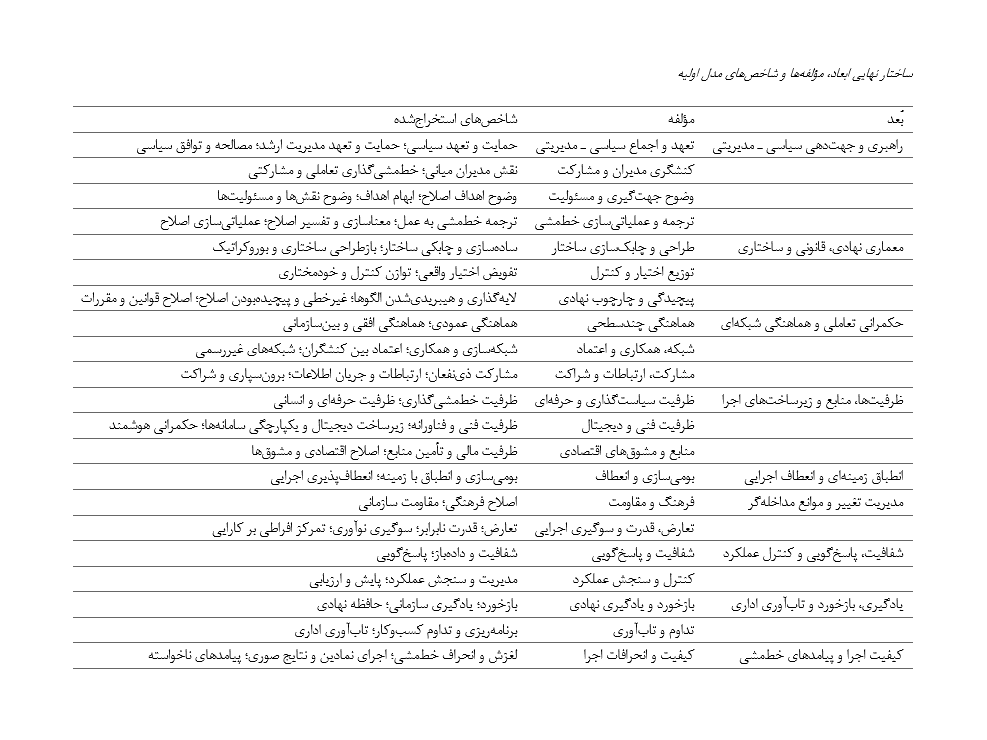
This study aimed to design and validate a policy implementation model for administrative system reform under Iran’s Seventh Development Plan in government organizations. This applied study employed a sequential exploratory mixed-methods design. In the qualitative phase, a meta-synthesis approach was used to review and integrate scientific studies, policy documents, laws, regulations, and other relevant sources on administrative reform and policy implementation, through which the main concepts, components, and dimensions of the model were identified. In the quantitative phase, the resulting conceptual model was tested using a researcher-developed 45-item questionnaire administered to managers, senior experts, and officials involved in administrative reform in government organizations in West Azerbaijan Province. The minimum sample size was estimated at 382 using Cochran’s formula. Data were analyzed through partial least squares structural equation modeling using SmartPLS 4. Convergent and discriminant validity, construct reliability, coefficients of determination, effect sizes, multicollinearity, and structural path coefficients were assessed. All factor loadings exceeded 0.826. Cronbach’s alpha ranged from 0.877 to 0.939, composite reliability from 0.922 to 0.950, and AVE from 0.725 to 0.813. All 17 hypotheses were supported. Political-managerial leadership significantly affected institutional architecture (β=0.514, p<0.001), while institutional architecture significantly influenced implementation capacities (β=0.398, p<0.001). Transparency and performance control had the strongest effect on organizational learning and administrative resilience (β=0.572, p<0.001). Intervening barriers negatively affected implementation quality (β=-0.209, p<0.001), whereas change management exerted a positive effect (β=0.235, p<0.001). Contextual fit also significantly strengthened the effects of implementation capacities and network governance on implementation quality. Successful implementation of administrative reform under the Seventh Development Plan requires coherent interaction among political-managerial leadership, institutional architecture, implementation capacities, network governance, transparency, organizational learning, change management, and contextual adaptation; therefore, the proposed model can provide an integrated framework for guiding and evaluating administrative reform implementation in government organizations.
Downloads
References
Babaei, S., Vaezi, R., Pourezzat, A. A., & Hosseinpour, D. (2023). A Model of Iranian Administrative System Based on Academic and Professional Experts' Outlook. Management and Development Process, 35(4), 3-38. https://doi.org/10.61186/jmdp.35.4.3
Barabashev, A., & Klimenko, A. (2023). Administrative and Civil Service Reforms in Russia: Recent Trends at the Time of Turbulence. Вопросы государственного и муниципального управления(6), 44-61. https://doi.org/10.17323/1999-5431-2023-0-6-44-61
Barsoum, G. (2025). "Not Like Father, Like Son": Public Sector Employment Reforms in Egypt. Review of Public Personnel Administration, 45(3), 589-609. https://doi.org/10.1177/0734371X241227406
Bawole, J. N., & Langnel, Z. (2023). Administrative Reforms in the Ghanaian Public Services for Government Business Continuity During the COVID-19 Crisis. Public Organization Review, 23(1), 181-196. https://doi.org/10.1007/s11115-022-00687-w
Bayati, M. A., Givaki, E., Moeinoddini, J., Anjom Shoa, Z., & Nikpour, A. (2024). A Public Policy Implementation Model with a Social and Ethical Responsibility Approach for Administrative System Reform. Ethics in Science and Technology, 19(7), 109-115.
Cohen, N. (2023). Public Administration Reform and Political Will in Cases of Political Instability: Insights from the Israeli Experience. Public Policy and Administration, 38(4), 405-423. https://doi.org/10.1177/09520767221076059
Crabolu, G., Font, X., & Eker, S. (2023). Evaluating Policy Complexity with Causal Loop Diagrams. Annals of Tourism Research, 100(11), 103572. https://doi.org/10.1016/j.annals.2023.103572
Cuffe, H. (2025). Knowledge Brokering for Public Sector Reform. Australian Journal of Public Administration, 84(1), 184-189. https://doi.org/10.1111/1467-8500.12665
Danaeefard, H. (2023). Editorial: The Challenges of Our Country: Can These Challenges Be Solved? Organizational Resource Management Research, 13(3), 1-20.
Elliott, I. C., Puppim de Oliveira, J. A., & Wu, A. M. (2024). Public Administration and Development in (Historical) Perspective. Public Administration and Development, 44(4), 298-314. https://doi.org/10.1002/pad.2052
Fan, L., Tang, T., & Yang, G. (2023). Administrative Reform and the Disposal of Zombie Enterprises: Evidence from China. Small Business Economics, 61(4), 1845-1869. https://doi.org/10.1007/s11187-023-00752-8
Galego, D., & Nieto-Morales, F. (2024). Navigating Public Administration Reforms and Democracy: Toward a Neo-Weberian State in Mexico. Journal of Policy Studies, 39(2), 37-49. https://doi.org/10.52372/jps39204
Goldfinch, S., & Halligan, J. (2024). Reform, Hybridization, and Revival: The Status of New Public Management in Australia and New Zealand. Public Management Review, 26(9), 2542-2560. https://doi.org/10.1080/14719037.2024.2329770
Goldfinch, S. F. (2023). The Challenge of Public Administration Reform: Introduction to the Handbook of Public Administration Reform. In Handbook of Public Administration Reform (pp. 1-26). Edward Elgar Publishing. https://doi.org/10.4337/9781800376748.00005
Hysi, A., Avdulaj, J., Shahini, E., Goga, I., & Shahini, E. (2024). Role of Legal Regulation in the Establishment and Development of the Public Administration System with Local Self-Government Aspects. Social and Legal Studios, 7(1), 27-36. https://doi.org/10.32518/sals1.2024.27
Inkina, S. (2023). Comparative Administrative Reforms. In Global Encyclopedia of Public Administration, Public Policy, and Governance (pp. 1942-1949). Springer International Publishing. https://doi.org/10.1007/978-3-030-66252-3_1276
Iroulo, L. C., & Boateng, O. A. (2023). Bureaucratic Acquiescence as an Institutional Strategy in the African Union. African and Asian Studies, 22(1-2), 113-134. https://doi.org/10.1163/15692108-12341583
Johnston, K. (2023). New Public Service Bargain: Time for Paradigm Shift in Turbulent Times? Transylvanian Review of Administrative Sciences, 19(SI), 85-100. https://doi.org/10.24193/tras.SI2023.5
Kaviani, H., & Ghafrani, F. (2023). Administrative System and Development Management in Iran: Assessing Bureaucratic Readiness and Quality on the Eve of the Seventh Development Plan [Report e19040].
Khozhylo, M. E. (2025). Transformation of the Modern Scientific Concept of Public Administration Based on the Principles of "Green Transformation": Analysis of the Current State. In. Publishing House "Baltija Publishing". https://doi.org/10.30525/978-9934-26-571-6-26
Krogh, A. H., & Triantafillou, P. (2024). Developing New Public Governance as a Public Management Reform Model. Public Management Review, 26(10), 3040-3056. https://doi.org/10.1080/14719037.2024.2313539
Kuhlmann, S. (2023). From Weberian Bureaucracy to Digital Government? Trajectories of Administrative Reform in Germany. In Handbook of Public Administration Reform (pp. 207-226). Edward Elgar Publishing. https://doi.org/10.4337/9781800376748.00016
Law of the Seventh Five-Year Progress Plan of the Islamic Republic of Iran, (2024). https://rc.majlis.ir/fa/law/show/1809128
Liu, T., Wu, H., Zheng, Y., & Cui, Z. (2025). Reform of the Administrative Approval System, Regional Financial Development, and Corporate Performance: An Exploration of a Market-Oriented Governance Mechanism. Finance Research Letters, 80, 107373. https://doi.org/10.1016/j.frl.2025.107373
Maleki, M., & Afrasiabi, H. (2024). Dynamics of the Administrative System in Iran: Country Challenges Dynamics Report Series (10) [Report e20187].
Martínez Guzmán, J. P., Jordan, M. M., & Joyce, P. G. (2024). Towards Inclusive Public Administration Systems: Public Budgeting from the Perspective of Critical Race Theory. Public Administration, 102(3), 797-814. https://doi.org/10.1111/padm.12956
Mattarella, B. G. (2025). The Administrative Reform Trajectory in Italy: 1993-2023. In Public Administration in Italy in Political and Historical Context: The Craft of the Italian State (pp. 95-111). Springer Nature Switzerland. https://doi.org/10.1007/978-3-031-74615-4_6
Men, S., Aimimtham, S., Chamruspanth, V., Nurmandi, A., Sohsan, I., Lawelai, H., & Younus, M. (2025). From Centralization to Decentralization: Organizational Restructuring Within a Legislative Context in the Public Sector. Corporate Law & Governance Review, 7(1). https://doi.org/10.22495/clgrv7i1p8
Mozaffari, N., Vaezi, R., & Koushki Jahromi, A. (2024). Identifying Challenges in the Selection and Appointment of Managers in Iran's Administrative System: A Case Study of the Administrative and Recruitment Organization. Human Resources Studies, 14(1), 64-84.
Nakrošis, V., Dan, S., & Goštautaitė, R. (2023). The Role of EU Funding in EU Member States: Building Administrative Capacity to Advance Administrative Reforms. International Journal of Public Sector Management, 36(1), 1-19. https://doi.org/10.1108/IJPSM-01-2022-0008
Obong'o, S. O. (2025). Political Influence, Appointments and Public Sector Management Reform in Kenya, 1963-2014 [Doctoral dissertation, Open Research Newcastle].
Ongaro, E., Di Mascio, F., Melis, G., & Natalini, A. (2023). Reforming Public Administration in Italy: Continuity and Change from 1861 to 2020. In Handbook of Public Administration Reform (pp. 227-246). Edward Elgar Publishing. https://doi.org/10.4337/9781800376748.00017
Othman, M. H., Razali, R., & Nasrudin, M. F. (2025). Towards Integrated E-Government Services: Key Contributing Factors from a Whole-of-Government Perspective. Journal of Applied Science, Engineering, Technology, and Education, 7(1), 102-113. https://doi.org/10.35877/454RI.asci3800
Ranji Jafroudi, N. (2023). A Foresight Approach to Formulating the Seventh Development Plan. Foresight of the Islamic Revolution, 4(2), 131-151. https://fsir.ihu.ac.ir/article_208424.html
Sader, S., Mohebbi, S., & Soltani, H. (2025). Presenting an Organizational Smartification Model Focused on Administrative System Reform in Government Organizations. Development and Resource Management Studies, 3(10), 1-10.
Salehi, M., & Koshtegar, A. (2023). Examining and Explaining the Challenges of Administrative Systems in the Third World. Development and Resource Management Studies, 3(1), 39-64.
Secchi, L., Caeiro, J. C., Ramos Pinto, R., & Arenilla Sáez, M. (2024). Administrative Reforms in Portugal and Spain: From Bureaucracy to Digital Transition. International Review of Administrative Sciences. https://doi.org/10.1177/00208523241250314
Shahraini, S. M., Amiri, M., Gholipour Souteh, R., Mirbagheri, S. M., & Babaei Mojarad, H. (2024). Challenges Facing Administrative Reform Programs in Iran with a Focus on Structural Reform. Strategic Management Thought, 18(2).
Tambun, A. O., Nasution, H., & Simanjuntak, R. C. (2025). Optimization of Government Administration Reform: SWOT Analysis of Electronic Land Certificate Implementation through Keyword Visualization Identification. Journal La Sociale, 6(1), 199-213. https://doi.org/10.37899/journal-la-sociale.v6i1.1808
Tomaževič, N., Kovač, P., Ravšelj, D., Umek, L., Babaoğlu, C., Bohatá, M., Hirsch, B., Kulaç, O., Nurlybaeva, G. K., Schäfer, F. S., & Aristovnik, A. (2023). The Role of Agile Values in Enhancing Good Governance in Public Administration during the COVID-19 Crisis: An International Survey. Administrative Sciences, 13(12), 248. https://doi.org/10.3390/admsci13120248
Zhang, Y., & Liu, J. Z. (2025). The Rise of the Chinese Judiciary and Its Limits: Administrative Litigation in the Reform Period. The China Quarterly, 262, 330-351. https://doi.org/10.1017/S0305741025000311
Downloads
Publication Timeline
- Submitted
- Revised
- Accepted
Issue
Section
License
Copyright (c) 2025 Iraj Monjezi (Author); Mahrokh Lotfollahi Haghi; Rasoul Ranjbarian, Reza Rostam Zadeh (Author)

This work is licensed under a Creative Commons Attribution-NonCommercial 4.0 International License.