Identification and Prioritization of Factors Affecting the Commercialization Strategy of Nanotechnology-Based Products in Iranian Industries
Keywords:
Technology commercialization, nanotechnology, marketing strategy, structural equation modeling, relative weight of predictorsAbstract
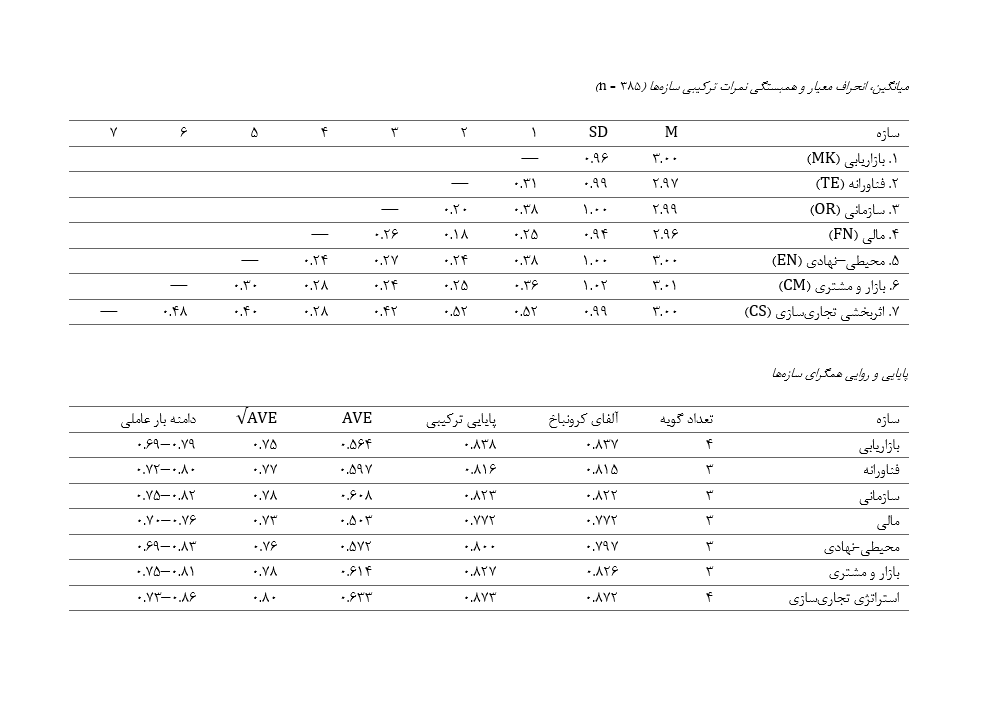
This study aimed to develop and empirically test a conceptual model for identifying the factors associated with the effectiveness of commercialization strategies for nanotechnology-based products in Iranian industries and to determine the relative priority of these factors. This applied quantitative study employed a cross-sectional survey design. Data were collected from 385 questionnaires comprising 23 items rated on a five-point Likert scale and measuring six predictor constructs—marketing capabilities and strategies, technological capabilities and advantages, organizational and managerial capabilities, financial and economic resources, environmental and institutional conditions, and market and customer factors—along with commercialization strategy effectiveness as the outcome construct. The measurement model was evaluated using confirmatory factor analysis, while the structural relationships were examined through latent-variable structural equation modeling with maximum likelihood estimation. Bootstrap procedures and regression analysis based on composite scores were used to assess the robustness of the findings, and Johnson’s relative weights analysis was employed to determine the relative contribution of the predictors. The structural model explained 64.1% of the variance in commercialization strategy effectiveness. Technological capability had the strongest positive and significant effect (β=0.383), followed by market and customer factors (β=0.239), marketing capabilities (β=0.215), and organizational and managerial capabilities (β=0.189). The environmental–institutional dimension did not show a significant effect in the latent-variable model (β=0.103), although it became significant in the composite-score analysis, whereas the direct effect of financial and economic factors was not significant (β=0.009). Relative weights analysis showed that technological factors accounted for 29.8% of the explained variance, followed by marketing (21.5%), market and customer factors (20.0%), organizational factors (13.9%), environmental–institutional factors (11.0%), and financial factors (3.8%). The effectiveness of nanotechnology commercialization strategies is primarily associated with technological strength, marketing capabilities, and market and customer conditions; therefore, firms should prioritize technological maturity and demonstrable product advantages alongside market-oriented capabilities and customer responsiveness, while recognizing that financial resources alone may not directly ensure commercialization effectiveness.
Downloads
References
Aithal, P. S., & Aithal, S. (2016). A New Model for Commercialization of Nanotechnology Products and Services. International Journal of Computational Research and Development, 1(1), 84-93.
Arikpo, S., & Musta'amal, A. (2025). Stakeholders' Perspectives on Vocational Education Commercialization in Malaysia. Innovations in Pedagogy and Technology, 1(2), 110-125. https://doi.org/10.63385/ipt.v1i2.89
Benn, T. M., & Westerhoff, P. (2008). Nanoparticle silver released into water from commercially available sock fabrics. Environmental science & technology, 42(11), 4133-4139.
Borzouei, H., Mirdamadi, S. M., & Hosseini, S. J. F. (2011). Affective factors in commercialization of nanotechnology in Iran's agricultural sector. Scholars Research Library, Annals of Biological Research, 2(6), 56-61. https://www.scholarsresearchlibrary.com/articles/affective-factors-in-commercialization-of-nanotechnology-in-irans-agricultural-sector.pdf
Bui, H., Vu, X. T. M., & Tran, A. D. (2025). The Moderating Role of Emotional Intelligence in the Relationship Between Transformational Leadership, Organizational Citizenship Behavior, Innovative Work Behavior, and Employee Performance in Commercial Banks in Vietnam. Human Systems Management, 45(3), 359-378. https://doi.org/10.1177/01672533251369706
Dzakiy, U. N., Matsuura, Y., Simatupang, T. M., & Prasetio, E. A. (2024). Practical model of technology commercialisation at an Indonesian University: A case study from Institut Teknologi Bandung. Journal of Open Innovation: Technology, Market, and Complexity, 10(3), 100341. https://doi.org/10.1016/j.joitmc.2024.100341
Eslamloo, F., Brown, K., & Amrollahi Biyouki, Z. (2025). Successful commercialisation in startup accelerator programmes: How different startup ecosystems matter. Journal of Innovation & Knowledge, 10(3), 100688. https://doi.org/10.1016/j.jik.2025.100688
Fallah Tabar Malekshah, R., Delafrooz, N., Shahroudi, K., & Shabgoo Monsef, S. M. (2024). Designing a Business Commercialization Model for Iran's Air Navigation Industry Services. Innovation Management in Defense Organizations, 7(3), 45-72. https://doi.org/10.22034/qjimdo.2024.440591.1659
Hosseini, S. M., & Emamifar, S. N. (2025). Transformation of Audience Perception in Commercial Advertising with Emphasis on the Role of Digital Technologies. Digital Transformation and Administration Innovation, 1-11. https://doi.org/10.61838/dtai.182
Jacobides, J., Knudsen, & Augier. (2016). Market Challenges Facing Academic Research in Commercializing Nano-Enabled Implantable Devices for In-Vivo Biomedical Analysis. Technovation, 32, 193-204.
Karimi, S., & Hadi, M. (2024). Innovations of the New Commercial Bill in General Contract Rules: Challenges and Opportunities. Judgment, 24(118), 70-91.
Khramova, K., Shymoshenko, A., & Reshetniak, Y. (2024). Commercialization of Innovations in Ukrainian Book Publishing: Current Trends and Prospects. Vìsnik Sumsʹkogo Deržavnogo Unìversitetu, 2024(2), 7-17. https://doi.org/10.21272/1817-9215.2024.2-01
Kiyambade, M., Kagere, R., & Namatovu, A. (2024). Technological Innovation and Commercial Banks' Financial Performance: A Mediation Analysis of Risk Management Practices. Seisense Business Review, 4(1), 98-117. https://doi.org/10.33215/bb6wrs68
Marampa, A. M., Pongtuluran, A. K., & Pariyanti, E. (2025). From Sharing to Success: Enhancing Innovative Work Behavior through Psychological Empowerment and Kinship Employee Engagement. Industrial and Commercial Training, 57(1), 99-117. https://doi.org/10.1108/ICT-07-2024-0064
Mbuthia, P. M., & Datche, E. A. (2023). Strategic Technological Innovations and Performance of Commercial Banks in Kenya. strategicjournals.com, 10(2). https://doi.org/10.61426/sjbcm.v10i2.2650
Nabipour Afrouzi, M., Yazdanjo, M., Aliakbarnia Omran, M., & Kaveh, M. (2023). The impact of banking innovations on the financial performance of commercial banks. Management and Accounting in the Third Millennium(27), 112-130.
Olawore, A. S., Wong, K. Y., Ma'aram, A., & Sutopo, W. (2023). Prioritization of Technology Commercialization Success Factors Using Fuzzy Best Worst Method. Journal of Open Innovation: Technology, Market, and Complexity, 100096. https://doi.org/10.1016/j.joitmc.2023.100096
Pujotomo, D., Ma'aram, A., Ikmal Isyraf, M., Helmi Syed Hassan, S. A., & Sutopo, W. (2025). The scenario of accelerating technology commercialization at research university, a system dynamics approach. Journal of Open Innovation: Technology, Market, and Complexity, 11(1), 100497. https://doi.org/10.1016/j.joitmc.2025.100497
Safa, L., Hejazi, S. Y., Hosseini, S. M., & Rezvanfar, A. (2013). Designing a Model for Measuring Indicators of Nanotechnology Commercialization in Iran's Agricultural Sector. Entrepreneurship Development Quarterly, 6(2), 175. https://jed.ut.ac.ir/article_36264.html
Tam, P. T. (2025). Impacting innovation culture on fintech development and financial stability at commercial banks in Vietnam. Journal of Corporate Accounting & Social Change, 2442-2456. https://doi.org/10.64753/jcasc.v10i4.3275
Zahra, T. (2024). Role of Office of Research Innovation and Commercialization in Promotion of Research and Development in Degree Awarding Institutes of Pakistan. Journal of Fatima Jinnah Medical University, 18(01), 1-2. https://doi.org/10.37018/jfjmu/701
Downloads
Publication Timeline
- Submitted
- Revised
- Accepted
Issue
Section
License
Copyright (c) 2025 Kamal Ghalandari

This work is licensed under a Creative Commons Attribution-NonCommercial 4.0 International License.