Designing a Paradigmatic Model for Artificial Intelligence Application in the Export of Electronic Industry Products
Keywords:
Artificial Intelligence, Export, Electronic Industry, Paradigmatic Model, Smart Decision-MakingAbstract
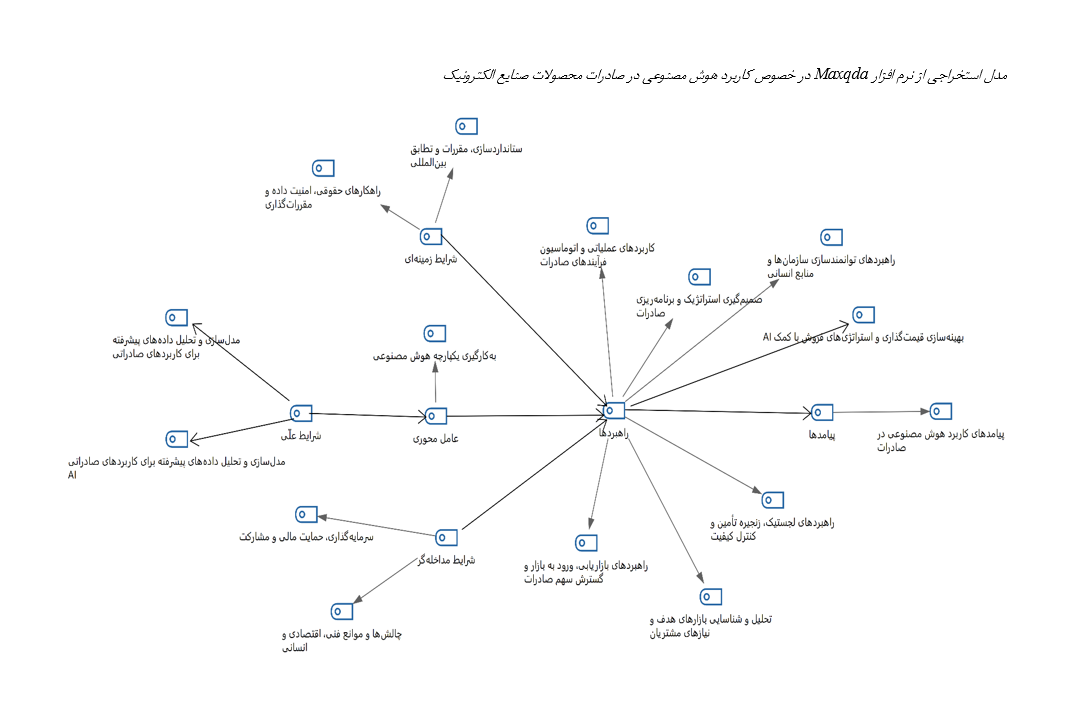
This study aimed to design a paradigmatic model for the application of artificial intelligence to enhance the export of Iranian electronic industry products. This applied qualitative study employed a grounded theory approach. Data were collected through semi-structured interviews with 16 experts, managers, and specialists in the electronic industry and smart technologies. Participants were selected using purposive sampling based on the principle of theoretical saturation. Interviews were transcribed verbatim, and data were analyzed using a three-stage coding process: open, axial, and selective coding. This approach enabled the identification of relationships among categories and the development of a comprehensive paradigmatic model. The analysis revealed that the application of artificial intelligence in the export of Iranian electronic products comprises five main dimensions: causal conditions, contextual conditions, intervening conditions, strategies, and outcomes. Causal conditions included global competitive pressure, changing demand patterns, and technological sanctions. Contextual conditions involved digital infrastructure, facilitating trade regulations, and international standards. Intervening conditions were identified as financial constraints, lack of specialized knowledge, and cultural resistance. Strategies encompassed data-driven market analysis, demand forecasting with AI algorithms, smart logistics optimization, digital marketing, and algorithmic decision-making. Outcomes included improved operational efficiency, enhanced decision accuracy, cost reduction, and sustainable competitive advantage in international markets. The proposed paradigmatic model clarifies the path toward digital transformation and intelligent decision-making in the export of electronic industry products in Iran. It provides a practical roadmap for exporters seeking to implement AI-driven strategies and optimize export performance effectively.
Downloads
References
Akbar, M. B., Ibrahim, I., Nabil, S. J., Iqbal, K. A., & Islam, A. K. M. S. (2024). The Influence of Artificial Intelligence on Consumer Trust in E-Commerce: Opportunities and Ethical Challenges. European Journal of Theoretical and Applied Sciences, 2(6), 250-259. https://doi.org/10.59324/ejtas.2024.2(6).20
Al-Moghrabi, K. G. (2024). Harnessing the Power of Blockchain Technology to Support Decision-Making in E-Commerce Processes. Iaes International Journal of Artificial Intelligence (Ij-Ai), 13(2), 1380. https://doi.org/10.11591/ijai.v13.i2.pp1380-1387
Arora, R. (2024). Bridging the Gap Between Offline and Online Presence in E-Commerce: The Role of Artificial Intelligence. Interantional Journal of Scientific Research in Engineering and Management, 08(12), 1-6. https://doi.org/10.55041/ijsrem33002
Asgarpour, E., Kashmiri Haq, M. A., & Pourvoli Aliyar, N. (2022). Artificial Intelligence as a Driver of Knowledge-Based Businesses and Resistant Economy: Businesses Based on Machine Learning and Deep Learning Applications in Digital Marketing and Consumer Behavior Prediction Fourth National Conference on Knowledge Management and E-Business with a Focus on Resistant Economy.
Catanzaro, A., & Teyssier, S. (2021). Resource based view and export performance: Systematic review and new insights. Journal of World Business, 56(4), 101127. https://doi.org/10.1016/j.jwb.2020.101127
Cheng, J. (2023). Innovation of Fresh Agricultural Products E-Commerce Operation Mode Based on Artificial Intelligence and Machine Learning Model. Applied Mathematics and Nonlinear Sciences, 9(1). https://doi.org/10.2478/amns.2023.2.00528
Faryabi, M., Rahimi Aqdam, S., Ebrahimi, V., & Kazemi, S. (2021). Examining the Impact of Organizational, Strategic, and Environmental Factors on Export Performance; Analyzing the Role of Innovative Exports Among Exporting Companies. International Business Management, 4(2), 63-86. https://jiba.tabrizu.ac.ir/article_13035.html
Giang, N. T. P., Hung, D. M., Huong, T. T., Quyên, H. T. T., Thơm, N. T., Tran, T. B., & Dong, T. T. (2025). Researching User Experience With Artificial Intelligence Application for Customer Care Services on E-Commerce Platform. Jurnal Ekonomi Perusahaan, 31(2), 149-174. https://doi.org/10.46806/jep.v31i2.1319
Kráľ, Š., Fedorko, R., & Štofejová, L. (2024). The Importance of Artificial Intelligence in the E-Commerce Process. 349-359. https://doi.org/10.34135/mmidentity-2024-36
Nazarian-Jashnabadi, J., Ronaghi, M., alimohammadlu, m., & Ebrahimi, A. (2023). The framework of factors affecting the maturity of business intelligence. Business Intelligence Management Studies, 12(46), 1-39. https://doi.org/10.22054/ims.2023.74305.2346
Radha, D. S. (2025). Role of Artificial Intelligence in Shaping Consumer Experience and Loyalty in Fashion E-Commerce. Interantional Journal of Scientific Research in Engineering and Management, 09(04), 1-9. https://doi.org/10.55041/ijsrem44114
Rahimi Kalor, H., & Mohammadi Khani, R. (2024). Designing a Model for the Impacts of Artificial Intelligence and Machine Learning Applications in Advertising and Sales. Studies in Smart Business Management, 12(48), 223-270. https://ims.atu.ac.ir/article_17446.html
Rezaei, M. (2023). The Role of Artificial Intelligence in E-Commerce: Current Status and Future Research Agenda Seventh National Conference on Interdisciplinary Research in Engineering Sciences and Management. Tehran.
Turatti, R. C. (2025). Application of artificial intelligence in forecasting consumer behavior and trends in E-commerce. Brazilian Journal of Development, 11(3), e78442-e78442. https://doi.org/10.34117/bjdv11n3-039

Downloads
Published
Submitted
Revised
Accepted
Issue
Section
License
Copyright (c) 2025 Abolfazl Zolghadr (Author); Soheil Sarmad saeedi; Behrooz Ghasemi (Author)

This work is licensed under a Creative Commons Attribution-NonCommercial 4.0 International License.