Validation of an Oil Products Marketing Model under Sanctions for Target Market Development in a Petrochemical Trading Company
Keywords:
Marketing, petroleum products, sanctions, market development, structural equation modelingAbstract
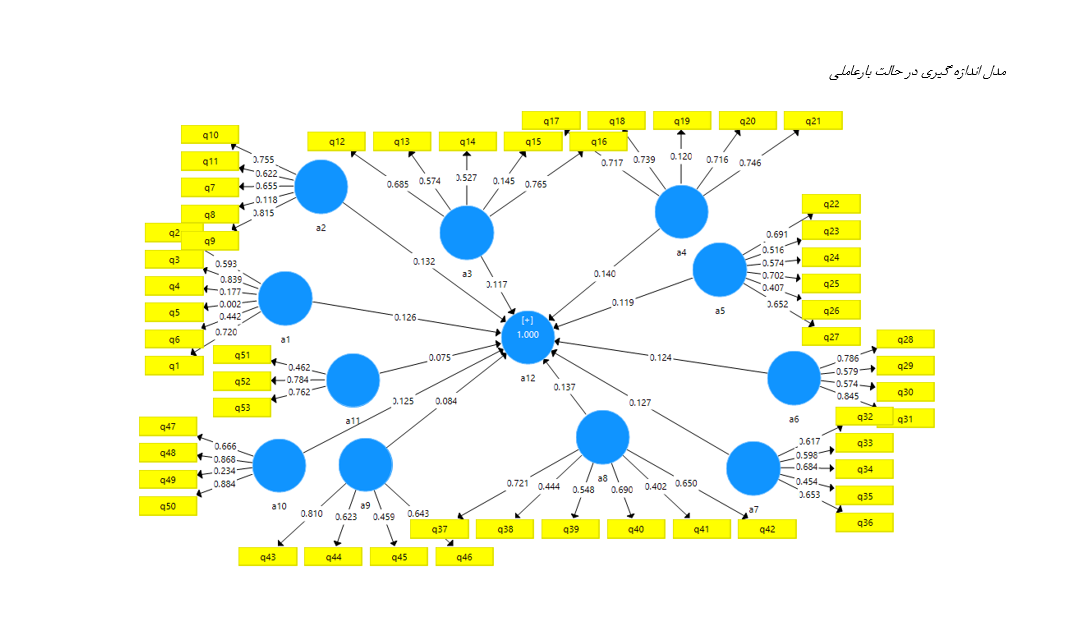
Iran has faced extensive oil and non-oil sanctions over recent decades, conditions that have significantly impacted the export, pricing, and marketing networks of oil products. Therefore, designing an efficient marketing model under sanctions represents a strategic necessity for the continuity and sustainability of the national economy. The present study was conducted using a mixed-methods (qualitative–quantitative) approach. In the qualitative phase, employing Sandelowski and Barroso’s (2007) meta-synthesis method, 32 published articles from 2014 to 2024 were analyzed, resulting in 53 key themes categorized into 11 main domains: strategies and tactics, contracts and transactions, refineries and storage facilities, market and pricing, relationships and diplomacy, risk coverage and security, sales and exchange, customers and new markets, exports and global markets, projects and investments, and refining and extraction technology. Based on the qualitative results, a questionnaire was developed and distributed among 151 employees of the petrochemical trading company using stratified random sampling. The data were analyzed using structural equation modeling (SEM) and the SMARTPLS software. The results indicated that the proposed conceptual model had good fit, and all study variables demonstrated acceptable validity and reliability. Ultimately, this research provides a comprehensive model for marketing oil products under sanctions and offers practical guidance for managers in the oil and petrochemical industry, as well as economic policymakers, in developing strategies to counter international restrictions and expand target markets.
Downloads
References
Ahmadi, S., & Karimi, F. (2025). Innovative marketing models for petroleum products in sanctioned environments. Journal of Industrial Marketing Research, 7(1), 12-30.
Asarian, A. M., Mehrani, D. A. P., & Moradi, H. (2023). Development of a Native Social Media Marketing Model for E-commerce Stores with a Mixed Approach. Scientific-Research Quarterly of Entrepreneurship Development, 16(1), 93-107. https://journals.ut.ac.ir/article_93243.html
Bafghi, P., Ahmadi Sharif, M., & Nematizadeh, S. (2023). Presentation of an Entrepreneurial Marketing Model for Startups Using a Meta-Analytic Method. Advertising and Sales Management, 4(2), 181-197. https://doi.org/10.52547/jabm.3.2.13432
Barton, B., Zlatevska, N., & Oppewal, H. (2022). Scarcity tactics in marketing: A meta-analysis of product scarcity effects on consumer purchase intentions. Journal of Retailing, 98(4), 741-758. https://doi.org/10.1016/j.jretai.2022.06.003
Faiz, D., Ali Pour, S., & Asghari Najib, M. (2022). Designing an International Marketing Development Model for the Country Under Sanctions. Scientific-Research Journal of International Business Management, 5(3), 95-113. https://doi.org/10.22034/jiba.2022.50743.1860
Habibi, M., Kheiri, B., & Aligholi, M. (2023). Presentation of an Integrated Marketing Mix Model Based on Industrial Customer Behavior (Case Study: Baharan Oil Company). Consumer Behavior Studies, 10(2), 1-20. https://doi.org/10.34785/j018.2023.002
Jayadeva, S. M., Al Ayub Ahmed, A., Malik, R., Shaikh, A. A., Siddique, M. N. E. A., & Naved, M. (2022). Roles of cloud computing and Internet of Things in marketing management: A critical review and future trends. Proceedings of Second International Conference in Mechanical and Energy Technology: ICMET 2021, India,
Lazaar, F., Khodayari, F., & Yazdani. (2024). Presentation of an Inbound Marketing Model with a Meta-Analytic Approach. Business Management. https://jibm.ut.ac.ir/article_97337_cd44ed6410c56167963eea28c328c42f.pdf
Lopez, M., & Chen, D. (2025). Adaptive marketing models in the oil industry facing economic sanctions. Journal of International Energy Marketing, 9(1), 55-72. https://doi.org/10.5678/jiem.2025.09.01.55
Manneh, M. (2020). Retail marketing of imported petroleum products: Evidence from the downstream petroleum sector of the Gambia. European Journal of Business and Management Research, 5(4). https://www.ejbmr.org/index.php/ejbmr/article/view/365
Najafpour, H., Shirkhodaie, M., Aghajani, H., & Soltanzadeh, J. (2023). Policy Inhibitors of Petrochemical Product Export Development. Business Management and Finance Open Access Journal, 2(2), 113-128. https://sspp.iranjournals.ir/article_709039.html
Rasouli-Amirabadi, M., & Nourouzi, M. (2021). Identification and Prioritization of International Marketing Strategies for Iranian Crude Oil Under Sanctions. Strategic Studies of public policy, 38(11), 135-153. https://www.noormags.ir/view/en/articlepage/1794060
Sari, A. (2022). Penerapan E-Marketing menggunakan model Oohdm dan strategi marketing 7P (Studi Kasus: Sudden Inc). Jurnal Teknologi Dan Sistem Informasi, 3(4), 80-85. https://www.sid.ir/fa/journal/SearchPaperlight.aspx?str=%D8%A2%D9%85%DB%8C%D8%AE%D8%AA%D9%87%20%D8%A8%D8%A7%D8%B2%D8%A7%D8%B1%DB%8C%D8%A7%D8%A8%DB%8C%20(7P)
Spiro, D. (2025). Assessing the impacts of oil sanctions on Russia. Energy Economics. https://doi.org/10.2139/ssrn.5071223
Xiao, Y., Zhu, Y., He, W., & Huang, M. (2023). Influence prediction model for marketing campaigns on e-commerce platforms. Expert Systems with Applications. https://doi.org/10.1016/j.eswa.2022.118575
Yavari, A., Qareh Beiglou, H., Alavi Matin, Y., & Faqhi Farahmand, N. (2023). A Green Marketing Model for the Oil Industry Based on General Environmental Policies. Strategic and Macro Policies, 11(44). https://www.jmsp.ir/article_169910.html

Downloads
Published
Submitted
Revised
Accepted
Issue
Section
License
Copyright (c) 2025 Ahmadreza Saffary (Author); Alireza Nobari; Alireza Afsharnejad, Maryam Majidi (Author)

This work is licensed under a Creative Commons Attribution-NonCommercial 4.0 International License.