Providing a Paradigmatic Model of Entrepreneurial Orientation in Knowledge-Based Firms
Keywords:
Entrepreneurial orientation, knowledge-based firms, entrepreneurshipAbstract
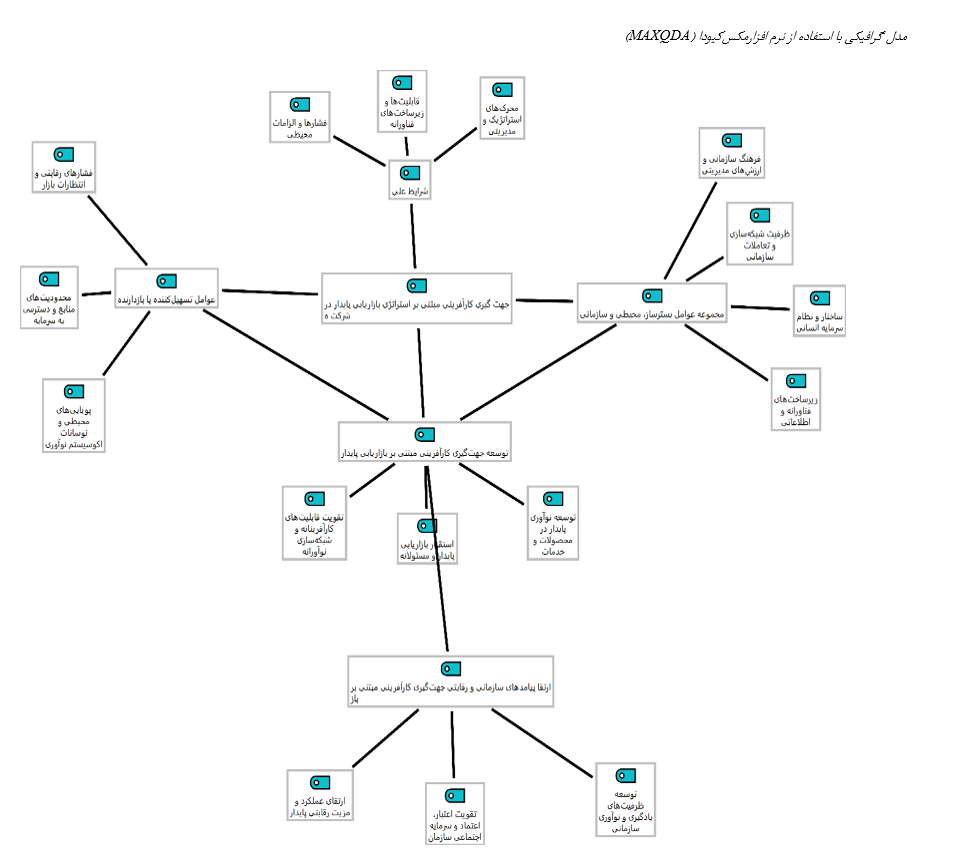
The purpose of this study was to develop a paradigmatic model of entrepreneurial orientation in knowledge-based firms with an emphasis on sustainable marketing strategies and to identify the causal, contextual, intervening, strategic, and consequential factors associated with this phenomenon. This study was applied in terms of purpose and employed a qualitative grounded theory methodology. The study population consisted of experts and managers of knowledge-based firms holding master’s or doctoral degrees with at least ten years of managerial experience. Purposeful sampling was used, and interviews continued until theoretical saturation was achieved. A total of 15 semi-structured interviews were conducted, and the data were analyzed through open, axial, and selective coding procedures. During the analytical process, initial concepts were extracted and categorized into main and subcategories, leading to the development of the final paradigmatic model. The findings indicated that entrepreneurial orientation based on sustainable marketing strategies in knowledge-based firms is influenced by three categories of causal conditions, including strategic and managerial drivers, technological capabilities and infrastructures, and environmental pressures and requirements. Contextual conditions such as human capital structure, technological infrastructures, networking capacity, and organizational culture also played a significant role in shaping this phenomenon. Intervening conditions, including resource limitations, environmental dynamism, and competitive pressures, affected the intensity and direction of the process. The main organizational strategies included the development of sustainable innovation, implementation of responsible marketing, and reinforcement of entrepreneurial and networking capabilities. The outcomes of these strategies were reflected in improved organizational performance, sustainable competitive advantage, enhanced social capital, organizational learning, and innovation capacity development. The results demonstrated that entrepreneurial orientation based on sustainable marketing is a multidimensional and strategic approach in knowledge-based firms that emerges through the interaction of managerial, technological, and environmental factors. This orientation can facilitate sustainable growth, continuous innovation, enhanced competitiveness, and shared value creation for organizations and society. Adopting this model enables knowledge-based firms to move toward sustainable development and value-creating entrepreneurship.
Downloads
References
Al Halbusi, H., Popa, S., Alshibani, S. M., & Soto-Acosta, P. (2025). Greening the Future: Analyzing Green Entrepreneurial Orientation, Green Knowledge Management and Digital Transformation for Sustainable Innovation and Circular Economy. European Journal of Innovation Management, 28(5), 1916-1942.
Cacciolatti, L., & Lee, S. H. (2016). Revisiting the Relationship between Marketing Capabilities and Firm Performance: The Moderating Role of Market Orientation, Marketing Strategy and Organisational Power. Journal of Business Research, 69(12), 5597-5610.
Covin, J. G., & Lumpkin, G. T. (2011). Entrepreneurial Orientation Theory and Research: Reflections on a Needed Construct. Entrepreneurship Theory and Practice, 35(5), 855-872.
Hanaysha, J. R., & Al-Shaikh, M. E. (2024). Impact of Entrepreneurial Orientation, Marketing Capability, and Market Orientation on Business Sustainability and Corporate Reputation. Discover Sustainability, 5(1), 273.
Hillenbrand, C., & Money, K. (2007). Corporate Responsibility and Corporate Reputation: Two Separate Concepts or Two Sides of the Same Coin? Corporate Reputation Review, 10(4), 261-277.
Hosseini, S. R., Jabbari, H., Baghiri, B., & Behboudi, O. (2025). The Effect of Sustainable Strategic Orientation on Firm Performance: The Role of Green Product Innovation in Iranian Knowledge-Based Companies. Green Development Management Studies, 4(1), 127-154.
Huang, L., Solangi, Y. A., Magazzino, C., & Solangi, S. A. (2024). Evaluating the Efficiency of Green Innovation and Marketing Strategies for Long-Term Sustainability in the Context of Environmental Labeling. Journal of Cleaner Production, 450, 141870.
Korayim, D., Shaik, A. S., Agarwal, R., Nijjer, S., & Sasso, P. (2025). Entrepreneurial Orientation and Sustainable Business Model Innovation through Technology Transfer: A Study of SMEs Leadership in Knowledge-Based Economies. Journal of Knowledge Management, 29(3), 789-813.
Malek Mohammadi, B., Saeida Ardakani, S., & Konjkav Monfared, A. R. (2024). Analyzing the Antecedents and Consequences of Sustainable Marketing Strategies in the Construction Industry. Journal of Entrepreneurship Development, 17(4), 184-210.
Melo, T., & Garrido-Morgado, A. (2012). Corporate Reputation: A Combination of Social Responsibility and Industry. Corporate Social Responsibility and Environmental Management, 19(1), 11-31.
Miller, D. (1983). The Correlates of Entrepreneurship in Three Types of Firms. Management Science, 29(7), 770-791.
Slevin, D. P., & Terjesen, S. (2011). Entrepreneurial Orientation and Firm Performance. Journal of Small Business Management, 49(2), 207-230.
Talari, M., Fallah, M., & Hossein Khani, M. (2021). Examining the Role of Entrepreneurial Orientation in the Success of New Products of Knowledge-Based Companies with Emphasis on Ambidextrous Marketing. New Marketing Research, 11(1), 157-178.
Yang, L., & Aumeboonsuke, V. (2022). The Impact of Entrepreneurial Orientation on Firm Performance: The Multiple Mediating Roles of Competitive Strategy and Knowledge Creation Process. Mobile Information Systems, 2022(1), 2339845.
Ye, F., Yang, Y., Xia, H., Shao, Y., Gu, X., & Shen, J. (2022). Green Entrepreneurial Orientation, Boundary-Spanning Search and Enterprise Sustainable Performance: The Moderating Role of Environmental Dynamism. Frontiers in psychology, 13, 978274.
Zhang, J. A., Edgar, F., Geare, A., & O'Kane, C. (2016). The Interactive Effects of Entrepreneurial Orientation and Capability-Based HRM on Firm Performance: The Mediating Role of Innovation Ambidexterity. Industrial Marketing Management, 59, 131-143.
Downloads
Publication Timeline
- Submitted
- Revised
- Accepted
Issue
Section
License
Copyright (c) 2025 Seyed Sajjad Mohtasham (Author); Peiman Alidoust Zoghi; Ali Gholi Pour Soleimani, Ahmad Ghanbarian Boroujeni (Author)

This work is licensed under a Creative Commons Attribution-NonCommercial 4.0 International License.