Designing a Seven-Layer Entrepreneurial Marketing Model for Startups: Development of the EMM-L7 Model Using Thematic Analysis
Keywords:
Entrepreneurial marketing, Startups, Context analysis, Entrepreneurial orientation, Resource leveraging, Entrepreneurial marketing mix, 7L-EMM, Market intelligenceAbstract
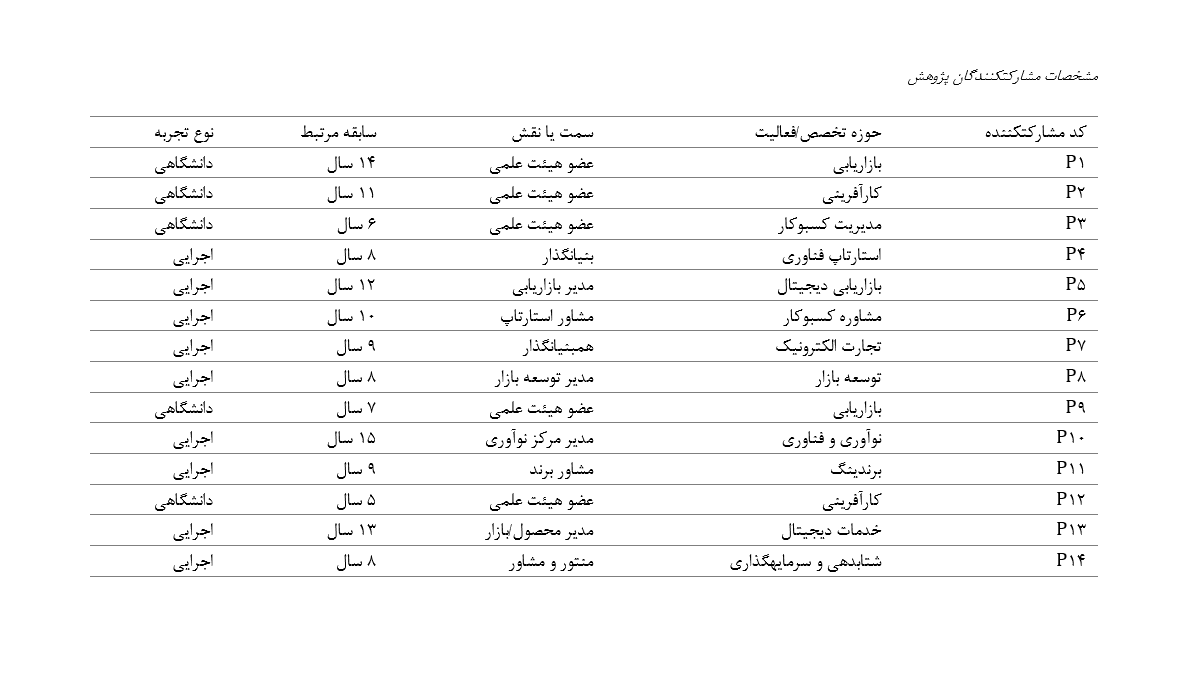
This study aimed to identify and conceptualize the key components and layers of entrepreneurial marketing in startup businesses and to develop a comprehensive, dynamic, and multi-layered framework for understanding marketing behavior under conditions of uncertainty, resource constraints, and market turbulence. This applied qualitative study employed a thematic analysis approach. The research population consisted of academic and industry experts with substantial experience in entrepreneurial marketing and startup development. Data were collected through 14 semi-structured interviews using purposive and snowball sampling until theoretical saturation was achieved. Data analysis was conducted following Braun and Clarke’s thematic analysis procedure with the support of MAXQDA 2020 software. Trustworthiness was ensured through credibility, transferability, dependability, and confirmability criteria based on Lincoln and Guba’s framework. The analysis resulted in the identification of 7 main themes, 50 subthemes, and numerous initial codes. Findings revealed that entrepreneurial marketing can be explained through the EMM-L7 framework, consisting of seven interconnected layers: entrepreneurial orientation core, resource leveraging and infrastructure, market interaction and entrepreneurial marketing capabilities, entrepreneurial marketing mix, protective principles, governing principles, and monitoring, intelligence, and feedback. The results demonstrated that entrepreneurial marketing is not merely a collection of marketing tools and tactics; rather, it represents a cognitive, resource-based, interactive, ethical, learning-oriented, and self-regulating system. The layers operate through dynamic and recursive relationships, enabling continuous adaptation and strategic refinement. The EMM-L7 model provides a holistic framework for understanding and managing entrepreneurial marketing in startup environments. The model suggests that marketing success emerges from the integration of entrepreneurial orientation, creative resource utilization, market learning, adaptive marketing practices, risk management, ethical governance, and continuous feedback mechanisms. The framework contributes to the theoretical advancement of entrepreneurial marketing and offers practical guidance for startup founders, marketing managers, and innovation ecosystem actors.
Downloads
References
Al-Mamary, Y. H., & Alshallaqi, M. (2022). Impact of Autonomy, Innovativeness, Risk-Taking, Proactiveness, and Competitive Aggressiveness on Students' Intention to Start a New Venture. Journal of Innovation & Knowledge, 7(4), 100239. https://doi.org/10.1016/j.jik.2022.100239
Bonamigo, A., Silva, A. A. d., Silva, B. P. d., & Werner, S. M. (2022). Criteria for Selecting Actors for the Value Co-Creation in Startups. Journal of Business and Industrial Marketing, 37(7), 1483-1496. https://doi.org/10.1108/jbim-02-2021-0083
Ebrahimi, P., Salamzadeh, A., Soleimani, M., Khansari, S. M., Zarea, H., & Fekete-Farkas, M. (2022). Startups and Consumer Purchase Behavior: Application of Support Vector Machine Algorithm. Big Data and Cognitive Computing, 6(2), 34. https://doi.org/10.3390/bdcc6020034
Fegada, A., & Veres, Z. (2024). The Moderating Role of Technological Capabilities in the Relationship between Entrepreneurial Marketing and Firm Performance: A Qualitative Approach. European Scientific Journal Esj, 20(7), 1-24. https://doi.org/10.19044/esj.2024.v20n7p1
Geng, L., Cui, X., Nazir, R., & An, N. B. (2022). How Do CSR and Perceived Ethics Enhance Corporate Reputation and Product Innovativeness? Economic Research-Ekonomska Istraživanja, 35(1), 5131-5151. https://doi.org/10.1080/1331677x.2021.2023604
Guerola-Navarro, V., Gil-Gómez, H., Oltra-Badenes, R., & Soto-Acosta, P. (2022). Customer Relationship Management and Its Impact on Entrepreneurial Marketing: A Literature Review. International Entrepreneurship and Management Journal, 18(2), 971-996. https://doi.org/10.1007/s11365-022-00800-x
Hassanpour, I., & Giti Nejad, M. R. (2020). Regional Planning in Developing an Entrepreneurial Marketing Pattern in Innovative Iranian Companies. Journal of Regional Planning.
Hsu, T. H., Her, S. T., & Chang, Y. H. (2021). The Application of an Innovative Marketing Strategy MADM Model—SIVA-Need: A Case Study of Apple Company. Mathematics, 9, 1435.
Hsu, T. H., Her, S. T., Chang, Y. H., & Hou, J. J. (2021). The Application of an Innovative Marketing Strategy MADM Model—SIVA-Need: A Case Study of Apple Company. International Journal of Electronic Commerce Studies, 12(2), 133-148. https://doi.org/10.7903/ijecs.1972
Jumasseitova, A., Issakhova, D., & Chowdhury, D. (2025). Unveiling New Frontiers: A Blue Ocean Strategy Framework for Cultivating Creative Entrepreneurial Pathways. Statistika, Učet i Audit(2), 17-31. https://doi.org/10.51579/1563-2415.2025.-2.17
Khasmafkan-Nezam, M. H. (2023). Does Ethical Climate of the Organization Foster Entrepreneurial Marketing? The Role of Work Engagement and Effective Knowledge Transfer. VINE Journal of Information and Knowledge Management Systems. https://doi.org/10.1108/vjikms-02-2023-0029
Khasmafkan-Nezam, M. H. (2025). The Intersection of Responsible Leadership and Entrepreneurial Marketing: The Roles of Ethical Climate, Effective Knowledge Transfer and Person-Organization Fit. Social Responsibility Journal. https://doi.org/10.1108/srj-01-2025-0008
Korsgaard, S., Müller, S., & Welter, F. (2020). It's Right Nearby: How Entrepreneurs Use Spatial Bricolage to Overcome Resource Constraints. Entrepreneurship and Regional Development, 33(1-2), 166-183. https://doi.org/10.1080/08985626.2020.1855479
Mansur, D. M. (2025). Strategic Marketing Innovation in Startups: Navigating Uncertainty with Agility and Creativity. Golden Ratio of Mapping Idea and Literature Format, 5(2). https://doi.org/10.52970/grmilf.v5i2.1545
Manzi Puertas, M. A., Agirre-Aramburu, I., Urzelai, B., & López Pérez, S. M. (2025). Bridging Bricolage and Effectuation: The Mediating Role of Innovative Behavior in Student Entrepreneurial Action under Resource Constraints. Journal of Entrepreneurship Management and Innovation, 21(2), 59-80. https://doi.org/10.7341/20252133
Maroofi, F., & Hosseini, S. F. (2024). Internationalization of Startups through Entrepreneurial Marketing and Temporary Cessation of Overseas Sales. Journal of International Entrepreneurship.
Nagabhaskar, M. (2022). A Conceptual Study of Service Marketing: Competitive Edge of 7P's over 4P's in Indian.
Neill, S., & Dang, L. (2025). The Integration of Entrepreneurial Marketing Processes and Controls. Journal of Research in Marketing and Entrepreneurship, 27(2), 281-303. https://doi.org/10.1108/jrme-06-2024-0138
Reis, L. P., Fernandes, J. M., Araújo, M. F. P. d., & Beaulieu, M. (2022). Lean Startup Practices: Operationalizing the Technological Business Planning Process in an Academic Environment. European Conference on Innovation and Entrepreneurship,
Reshadatjo, H., & Ebrahimpour, A. (2021). Presenting the Model of the Effect of Entrepreneurial Marketing Dimensions on Consumer Behavior with the Approach of Structural Equations in Startups in the Field of New Technology. Journal of Marketing Management, 16(51), 27-52.
Risitano, M., La Ragione, G., & Turi, A. (2023). Analysing the Relevance of Value Creation in the Interconnection amongst Entrepreneurship, Marketing and Innovation: A Systematic Literature Review. International Journal of Entrepreneurial Behavior & Research.
Rizvanović, B., Zutshi, A., & Grilo, A. (2022). Linking the Potentials of Extended Digital Marketing Impact and Start-Up Growth: Developing a Macro-Dynamic Framework of Start-Up Growth Drivers Supported by Digital Marketing. Journal of Open Innovation: Technology, Market, and Complexity.
Sari, D., Kusuma, B. A., Sihotang, J., & Febrianti, T. (2023). The Role of Entrepreneurial Marketing & Innovation Capability in the Performance of SMEs during COVID-19 Pandemic. Cogent Business & Management, 10(1), 2194091. https://doi.org/10.1080/23311975.2023.2194091
Xu, S., He, J., Morrison, A. M., Su, X., & Zhu, R. (2023). The Role of Bricolage in Countering Resource Constraints and Uncertainty in Start-Up Business Model Innovation. European Journal of Innovation Management. https://doi.org/10.1108/ejim-11-2022-0632
Yadav, A., & Bansal, S. (2020). Viewing Marketing through Entrepreneurial Mindset: A Systematic Review. Journal of Research in Marketing and Entrepreneurship, 22, 189-211.
Yadav, A., Paul, J., Bansal, S., & Talan, A. (2024). Developing and Validating a Scale for Entrepreneurial Marketing Orientations: EMICO Framework and Its Impact on Business Performance in Startups. Journal of Organizational Change Management, 37(7), 1401-1432. https://doi.org/10.1108/jocm-11-2023-0461
Yonel, T., Merlo, O., & Eisingerich, A. B. (2025). Branding in New Ventures: A Systematic Review of Extant Research and Future Research Directions. International Journal of Consumer Studies, 49(1), e70167. https://doi.org/10.1111/ijcs.70167
Downloads
Publication Timeline
- Submitted
- Revised
- Accepted
Issue
Section
License
Copyright (c) 1404 Ali Shaddel , Mohammad Bashkoh Ajirloo (Author); Bahman Khodapanah

This work is licensed under a Creative Commons Attribution-NonCommercial 4.0 International License.