Developing a Strategic Model for the Use of Blockchain Technology: A Qualitative Study
DOI:
https://doi.org/10.61838/kman.jtesm.516Keywords:
Blockchain Technology, Strategic Model, Grounded Theory, Digital Transformation, Data Governance, Digital LeadershipAbstract
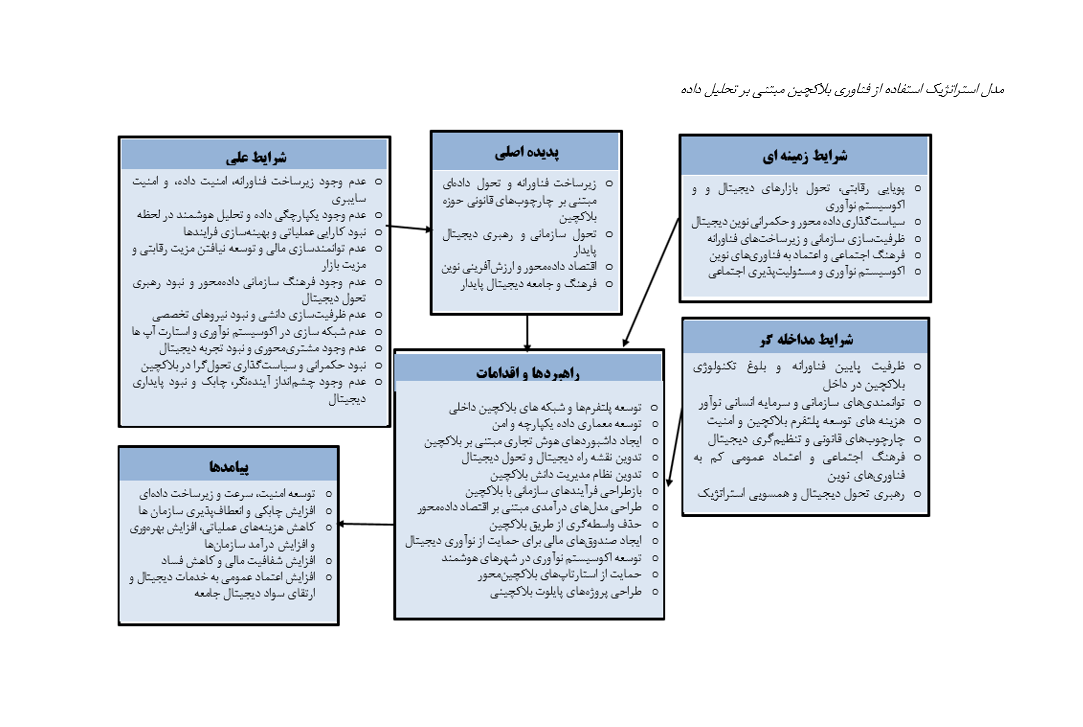
This study aimed to develop a strategic model for the use of blockchain technology by identifying and explaining the causal, contextual, and intervening conditions, strategies, and consequences associated with its strategic organizational adoption. This applied, exploratory qualitative study was conducted using the grounded theory approach. Participants comprised experts, managers, specialists, and professionals with knowledge and practical experience in blockchain technology, digital banking, information technology, and strategic management. Participants were recruited through purposive sampling, and data collection continued until theoretical saturation was achieved. Data were primarily collected through in-depth semi-structured interviews. Analysis was conducted through open, axial, and selective coding. During axial coding, concepts and categories were systematically organized according to causal conditions, contextual conditions, intervening conditions, strategies, and consequences. Selective coding was subsequently employed to integrate the categories around the core phenomenon and construct the final strategic model. Constant comparison, data review, and expert confirmation of selected findings were used to enhance the credibility of the analysis. The analysis indicated that strategic blockchain adoption is a multidimensional phenomenon shaped by interdependent technological, organizational, economic, regulatory, and sociocultural factors. Inadequate technological and data-security infrastructure, poor data integration and intelligent analytics, operational inefficiencies, resource constraints, weak data-driven culture, insufficient digital transformation leadership, and governance deficiencies emerged as major causal conditions. Digital-market dynamics, data-driven policymaking, organizational capacity, and social trust constituted important contextual conditions, whereas technological maturity, development and cybersecurity costs, regulatory frameworks, and public trust functioned as intervening conditions. The principal strategies included developing secure and integrated blockchain and data infrastructures, establishing blockchain-oriented digital transformation roadmaps, redesigning organizational processes, creating data-driven revenue models, strengthening regulatory frameworks, enhancing digital literacy and technology acceptance, supporting blockchain startups, and implementing pilot projects. Successful blockchain implementation extends beyond technological deployment and requires an integrated strategic framework aligning technology with organizational structure, business processes, human resources, regulatory requirements, digital leadership, organizational culture, and public trust. A gradual progression from awareness and capacity building to pilot implementation, infrastructure development, and institutionalization may therefore facilitate sustainable and strategically aligned blockchain adoption.
Downloads
References
Ahmed, G. M. F., Hasan, I., Hassan, M. S., Khan, R., Gefari, A. J. A., Buksh, Z., Liu, J., & Ali, A. B. M. S. (2023). A Systematic Literature Review of Blockchain-Based e-KYC Systems.
Ahmed, G. M. F., Hasan, I., Hassan, M. S., Khan, R., Gefari, A. J. A., Buksh, Z., Liu, J., & Ali, A. B. M. S. (2024). Enhancing e-KYC Security and Privacy: Harnessing Quantum Computing and Blockchain in Web 3.0. Distributed Ledger Technologies: Research and Practice. https://doi.org/10.1145/3686166
Anvari Saadi, Z., & Safaei, A. A. (2022). A Narrative Review of Blockchain Technology in Healthcare: Applications and Challenges. Journal of Health and Biomedical Informatics, 9(3), 180-192.
Baghani, E., Elahi, S., Hassanzadeh, A., & Rajabzadeh Ghatri, A. (2023). A Taxonomy for Identifying Banking Industry Customers Using Machine Learning: A Systematic Review with a Meta-Synthesis Approach. Information Processing and Management Research Journal, 39(1), 394-429.
Chafiq, T., Rida, A. Z. M. I., Fadil, A., & Mohammed, O. (2024). Investigating the Potential of Blockchain Technology for Geospatial Data Sharing: Opportunities, Challenges, and Solutions. Geomatica, 100026. https://doi.org/10.1016/j.geomat.2024.100026
Gholizadeh, M. H., Esmaeili, M., Ebrahimpour, M., & Moradi, M. (2023). Strategic Analysis of Blockchain Technology Use to Facilitate Customer Identity Verification in the Social Security Organization Using Actor-Network Theory. Information Management Sciences and Techniques, 9(1), 279-310.
Govindan, K., Jain, P., Singh, R. K., & Mishra, R. (2024). Blockchain Technology as a Strategic Weapon to Bring Procurement 4.0 Truly Alive: Literature Review and Future Research Agenda. Transportation Research Part E: Logistics and Transportation Review, 181, 103352. https://doi.org/10.1016/j.tre.2023.103352
Henry, A. (2021). Understanding Strategic Management (4th ed.). Oxford University Press. https://doi.org/10.1093/hebz/9780198859833.001.0001
Houshyar, A., Rousta, A., Asayesh, F., & Gholami, M. (2022). Validation of a Strategic Value-Creation Model in the Marine Insurance Industry with a Focus on Blockchain Technology. Marine Management Science Studies, 3(3), 53-64.
Kulkarni, A. V., Mondal, T., & Modi, D. (2025). Enhancing Privacy in Banking Systems: A Blockchain-Based Access Management and KYC Solution. Cogent Business & Management. https://doi.org/10.1080/23311975.2025.2570063
Laudon, K. C., & Laudon, J. P. (2022). Management Information Systems: Managing the Digital Firm (17th ed.). Pearson.
Mousavi, P., Salehan, A., & Yousefi Zanouz, R. (2022). Identification and Analysis of Blockchain Technology Research Domains and Trends. Smart Business Management Studies, 10(39), 127-162.
Pearlson, K. E., Saunders, C. S., & Galletta, D. F. (2022). Managing and Using Information Systems: A Strategic Approach (8th ed.). Wiley.
Rajabi, M., Asadi, R., & Kharazmi, O. (2023). Strategic Analysis of the Status of Emerging Waste Technologies in the Mashhad Metropolis. Geography and Regional Development, 412(6), 34-56.
Ranjbar Malekshah, T., Mojaverian, S. M., Eshghi, F., Shirzadi Leskokolaei, S., & Raftani Amiri, Z. (2022). Blockchain Technology for Efficient Management of the Vegetable Oil Supply Chain. Iranian Journal of Food Science and Technology, 19(133), 309-325.
Sadeghi, Z., Jahanian, S., & Shahin, A. (2023). Mapping the Influence Model of Blockchain Capabilities in the Green Supply Chain: A Combined DEMATEL and Interpretive Structural Modeling Approach. Industrial Management, 15(2), 244-271.
Shafiei Nikabadi, M., Aghababaei, H., Babaei Kafaki, S., & Rahmanimanesh, M. (2023). Identifying Sustainability Variables in the Electronic Payment Services Supply Chain Using Blockchain Technology. Industrial Technology Development Quarterly, 21(51), 55-68.
Takhtaei, N., & Kaedi, R. (2023). Blockchain Technology and the Transportation Industry. Scientific Journal of New Research Approaches in Management and Accounting, 7(27), 957-962.
Tien, H. T., Tran-Trung, K., & Hoang, V. T. (2024). Blockchain-Data Mining Fusion for Financial Anomaly Detection: A Brief Review. Procedia Computer Science, 235, 478-483. https://doi.org/10.1016/j.procs.2024.04.047
Zhong, B., Hu, X., Pan, X., Chen, X., & Liu, Z. (2025). Construction Quality Hazard Management with Deep Learning-Based Multimodal Storage Strategy-Enabled Blockchain. Journal of Construction Engineering and Management, 151(1), 04024184. https://doi.org/10.1061/JCEMD4.COENG-14839
Downloads
Publication Timeline
- Submitted
- Revised
- Accepted
Issue
Section
License
Copyright (c) 2025 Kaveh Mangoli Kahtuee, Hamid Esmaeeli, Narges Norouzi, Razieh Keshavarzfard (Author)

This work is licensed under a Creative Commons Attribution-NonCommercial 4.0 International License.