Elucidating the Role of Ethical Principles in the Use of Artificial Intelligence in Consumer Behavior Prediction
Keywords:
Artificial intelligence, technological activism, ethics-based governance, algorithmic transparency, consumer behavior predictionAbstract
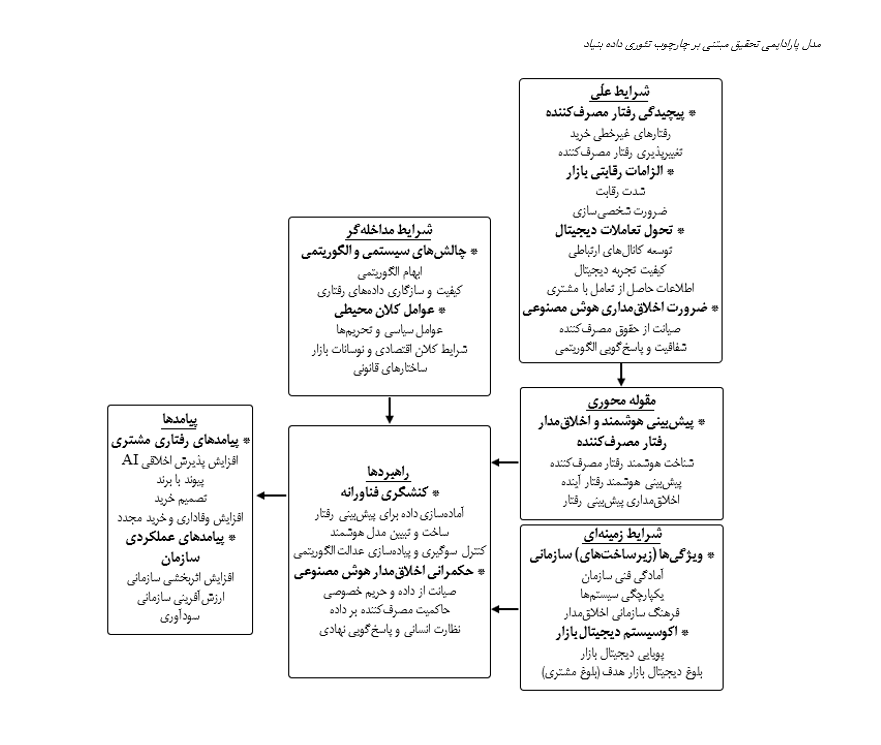
This study aimed to elucidate the role of ethical principles in the use of artificial intelligence for predicting consumer behavior and to develop an integrated model combining technological capabilities with ethical requirements. This applied study adopted a qualitative, exploratory–explanatory design based on grounded theory and the systematic approach of Strauss and Corbin. Data were collected through semi-structured interviews with 16 academic experts, managers, and specialists in marketing, consumer behavior, artificial intelligence, information technology, and AI ethics. Participants were recruited through purposive and snowball sampling, and sampling continued until theoretical saturation was achieved. The data were analyzed through open, axial, and selective coding using MAXQDA. The credibility of the findings was assessed through participant review and academic expert validation. The analysis identified “intelligent and ethical prediction of consumer behavior” as the core phenomenon, shaped by the complexity of consumer behavior, competitive market requirements, transformation of digital interactions, and the necessity of ethical AI. Achieving this phenomenon requires the integration of technological agency—including data preparation, intelligent model development and explanation, and algorithmic bias control—with ethical AI governance encompassing data and privacy protection, consumer sovereignty over personal data, human oversight, and institutional accountability. Organizational infrastructure and the digital market ecosystem emerged as contextual conditions, whereas systemic and algorithmic challenges and macro-environmental factors acted as intervening conditions. Implementation of these strategies was associated with enhanced ethical acceptance of AI, stronger brand relationships, purchasing decisions, customer loyalty and repurchase, as well as improved organizational effectiveness, value creation, and profitability. Sustainable and legitimate AI-based consumer behavior prediction requires ethical principles to be institutionalized throughout the design, development, and deployment lifecycle of intelligent systems. Technological accuracy and ethical responsibility should therefore be treated as complementary dimensions of responsible AI governance rather than separate objectives.
Downloads
References
Acquah, B. Y. S., Salifu, I., Arthur, F., Inkoom, M., Suradji, S. D., Inkoom, C., Quayson, E., Quaye, S. A., Gyedu, F. O., & Nortey, S. A. (2026). Artificial Intelligence Ethical Awareness of University Students in Ghana: A Network and Latent Profile Analyses. Computers and Education: Artificial Intelligence, 11, 100652. https://doi.org/10.1016/j.caeai.2026.100652
Chaudhary, A., Rane, N. L., Rastogi, R., & Rane, J. (2026). Explainable and Ethical Artificial Intelligence in Customer Relationship Management: Improving Customer Experience, Value Creation, and Loyalty. International Journal of Applied Resilience and Sustainability, 2(2), 243-278. https://doi.org/10.70593/deepsci.0202010
Dholakia, U. M., Kahn, B. E., Reeves, R., Rindfleisch, A., Stewart, D., & Taylor, E. (2026). Consumer Behavior in a Multichannel, Multimedia Retailing Environment. Journal of Interactive Marketing, 24(2), 86-95.
Emami, A., Mohammadi, N. M., Hosseini, S. H., Ghobadi, T., & Aghighi, A. (2025). Designing an Artificial Intelligence-Based Customer Relationship Management Model in Digital Marketing of Services in the Health Tourism Industry. Management in Business Value Creation, 5(2), 391-420.
Garcia, M., Lopez, R., & Martinez, J. (2026). Predicting Customer Loyalty in Digital Marketing Using Artificial Intelligence Models. Journal of Interactive Marketing, 65, 102-118. https://doi.org/10.1016/j.intmar.2025.104512
Ghane Sheikhabadi, A., Mahmoudipour, A., & Rashkan, D. (2025). Using Artificial Intelligence and Quantum Theory to Predict Consumer Behavior for Industrial Public Relations.
Goodell, J. W., Kumar, S., Lim, W. M., & Pattnaik, D. (2021). Artificial Intelligence and Machine Learning in Finance: Identifying Foundations, Themes, and Research Clusters from Bibliometric Analysis. Journal of Behavioral and Experimental Finance, 32, 100577.
Holzinger, A., Weippl, E., Tjoa, A. M., & Kieseberg, P. (2021). Digital Transformation for Sustainable Development Goals (SDGs): A Security, Safety and Privacy Perspective on AI. In (Vol. 12844, pp. 1-20).
James, S., S, K., Thomas, B., & Jose, J. (2026). Algorithmic Seduction: Ethical Boundaries in AI-Powered Consumer Nudging. Frontiers in psychology, 17, 1675412. https://doi.org/10.3389/fpsyg.2026.1675412
Kim, H., Park, J., & Lee, S. (2025). Machine Learning-Based Predictive Modeling of Consumer Behavior in Digital Marketing Environments. Journal of Business Research, 172, 114-126. https://doi.org/10.1016/j.jbusres.2024.113845
Kotler, P., & Armstrong, G. (2025). Principles of Marketing (16 ed.). Amookhteh Publications.
Motadi, M. S. (2024). Harnessing AI for Ethical Digital Consumer Behavior Analysis. In. IGI Global. https://doi.org/10.4018/979-8-3693-4453-8.ch012
Naeimi, M., & Family, Q. (2026). AI as a Decision Partner: Transforming Consumer Purchasing Behavior and Ethical Challenges. https://doi.org/10.2139/ssrn.6161287
Nemati, H., Asgarnejad Nouri, B., Zarei, G., & Molla Gholghachi, M. (2025). The Effect of Emerging Digital Marketing Technologies on Exploratory Purchasing Behaviors with the Moderating Role of Demographic Characteristics. Technology Growth, 21(82), 72-84.
Nyazabe, S. N., Lee, C. H., & Lucienne, V. (2025). SNS-Based Exposure Influence on Consumers' Purchasing Behavior: The Evidence from WhatsApp. Telematics and Informatics Reports, 18, 100202. https://doi.org/10.1016/j.teler.2025.100202
Oseni, A., Moustafa, N., Janicke, H., Liu, P., Tari, Z., & Vasilakos, A. (2021). Security and Privacy for Artificial Intelligence: Opportunities and Challenges. ArXiv.
Pookulangara, S., Hawley, J., & Xiao, G. (2024). Explaining Consumers' Channel-Switching Behavior Using the Theory of Planned Behavior. Journal of Retailing and Consumer Services, 18(4), 311-321.
Sharma, K., Rooble, V., & Sharma, P. (2026). Human-in-the-Loop Governance of Artificial Intelligence in Cardiology: From Ethical Principles to Operational Paradigms. Indian Heart Journal. https://doi.org/10.1016/j.ihj.2026.06.002
Solomon, M. R. (2020). Consumer Behavior: Buying, Having, and Being (16 ed.). Pearson.
Srivastava, R. K., & Gurme, V. (2026). Artificial Intelligence and Consumer Behaviour on Social Media: A Study of Personalization, Trust, and Privacy. Measurement: Digitalization, 5, 100021. https://doi.org/10.1016/j.meadig.2025.100021
Wei, J., Zhong, Z., Arango-Aramburo, S., & Zhao, X. (2025). Exploring Green Electricity Certificate Purchasing Behavior via a Laboratory Experiment. Renewable and Sustainable Energy Reviews, 215, 115527. https://doi.org/10.1016/j.rser.2025.115527
Downloads
Publication Timeline
- Submitted
- Revised
- Accepted
Issue
Section
License
Copyright (c) 2025 Soheil Karimi Rad (Author); Ahmad Askari; Dariyoush Jamshidi (Author)

This work is licensed under a Creative Commons Attribution-NonCommercial 4.0 International License.