Developing a Smart Financial Management Model for Startups with Emphasis on Inflationary Uncertainty and Emerging Technologies
Keywords:
Smart Financial Management, Startup, Inflationary Uncertainty, Emerging Technologies, Data-Driven Financial Intelligence, Financial Flexibility, Financial Decision-MakingAbstract
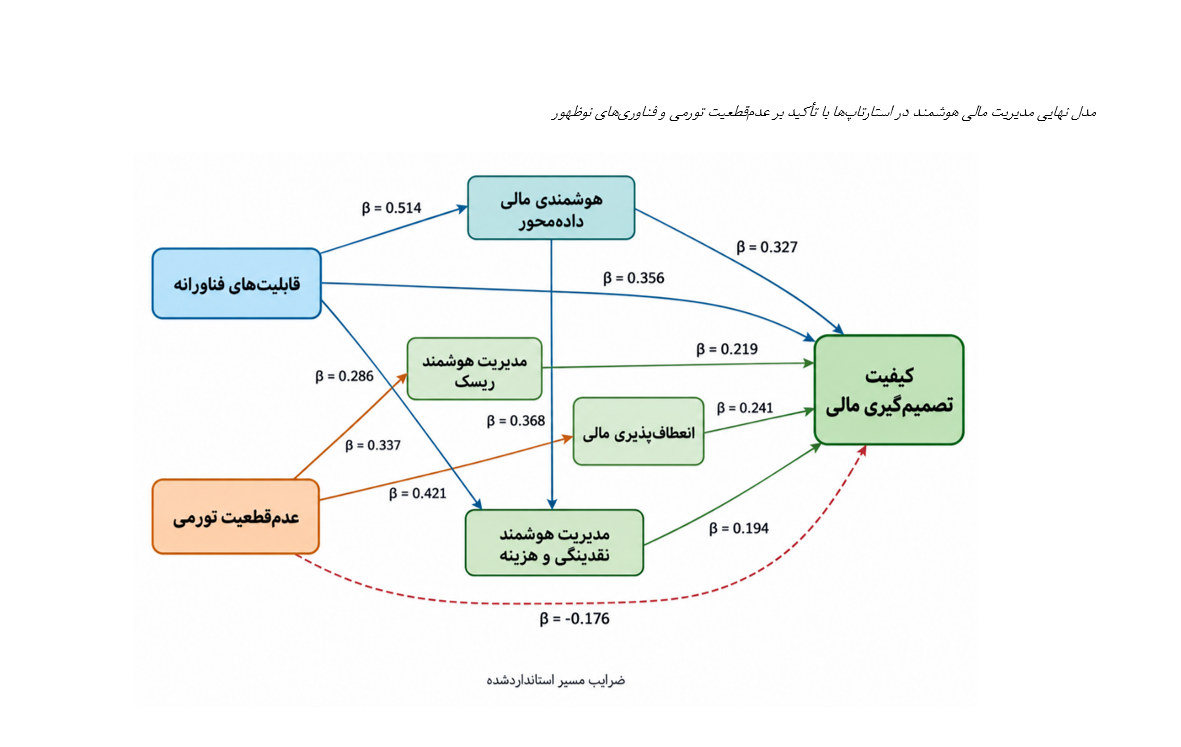
This study aimed to develop and validate a smart financial management model for startups with emphasis on inflationary uncertainty and emerging technologies. This applied study employed a sequential exploratory mixed-method design consisting of qualitative and quantitative phases. In the qualitative phase, 18 experts in financial management, startup management, fintech, economics, and investment in Tehran were selected through purposive sampling, and data were collected through semi-structured interviews and analyzed using thematic analysis. In the quantitative phase, 384 chief executive officers, founders, co-founders, financial managers, senior managers, and financial experts from startups operating in Tehran participated. Data were collected using a researcher-developed questionnaire. Reliability and validity were assessed using factor loadings, Cronbach’s alpha, composite reliability, average variance extracted, and HTMT. The model was tested using partial least squares structural equation modeling with 5,000 bootstrap resamples. Technological capabilities had a significant positive effect on data-driven financial intelligence (β = 0.514, p < 0.001) and financial decision quality (β = 0.356, p < 0.001). Data-driven financial intelligence positively affected financial decision quality (β = 0.327, p < 0.001). Inflationary uncertainty positively affected financial flexibility (β = 0.421, p < 0.001) and smart risk management (β = 0.337, p < 0.001), while negatively affecting financial decision quality (β = -0.176, p = 0.001). Financial flexibility (β = 0.241), smart risk management (β = 0.219), and smart liquidity and cost management (β = 0.194) also had significant positive effects on financial decision quality. The model explained 68.4% of the variance in financial decision quality, and the SRMR value was 0.061. Smart financial management in startups is shaped by the interaction of technological capabilities, data-driven financial intelligence, financial flexibility, risk management, and liquidity management, and the simultaneous development of these capabilities can mitigate the adverse effects of inflationary uncertainty and improve financial decision quality.
Downloads
References
Amaka, M. E. (2024). Financial Management in Startups: Analyzing Unique Accounting Challenges and Strategies. Contemporary Journal of Management, 2(3), 1-19. https://doi.org/10.5281/zenodo.10440639
Amhana, Z. B. R., & Thomas, A. B. (2024). The Impact of Performance Appraisal on Employees' Productivity in Financial Institutions: A Case of the United States Banking Sector. European Journal of Business Startups and Open Society, 4(4), 270-282. http://www.inovatus.es/index.php/ejbsos/article/view/3055
Bagheri, A., Faraji, O., Arabzadeh, M., & Ghodrati, H. (2025). Investigating the Financial Risk Management Model in Knowledge-Based Startup Companies. Journal of Technology in Entrepreneurship and Strategic Management, 4(2), 13. https://doi.org/10.61838/kman.jtesm.4.2.14
Botella-Carrubi, D., Ulrich-Berenguer, K., & Ribeiro Soriano, D. E. (2025). What Entrepreneurial Skills Are the Key to Startup Finance Performance? Venture Capital, 27(1), 21-41. https://doi.org/10.1080/13691066.2023.2240019
Chen, Z., Mirza, N., Umar, M., & Shan, S. (2025). Sustainability and Entrepreneurial Finance: How Does Climate Risk Affect Startup Financing and Valuations? International Journal of Entrepreneurial Behavior & Research, 32(2), 388-404. https://doi.org/10.1108/IJEBR-05-2025-0667
Das, K. C. (2023). What Affects Startup Acquisition in Emerging Economy? Evidence From India. Journal of Emerging Market Finance, 22(2), 111-134. https://doi.org/10.1177/09726527221141787
Hosseini, S. A., Valian, H., Abdoli, M. R., & Shahri, M. (2024). A Framework for Contextual Accounting Development Procedures for Implementing Financial Startups in Capital Market Companies. Empirical Studies in Financial Accounting, 21(83), 213-266.
Kubayevich, K. F. (2024). Current analysis and current issues of ensuring the financial stability of the banking system in Uzbekistan. European Journal of Business Startups and Open Society, 4(3), 169-176.
Kwon, S., & Manna, N. (2025). Corporate investments in startups: CVC unit vs. direct investment. Journal of Banking & Finance, 175(2), 111-135. https://doi.org/10.1016/j.jbankfin.2025.107444
Law, S. H., Ng, C. H., & Kutan, A. M. (2024). Inflation uncertainty and social welfare. Economic Systems, 48(1), 101210.
Lobozynska, S., Vladychyn, U., & Skomorovych, I. (2023). Digital Banking Transformation Through Cooperation with Fintech Startups in Ukraine. Journal of Finance and Financial Law, 1(37), 85-101. https://doi.org/10.18778/2391-6478.1.37.05
Modina, M., Fedele, M., & Formisano, A. V. (2025). Digital finance for SMEs and startups: a bibliometric analysis and future research direction. Journal of Small Business and Enterprise Development, 32(3), 524-571. https://doi.org/10.1108/JSBED-01-2024-0021
Mohammadkazemi, R., Heidari Gheshlaghi, S., & Sadeghi, H. (2025). Designing a Model of Microfinance Drivers in the Sustainability of Entrepreneurial Startup Businesses. Karafan Quarterly, 22(0), 1-21.
Moradi, M. H., Abdoli, M. R., Salehi, N., Valiyan, H., & Safarigrayeli, M. (2024). Foresight of the driving forces of startup financing based on libertarian philosophical strategies (metaphysics) of capital market companies. Financial Research, 26(4), 758-790.
Nilchi, M., Momenzade, M., & Farhadian, A. (2024). The Relation between Inflation and Inflation Uncertainty in Iran's Economy (Nonparametric Regression Approach and Bounded Innovation Propagation GARCH). Journal of Economics and Modelling, 14(2), 1-35. https://doi.org/10.48308/jem.2024.232380.1848
Nilchi, M., Momenzadeh, M. M., & Farhadian, A. (2023). The relationship between inflation and inflation uncertainty in the Iranian economy (Non-parametric regression approach and GARCH-limited disturbance expansion). Economics and Modeling, 14(2), 1-35.
Pallathadka, H. (2022). Challenges for Financing Startups in China: A Quantitative Investigation of Small and Medium Ventures. Integrated Journal for Research in Arts and Humanities. https://doi.org/10.55544/ijrah.2.6.31
Rathore, A. P. S. (2024). Impact of Marketing Budget Allocation on Financial Performance of Startups. Shodhkosh Journal of Visual and Performing Arts, 5(6). https://doi.org/10.29121/shodhkosh.v5.i6.2024.5761
Razavi, A., & Mousavi, Z. (2022). Analysis of financial risks in startup companies with an emphasis on technology industries. Journal of Economic Research, 26(4), 123-145.
Razavi, H. (2024). Predicting Startup Financing Methods Using Machine Learning Algorithms Considering Behavioral Biases. Journal of Engineering Management and Soft Computing, 1, 238-261.
Rostami, N., & Basharatpour, F. (2022). The Impact of Business Intelligence on the Financial Performance of Startups. Quarterly Journal of Empirical Financial Accounting Studies(36), 1-21.
Semnani, M., Keramati, M. A., Mehrinejad, S., & Mehrani, A. (2025). Providing a Smart Startup Model Based on Business Intelligence Capacity, Network Learning, and Innovation. Business, Marketing, and Finance Open, 1(2), 12-24.
Seyedalikhani, A. (2022). Examining Methods of Financing Startups from an Islamic Perspective. Sixteenth National Conference on New Approaches in Management, Economics, and Accounting,
Smith, R., Johnson, L., & Wang, S. (2024). Transparency in financial reporting and firm performance in tech startups. Journal of Business Finance & Accounting, 51(5-6), 857-879.
Staley, I., & Amankwa, E. (2026). Blockchain and Decentralized Finance in FinTech Startups in Emerging Markets: A Systematic Literature Review of Opportunities and Challenges. Journal of Applied Finance & Banking, 16(2), 81-108. https://doi.org/10.47260/jafb/1624
Usman, O., Ozkan, O., Koy, A., & Adebayo, T. S. (2024). Energy-related uncertainty shocks and inflation dynamics in the U.S: A multivariate quantile-on-quantile regression approach. Structural Change and Economic Dynamics, 71, 235–247. https://doi.org/10.1016/j.strueco.2024.07.012
Yang, Y., Fang, Y., Wang, N., & Xiang, S. (2023). Mitigating Information Asymmetry to Acquire Venture Capital Financing for Digital Startups in China: The Role of Weak and Strong Signals. Information Systems Journal. https://doi.org/10.1111/isj.12452
Zhou, Y., Park, S., Zhang, Z., & Ferreira, J. J. (2023). How Do Innovative Internet Tech Startups Attract Venture Capital Financing? Journal of Management & Organization, 31(3), 1367-1388. https://doi.org/10.1017/jmo.2023.39
Downloads
Publication Timeline
- Submitted
- Revised
- Accepted
Issue
Section
License
Copyright (c) 2025 Abolfazl Baeidi

This work is licensed under a Creative Commons Attribution-NonCommercial 4.0 International License.