ارائه مدل مدیریت مالی هوشمند در استارتاپها با تأکید بر عدمقطعیت تورمی و فناوریهای نوظهور
کلمات کلیدی:
مدیریت مالی هوشمند, استارتاپ, عدمقطعیت تورمی, فناوریهای نوظهور, هوشمندی مالی دادهمحور, انعطافپذیری مالی, تصمیمگیری مالیچکیده
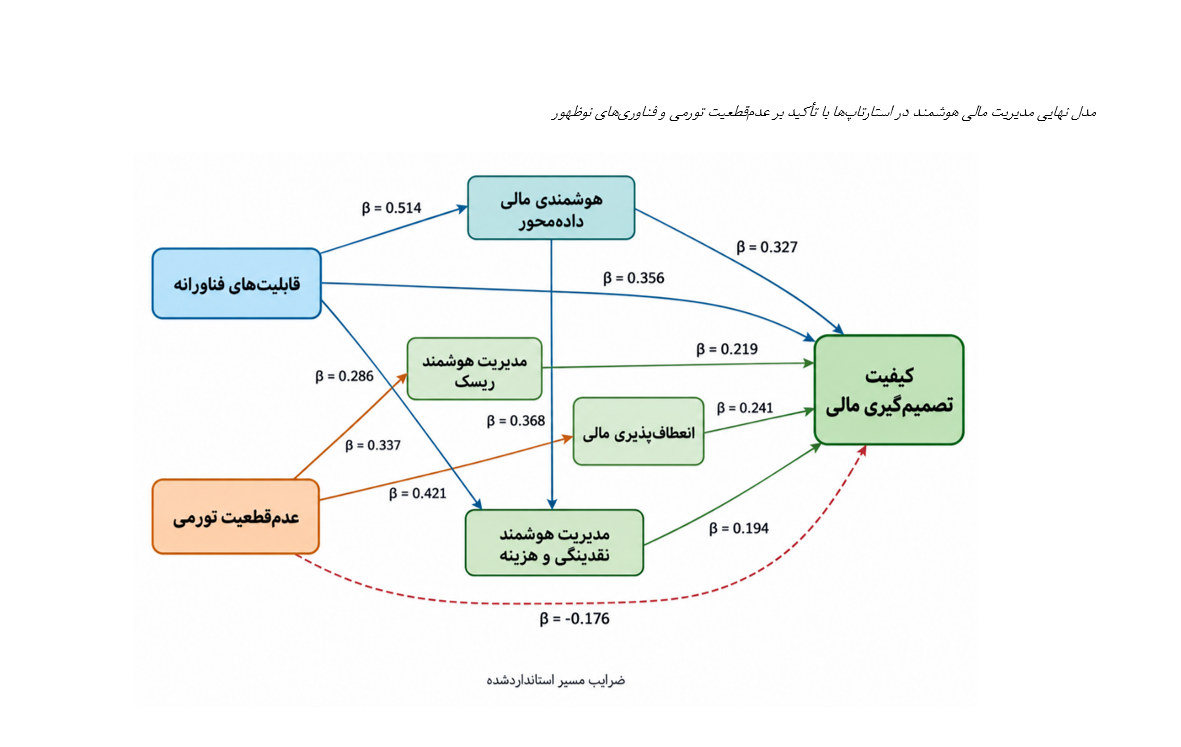
هدف پژوهش حاضر، ارائه و اعتبارسنجی مدل مدیریت مالی هوشمند در استارتاپها با تأکید بر عدمقطعیت تورمی و فناوریهای نوظهور بود. این پژوهش از نظر هدف کاربردی و از نظر روش، آمیخته اکتشافی متوالی بود که در دو مرحله کیفی و کمی انجام شد. در مرحله کیفی، 18 نفر از خبرگان حوزههای مدیریت مالی، مدیریت استارتاپ، فناوریهای مالی، اقتصاد و سرمایهگذاری در تهران به روش نمونهگیری هدفمند انتخاب شدند و دادهها از طریق مصاحبههای نیمهساختاریافته گردآوری و با تحلیل مضمون بررسی شدند. در مرحله کمی، 384 نفر از مدیران عامل، بنیانگذاران، همبنیانگذاران، مدیران و کارشناسان مالی و مدیران ارشد استارتاپهای فعال در تهران در پژوهش مشارکت کردند. ابزار گردآوری دادهها پرسشنامه محققساخته بود. روایی و پایایی ابزار با استفاده از بارهای عاملی، آلفای کرونباخ، پایایی ترکیبی، میانگین واریانس استخراجشده و HTMT بررسی شد و مدل با استفاده از مدلسازی معادلات ساختاری مبتنی بر حداقل مربعات جزئی و بوتاسترپ با 5,000 بازنمونه تحلیل شد. قابلیتهای فناورانه اثر مثبت و معناداری بر هوشمندی مالی دادهمحور داشتند (β = 0.514، p < 0.001) و مستقیماً کیفیت تصمیمگیری مالی را نیز افزایش دادند (β = 0.356، p < 0.001). هوشمندی مالی دادهمحور بر کیفیت تصمیمگیری مالی اثر مثبت داشت (β = 0.327، p < 0.001). عدمقطعیت تورمی بر انعطافپذیری مالی (β = 0.421، p < 0.001) و مدیریت هوشمند ریسک (β = 0.337، p < 0.001) اثر مثبت، اما بر کیفیت تصمیمگیری مالی اثر منفی و معنادار داشت (β = -0.176، p = 0.001). همچنین، انعطافپذیری مالی (β = 0.241)، مدیریت هوشمند ریسک (β = 0.219) و مدیریت هوشمند نقدینگی و هزینه (β = 0.194) اثر مثبت و معناداری بر کیفیت تصمیمگیری مالی داشتند. مدل 68.4 درصد از واریانس کیفیت تصمیمگیری مالی را تبیین کرد و شاخص SRMR برابر با 0.061 بود. مدیریت مالی هوشمند در استارتاپها حاصل تعامل قابلیتهای فناورانه، هوشمندی دادهمحور، انعطافپذیری مالی، مدیریت ریسک و مدیریت نقدینگی است و توسعه همزمان این قابلیتها میتواند آثار منفی عدمقطعیت تورمی را کاهش داده و کیفیت تصمیمگیری مالی را ارتقا دهد.
دانلودها
مراجع
Amaka, M. E. (2024). Financial Management in Startups: Analyzing Unique Accounting Challenges and Strategies. Contemporary Journal of Management, 2(3), 1-19. https://doi.org/10.5281/zenodo.10440639
Amhana, Z. B. R., & Thomas, A. B. (2024). The Impact of Performance Appraisal on Employees' Productivity in Financial Institutions: A Case of the United States Banking Sector. European Journal of Business Startups and Open Society, 4(4), 270-282. http://www.inovatus.es/index.php/ejbsos/article/view/3055
Bagheri, A., Faraji, O., Arabzadeh, M., & Ghodrati, H. (2025). Investigating the Financial Risk Management Model in Knowledge-Based Startup Companies. Journal of Technology in Entrepreneurship and Strategic Management, 4(2), 13. https://doi.org/10.61838/kman.jtesm.4.2.14
Botella-Carrubi, D., Ulrich-Berenguer, K., & Ribeiro Soriano, D. E. (2025). What Entrepreneurial Skills Are the Key to Startup Finance Performance? Venture Capital, 27(1), 21-41. https://doi.org/10.1080/13691066.2023.2240019
Chen, Z., Mirza, N., Umar, M., & Shan, S. (2025). Sustainability and Entrepreneurial Finance: How Does Climate Risk Affect Startup Financing and Valuations? International Journal of Entrepreneurial Behavior & Research, 32(2), 388-404. https://doi.org/10.1108/IJEBR-05-2025-0667
Das, K. C. (2023). What Affects Startup Acquisition in Emerging Economy? Evidence From India. Journal of Emerging Market Finance, 22(2), 111-134. https://doi.org/10.1177/09726527221141787
Hosseini, S. A., Valian, H., Abdoli, M. R., & Shahri, M. (2024). A Framework for Contextual Accounting Development Procedures for Implementing Financial Startups in Capital Market Companies. Empirical Studies in Financial Accounting, 21(83), 213-266.
Kubayevich, K. F. (2024). Current analysis and current issues of ensuring the financial stability of the banking system in Uzbekistan. European Journal of Business Startups and Open Society, 4(3), 169-176.
Kwon, S., & Manna, N. (2025). Corporate investments in startups: CVC unit vs. direct investment. Journal of Banking & Finance, 175(2), 111-135. https://doi.org/10.1016/j.jbankfin.2025.107444
Law, S. H., Ng, C. H., & Kutan, A. M. (2024). Inflation uncertainty and social welfare. Economic Systems, 48(1), 101210.
Lobozynska, S., Vladychyn, U., & Skomorovych, I. (2023). Digital Banking Transformation Through Cooperation with Fintech Startups in Ukraine. Journal of Finance and Financial Law, 1(37), 85-101. https://doi.org/10.18778/2391-6478.1.37.05
Modina, M., Fedele, M., & Formisano, A. V. (2025). Digital finance for SMEs and startups: a bibliometric analysis and future research direction. Journal of Small Business and Enterprise Development, 32(3), 524-571. https://doi.org/10.1108/JSBED-01-2024-0021
Mohammadkazemi, R., Heidari Gheshlaghi, S., & Sadeghi, H. (2025). Designing a Model of Microfinance Drivers in the Sustainability of Entrepreneurial Startup Businesses. Karafan Quarterly, 22(0), 1-21.
Moradi, M. H., Abdoli, M. R., Salehi, N., Valiyan, H., & Safarigrayeli, M. (2024). Foresight of the driving forces of startup financing based on libertarian philosophical strategies (metaphysics) of capital market companies. Financial Research, 26(4), 758-790.
Nilchi, M., Momenzade, M., & Farhadian, A. (2024). The Relation between Inflation and Inflation Uncertainty in Iran's Economy (Nonparametric Regression Approach and Bounded Innovation Propagation GARCH). Journal of Economics and Modelling, 14(2), 1-35. https://doi.org/10.48308/jem.2024.232380.1848
Nilchi, M., Momenzadeh, M. M., & Farhadian, A. (2023). The relationship between inflation and inflation uncertainty in the Iranian economy (Non-parametric regression approach and GARCH-limited disturbance expansion). Economics and Modeling, 14(2), 1-35.
Pallathadka, H. (2022). Challenges for Financing Startups in China: A Quantitative Investigation of Small and Medium Ventures. Integrated Journal for Research in Arts and Humanities. https://doi.org/10.55544/ijrah.2.6.31
Rathore, A. P. S. (2024). Impact of Marketing Budget Allocation on Financial Performance of Startups. Shodhkosh Journal of Visual and Performing Arts, 5(6). https://doi.org/10.29121/shodhkosh.v5.i6.2024.5761
Razavi, A., & Mousavi, Z. (2022). Analysis of financial risks in startup companies with an emphasis on technology industries. Journal of Economic Research, 26(4), 123-145.
Razavi, H. (2024). Predicting Startup Financing Methods Using Machine Learning Algorithms Considering Behavioral Biases. Journal of Engineering Management and Soft Computing, 1, 238-261.
Rostami, N., & Basharatpour, F. (2022). The Impact of Business Intelligence on the Financial Performance of Startups. Quarterly Journal of Empirical Financial Accounting Studies(36), 1-21.
Semnani, M., Keramati, M. A., Mehrinejad, S., & Mehrani, A. (2025). Providing a Smart Startup Model Based on Business Intelligence Capacity, Network Learning, and Innovation. Business, Marketing, and Finance Open, 1(2), 12-24.
Seyedalikhani, A. (2022). Examining Methods of Financing Startups from an Islamic Perspective. Sixteenth National Conference on New Approaches in Management, Economics, and Accounting,
Smith, R., Johnson, L., & Wang, S. (2024). Transparency in financial reporting and firm performance in tech startups. Journal of Business Finance & Accounting, 51(5-6), 857-879.
Staley, I., & Amankwa, E. (2026). Blockchain and Decentralized Finance in FinTech Startups in Emerging Markets: A Systematic Literature Review of Opportunities and Challenges. Journal of Applied Finance & Banking, 16(2), 81-108. https://doi.org/10.47260/jafb/1624
Usman, O., Ozkan, O., Koy, A., & Adebayo, T. S. (2024). Energy-related uncertainty shocks and inflation dynamics in the U.S: A multivariate quantile-on-quantile regression approach. Structural Change and Economic Dynamics, 71, 235–247. https://doi.org/10.1016/j.strueco.2024.07.012
Yang, Y., Fang, Y., Wang, N., & Xiang, S. (2023). Mitigating Information Asymmetry to Acquire Venture Capital Financing for Digital Startups in China: The Role of Weak and Strong Signals. Information Systems Journal. https://doi.org/10.1111/isj.12452
Zhou, Y., Park, S., Zhang, Z., & Ferreira, J. J. (2023). How Do Innovative Internet Tech Startups Attract Venture Capital Financing? Journal of Management & Organization, 31(3), 1367-1388. https://doi.org/10.1017/jmo.2023.39
دانلودها
گاهشمار انتشار
- ارسال
- بازنگری
- پذیرش
شماره
نوع مقاله
مجوز
حق نشر 2025 Abolfazl Baeidi

این پروژه تحت مجوز بین المللی Creative Commons Attribution-NonCommercial 4.0 می باشد.