From National Identity to the Global Market: A Qualitative Model of Drivers and Barriers to International Entrepreneurship in the Fashion and Clothing Industry
Keywords:
inhibitors, drivers , fashion and apparel industry , national identity , International entrepreneurshipAbstract
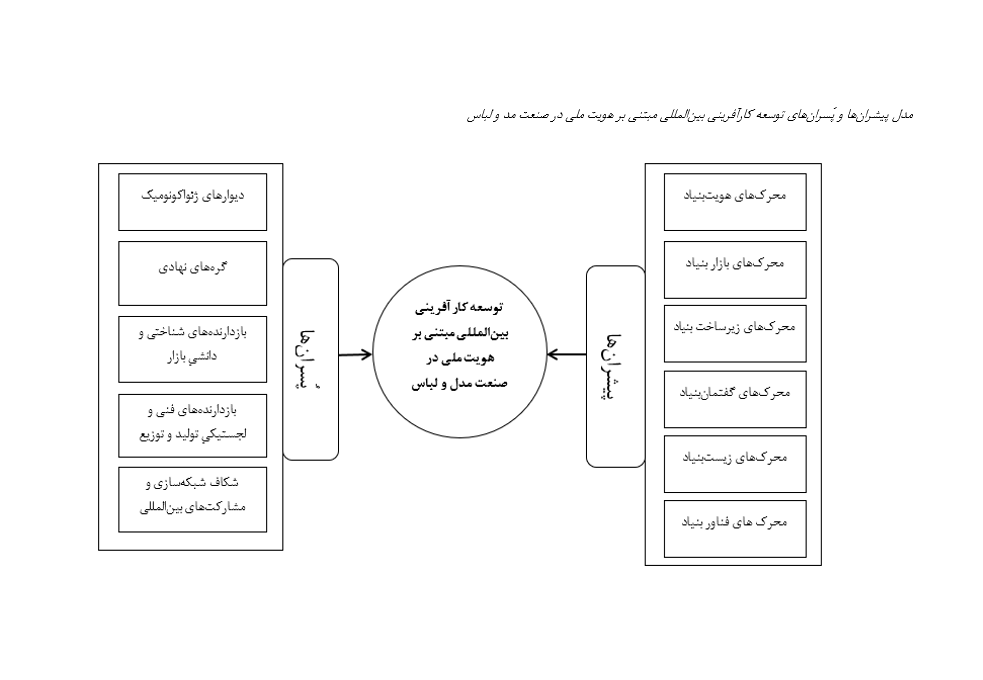
This study aimed to develop a model of the drivers and barriers to the development of national identity-based international entrepreneurship in the fashion and clothing industry. This exploratory qualitative study employed conventional content analysis based on the Graneheim and Lundman framework. The study population comprised experts in international marketing, university faculty specializing in entrepreneurship, branding, and fashion management, and professional practitioners in the fashion and clothing industry. Participants were recruited through snowball sampling, and in-depth semi-structured interviews continued until theoretical saturation was achieved. A total of 15 experts participated in the study. The interview data were transcribed and analyzed through open, axial, and selective coding. The reliability of the coding process was assessed using Cohen’s kappa coefficient, which was 0.844, indicating excellent inter-coder agreement. Data analysis yielded 127 open codes, 31 axial codes, and 11 selective categories. The drivers of national identity-based international entrepreneurship were classified into six dimensions: identity-based, market-based, infrastructure-based, discourse-based, ecological-based, and technology-based drivers. The barriers were organized into five dimensions: geoeconomic walls, institutional bottlenecks, cognitive and market-knowledge barriers, technical and logistical barriers to production and distribution, and gaps in international networking and partnerships. The findings demonstrated that the international development of Iranian identity-oriented fashion brands depends on the simultaneous interaction of cultural and symbolic resources, market opportunities, technological capabilities, supportive infrastructure, and the capacity to overcome institutional, commercial, logistical, and networking constraints. National identity-based international entrepreneurship in the fashion and clothing industry is a multidimensional process requiring the simultaneous mobilization of cultural assets, identity-oriented storytelling, digital and production technologies, and international networks, together with the reduction of geoeconomic, institutional, cognitive, and logistical barriers. The proposed model can provide a practical framework for policymakers, entrepreneurs, and fashion brands seeking sustainable internationalization while preserving and communicating distinctive national identity.
Downloads
References
Abdi, J., Savadkouhi, M., & Arabi, N. (2021). The Effect of Globalization and National Identity on Iranian Consumers' Behavior toward Foreign Clothing in Tehran. Modern Research Approaches in Management and Accounting, 5(69), 17-33.
Aghazadeh, Z., Esmaeilpour, H., Hosseini, S. R., & Alvani, S. M. (2024). Identifying the Antecedents and Consequences of Internationalization of Family Businesses. Development and Transformation Management(56), 62-70.
Akenzua, O. U., & Gbandi, E. C. (2026). Determinants of Brand Evangelism in the Fashion Clothing Industry in Benin Metropolis, Nigeria. Educational Advancement and Development Journal, 2(1), 235-244.
Astuti, N. C. (2022). Exploring International Entrepreneurship and Opportunity Creation in Emerging Markets [Doctoral dissertation, Queensland University of Technology].
Ben Mahrouche, A. (2023). International Entrepreneurship: Definitions and Evolution of a New Field of Research. Journal of Economic Development and Contracting, 5(4), 12-17.
Dana, L. P., Grandinetti, R., & Mason, M. C. (2016). International Entrepreneurship, Export Planning and Export Performance: Evidence from a Sample of Winemaking SMEs. International Journal of Entrepreneurship and Small Business, 29(4), 602-626. https://doi.org/10.1504/IJESB.2016.079965
De Mel, A. (2026). Asanka De Mel Builds Lovi Ceylon beyond Fashion. Sunday Observer. https://www.sundayobserver.lk
Etemad, H. (2023). The Need for Strategic Redirection and Business Model Change: The Impact of Evolving Influential Forces of Change on International Entrepreneurship Environment. Journal of International Entrepreneurship, 21(4), 441-463. https://doi.org/10.1007/s10843-024-00348-7
Hamidizadeh, M. R., & Fereydouni, B. (2024). The Effect of International Entrepreneurship through Internationalization Readiness on Firm Performance Success. Business Management Explorations, 16(35), 176-197.
Hosseini, M. H., Parhizgar, M. M., & Khademi, M. (2022). Designing a Branding Model in Social Production to Improve the Performance of the Domestic Apparel Industry. Productivity management, 16(61), 139-165.
Jalali, M. (2026). Examining Structural Barriers and Adaptive Strategies of Women's International Entrepreneurship in Iran. Third International Conference on Management, Economics, and Entrepreneurship, Nur, Iran.
Jami, S., Nasimi, M. A., & Pedarsalavati, S. (2023). Designing a Model of the Effectiveness of Social Media Advertising in the Domestic Apparel Industry: A Qualitative Grounded Theory Approach. Textile and Clothing Science and Technology, 12(3), 17-31.
Kabbara, D., Qin, E., Jarrar, H., & Salloum, C. (2024). Internationalisation and Growth of Small Sustainable Fashion Enterprises. International Journal of Entrepreneurship and Small Business, 51(4), 469-493. https://doi.org/10.1504/IJESB.2024.136955
Kahrizi, O. A., Amiri, Z., & Tavaghi Mianji, Z. (2025). The Role of International Entrepreneurship in Creating Export Opportunities for Small and Medium-Sized Enterprises and Start-Ups. Eleventh National Conference on Modern Studies and Research in Humanities, Management, and Entrepreneurship in Iran, Tehran, Iran.
Kalabi, A. M., & Ghandi, S. (2024). Business Internationalization with Emphasis on International Entrepreneurship: Explaining the Mediating Role of Organizational Capabilities and the Moderating Role of Global Mindset. International Business Management Quarterly, 7(2).
Keykhosravi, A., Bagheri Farahbakhsh, S., & Ali, S. (2021). Examining the Effect of National Identity on Consumers' Perceived Value of Domestic and Foreign Products: A Case Study of Clothing. Sixth International Conference on Management, Global Trade, Economics, Finance, and Social Sciences, Tehran, Iran.
Korhonen, S. (2016). Constructing the International Entrepreneurial Identity: A Study of International Entrepreneurship Sense-Making Narratives [Doctoral dissertation, University of Jyväskylä].
Lin, X. (2025). Explore Global Fashion Trends and Cultural Influences. Journal of Education, Humanities and Social Sciences, 46. https://doi.org/10.54097/rzdvr692
Martin-Rojas, R., Garcia-Morales, V. J., & Gonzalez-Alvarez, N. (2019). Technological Antecedents of Entrepreneurship and Its Consequences for Organizational Performance. Technological Forecasting and Social Change, 147, 22-35. https://doi.org/10.1016/j.techfore.2019.06.018
Masoudi, M. (2022). Examining Clothing as a Symbol of Culture and National Identity. Fourth International Conference on Humanities, Law, Social Studies, and Psychology,
McDougall, P. P., & Oviatt, B. M. (2000). International Entrepreneurship: The Intersection of Two Research Paths. Academy of Management journal, 43(5), 902-906. https://doi.org/10.2307/1556418
Milanesi, M., Runfola, A., & Guercini, S. (2024). Exploring the Internationalization Pathways of Luxury SMEs: Is There an Asset of Foreignness? International Marketing Review, 41(3-4), 806-826. https://doi.org/10.1108/IMR-08-2023-0174
Mounesi Sorkheh, M. (2017). Clothing and Identity: Dimensions of Cultural Identity in Iranian Clothing. Jelveh-ye Honar Scientific Quarterly, 9(1), 107-116.
Palacios-Marqués, D., García, M. G., Sánchez, M. M., & Mari, M. P. A. (2019). Social Entrepreneurship and Organizational Performance: A Study of the Mediating Role of Distinctive Competencies in Marketing. Journal of Business Research, 101, 426-432. https://doi.org/10.1016/j.jbusres.2019.02.004
Parvizi, A., & Seyedmoradi, M. (2024). A Review Study of the Role of Clothing in the Formation of National Identity. Third Conference on Islamic Culture and Art (National and International), Bandar Abbas, Iran.
Perera, S. R., Sinha, P., & Gilbert-Saad, A. (2026). From Entrepreneurial Orientation to Export Performance: A Pathway through Vicarious Learning and Absorptive Capacity in International SMEs. Journal of International Management, 101339. https://doi.org/10.1016/j.intman.2026.101339
Roustazadeh, M., Davoudi, M. R., Aghasi, S., & Shirvani, A. (2024). Identifying the Components of Digital Content Production in Marketing in the Fashion and Apparel Industry. Textile and Clothing Science and Technology, 13(3), 39-59.
Secinaro, S. F., Oppioli, M., Demarchi, L., & Novotny, O. (2025). Bridging Borders and Boundaries: The Role of New Technologies in International Entrepreneurship and Intercultural Dynamics. International Entrepreneurship and Management Journal, 21(1), 46. https://doi.org/10.1007/s11365-024-01061-6
Tan, C. S. L., & Islam, S. (2026). Fashion Entrepreneurship: Principles and Practice. Taylor & Francis. https://doi.org/10.4324/9781032631523
Downloads
Publication Timeline
- Submitted
- Revised
- Accepted
Issue
Section
License
Copyright (c) 2025 Shohreh Jelokhani (Author); Mohammad Javad Taghipourian; Elham Fazeli Veisari, Maryam Rahmaty (Author)

This work is licensed under a Creative Commons Attribution-NonCommercial 4.0 International License.