Developing a Smart Organizational Governance Model Based on Grounded Theory
DOI:
https://doi.org/10.61838/kman.jtesm.519Keywords:
Smart Organizational Governance, Data Governance, Digital Transformation, Artificial Intelligence, Data-Driven Decision-Making, Grounded TheoryAbstract
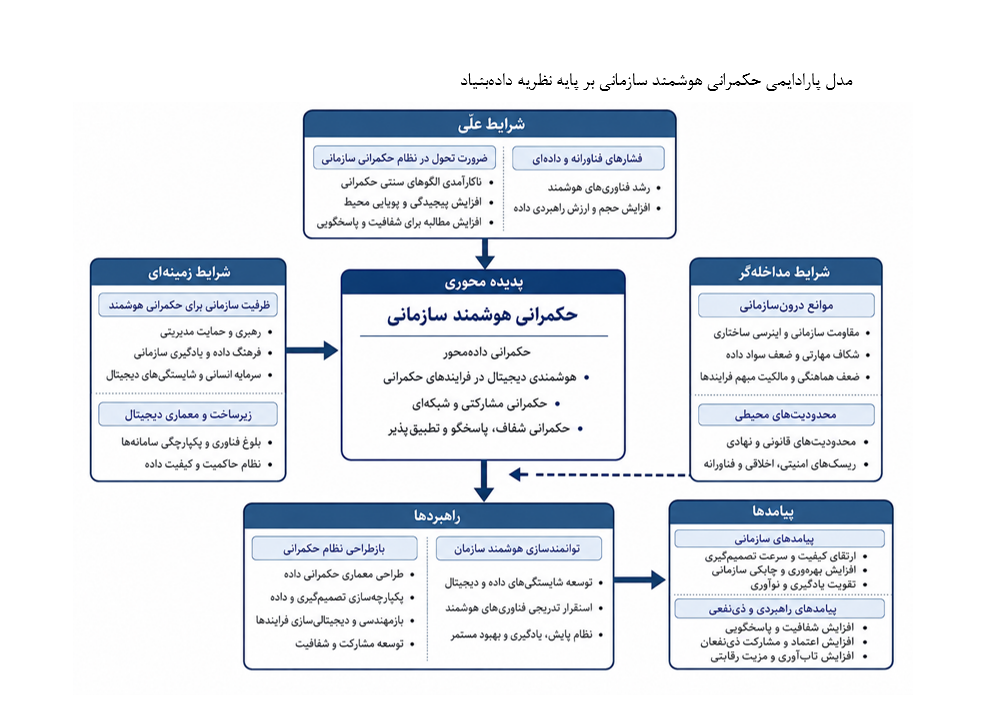
This study aimed to develop a model of smart organizational governance based on grounded theory by identifying its causal conditions, contextual and intervening conditions, strategies, and consequences. This qualitative study employed a grounded theory design. The study population consisted of senior and middle managers, organizational governance experts, information technology and digital transformation specialists, and academics with relevant professional experience in Tehran. Eighteen participants were selected through purposive sampling followed by theoretical sampling, and recruitment continued until theoretical saturation was achieved. Data were collected through in-depth semi-structured interviews lasting approximately 50–75 minutes. Data collection and analysis were conducted concurrently using open, axial, and selective coding and the constant comparative method. MAXQDA software was used for data management. Credibility and dependability were enhanced through participant checking, expert review, continuous comparison, and analytical memoing. Data analysis generated 1,296 initial codes, which were refined into 514 distinct open codes, 126 concepts, 32 subcategories, and 11 main categories. “Smart organizational governance” emerged as the core phenomenon and comprised data-driven governance, digital intelligence in governance processes, participatory and networked governance, and transparent, accountable, and adaptive governance. Causal conditions included the inadequacy of traditional governance, environmental complexity, and technological and data-related pressures. Leadership, data culture, digital competencies, and integrated infrastructure emerged as contextual conditions, whereas organizational resistance, skill gaps, and legal and security constraints functioned as intervening conditions. Major strategies included redesigning governance structures, establishing data governance architecture, integrating data with decision-making, developing digital competencies, and gradually implementing intelligent technologies. The principal consequences were improved decision quality, organizational agility, learning, transparency, stakeholder trust, resilience, and competitive advantage. Smart organizational governance represents an integrated and dynamic organizational transformation rather than a purely technological initiative, and its successful development depends on the coordinated interaction of data, technology, leadership, structure, culture, human capabilities, participation, and accountability.
Downloads
References
Ali, S., Razak, N. A. B. A., & Sajjid, N. (2024). Impact of Domestic Migration and Smart Governance on Quality of Life: Mediating Role of Emotional and Physical Well-Being. International Journal of Services, Economics and Management, 15(2), 136-157.
Ashrafi, A. (2024). Tax Collection in Smart Governance and Its Role in Controlling Tax Evasion. 23rd International Conference on Research in Management, Economics, and Development. https://civilica.com/doc/2220871/
Ashrafi, A. (2025). Taxation in Smart Governance and Its Role in Controlling Tax Evasion 23rd International Conference on Research in Management, Economics and Development, Tehran.
Emamipanah, F. (2025). Applied Analysis of Big Data in Enhancing Smart Urban Management: From Data-Driven Governance to Technology-Based Policymaking. Twenty-Third National Conference on Applied Research in Electrical, Computer, and Biomedical Engineering Sciences,
Gheiravani, G., Montazeri, M., & Zahedi, S. (2024). Presenting a Model of Factors Affecting Smart Governance in the Country. Value Creation in Business Management Quarterly, 4(1), 279-301. https://www.jvcbm.ir/article_179175.html
Habibi Gorgan, M., Sohrabi, S., & Salimi, G. (2023). A Model of Smart Governance in Crisis Situations with Emphasis on Urban Management in Line with the General Policies of the Islamic Republic of Iran. Strategic and Macro Policy Journal, 12(2). https://www.sid.ir/paper/1538735/fa
Haghshenas, F., & Borhani, S. (2024). Smart Governance: A Catalyst for Digital Market Transformation and a Driver of International Entrepreneurship in the Era of the Fifth Industrial Revolution. First National Conference on Smart Governance, Tehran.
Kamaneh, S. F., Zamahani, M., & Daraei, M. R. (2026). Designing and elucidating a data governance model in smart government organizations with an emphasis on information and media management in IDRO. System Engineering and Productivity, 6(1), 193-225.
Kasraei, A. R., & Alba, K. (2024). Digital Administrative Governance: Examining Implementation Models of Smart Administrative Systems. First National Conference on Smart Governance, Tehran.
Marhamati, N., & Ashrafpour, A. (2024). A Review of Factors Influencing Smart Governance in Digital Businesses. First National Conference on Smart Governance, Tehran.
Mirzaei, A., Seyednaghavi, M. A., Vaezi, R., & Aslipour, H. (2025). Identifying the Dimensions of Smart Human Resource Governance in the Iranian Public Sector: The Case of the National Iranian Oil Company. Journal of Human Resource Studies, 15(1), 1-29. https://doi.org/10.22034/JHRS.2025.514293.2390
Nasrulhaq, N. (2025). Smart Governance: The First Experience of the Two Metropolitan Cities in Indonesia. Administrative Culture, 23(1-2), 55-83. https://doi.org/10.32994/hk.v23i1-2.306
Naveen Kumar, R., Janani, M., Pavithra, R., & John William, A. (2025). The role of TIAS in shaping smart tourism: governance perspectives on choosing intelligent destinations. Business Analyst Journal, 0(0), 0-0. https://doi.org/10.1108/BAJ-02-2024-0009
Parvin, B., Shayan, A., Pourabrahimi, A., & Radfar, R. (2024). Foresight of Digital Governance toward Urban Smartization with a Sustainability Approach at the Level of National Metropolises. Journal of Information Processing and Management, 40(1), 93-124.
Pei, Y. (2025). The Integration of Artificial Intelligence Into Smart Policing Systems: Applications and Risk Governance. Adv. Manag. Intell. Technol., 1(4). https://doi.org/10.62177/amit.v1i4.486
Pour Ezzat, A. A., Abbasi, T., Maghsoudi Kenari, S., & Namdar Jouybari, M. M. (2024). Investigating the Role of Essential Components of Smart Governance in Achieving a Smart City (Case Study: Tehran City). Public Administration Management, 16(3), 535-561. https://jipa.ut.ac.ir/article_97385.html
Ramezani, S., Sohrabi, S., & Salimi, G. (2024). Human Resource Governance. First National Conference on Smart Governance, Tehran.
Ruijer, E., Van Twist, A., Haaker, T., Tartarin, T., Schuurman, N., Melenhorst, M., & Meijer, A. (2023). Smart Governance Toolbox: A Systematic Literature Review. Smart Cities, 6(2), 878-896.
Sulistiyo, H. (2024). Dimension of Smart Governance in Supporting Public Services in Madiun City, East Java Province. Jurnal Politik Pemerintahan Dharma Praja, 17(2), 47-58. https://doi.org/10.33701/jppdp.v17i2.4812
Taghva, M. R., Masnavi, H., Taghavifard, M. T., & Zarandi, S. (2023). E- Governance Development Model Towards Anti-Corruption in Iran. Public Management Researches, 16(60), 163-190. https://doi.org/10.22111/jmr.2022.43343.5841
Taghvaei, M., & Rahimi, A. (2024). Innovation in Smart Governance: The Convergence of Management, Law, and Politics in Government Digital Transformation. First National Conference on Smart Governance, Tehran.
Testi, N., Marconi, R., & Pasher, E. (2025). Exploring the Potential of Blockchain Technology for Citizen Engagement in Smart Governance. Open Research Europe, 3(183), 183. https://doi.org/10.12688/openreseurope.16153.4
Zafari, H., & Pour, M. M. (2024). Data-Driven Artificial Intelligence Governance in Public Services: Opportunities, Challenges, and Solutions. First National Conference on Smart Governance,
Zanoubi, M., Zarezadeh, S., & Parvin, F. (2024). Investigating Factors Influencing Smart Governance in the Era of Digital Transformation for the Development of Imam Khomeini Relief Committee. First National Conference on Smart Governance, Tehran.
Downloads
Publication Timeline
- Submitted
- Revised
- Accepted
Issue
Section
License
Copyright (c) 2025 Saba Bakhshayesh Ardestani (Author); Leila Mosafer

This work is licensed under a Creative Commons Attribution-NonCommercial 4.0 International License.