فراترکیبی از کارکردهای فناوری بر نوآوری مدل کسبوکار فینتک
کلمات کلیدی:
فناوری, نوآوری, کسب و کار, فینتک, فراترکیبچکیده
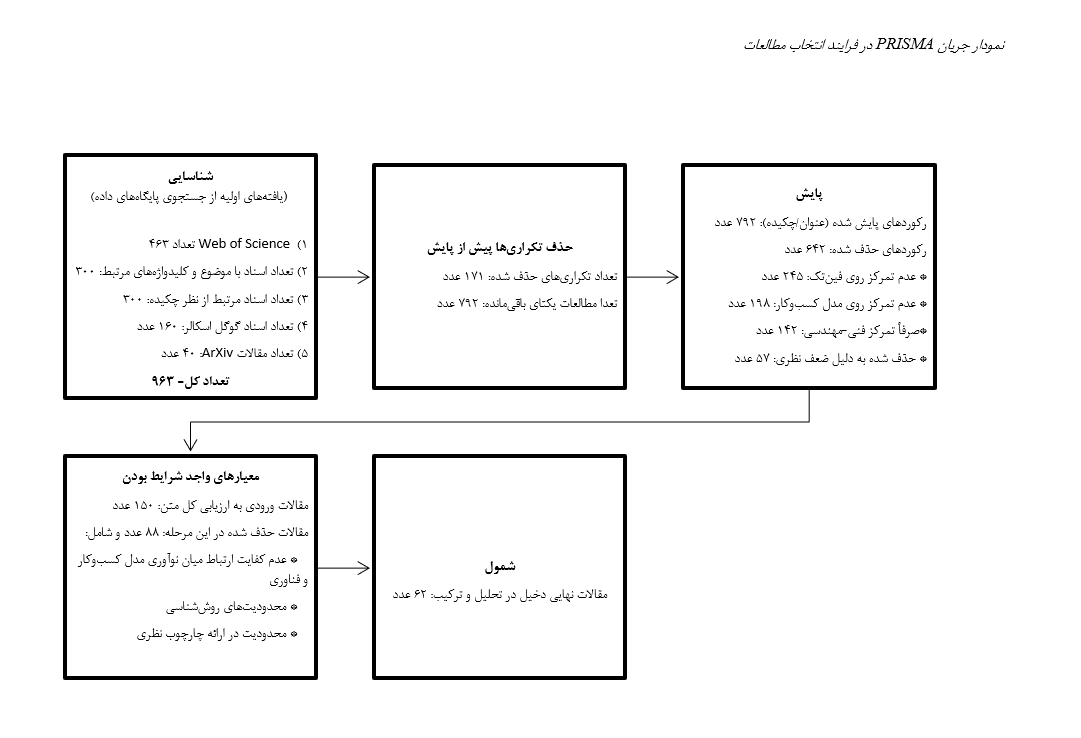
هدف از پژوهش حاضر، تبیین نقش فناوریهای دیجیتال در شکلدهی نوآوری مدلهای کسبوکار در شرکتهای فناوری مالی (فینتک) است و به همین منظور نتایج 62 مطالعه منتشرشده بین سالهای ۲۰۱5 تا ۲۰۲۵ را با استفاده از روش فراترکیب تحلیل و ترکیب کردهاست. در همین راستا با بهرهمندی از تکنیک PRISMA، تعداد ۷۹۲ مقاله منحصربهفرد از پایگاههای داده دانشگاهی (Web of Science، Google Scholar، ArXiv) تحلیل شد و 62 مطالعه مرتبطتر بر اساس رتبهبندی انتخاب گردید. یافتههای تحلیل نشان میدهد که پنج پیشران اصلی فناوری—فناوریهای موبایل/عاملها/SMS، بلاکچین/رمزارز، هوش مصنوعی/هوش مصنوعی مولد، رایانش ابری/APIها و کلانداده—نوآوری مدل کسبوکار را از طریق چهار سازوکار اصلی حذف واسطهگری، شخصیسازی و خودکارسازی، راهبری اکوسیستم و کاهش هزینه همراه با مقیاسپذیری توانمند میسازند. این سازوکارها مدلهای کسبوکار را در هر یک از چهار بعد مثلث جادویی گاسمن (چگونگی، چه چیزی، چه کسی و ارزش) متحول ساخته و دو نوع از نوآوری مشتمل بر نوآوری تدریجی (تأثیرگذار بر ۱ تا ۳ بعد) و نوآوری برافکن (دگرگونکننده هر ۴ بعد) را پدید میآورند. چارچوب مستخرج مبین آن است که نوآوری مدل کسبوکار مبتنی بر فناوری در فینتک از مسیرهای نظاممند، از قابلیتهای فناورانه تا سازوکارهای نوآوری و سپس بازپیکربندیهای مشخص مدل کسبوکار، نمود و نمو میکند. یافتههای کلیدی همچنین نشان میدهد که هوش مصنوعی و کلاندادهها خدمات شخصیسازیشده و خودکار را امکانپذیر میسازند؛ بلاکچین واسطهزدایی و پیشنهادهای ارزش جدید را تسهیل میکند؛ رایانش ابری و APIها مدیریت اکوسیستم و مدلهای کسبوکار پلتفرمی را فعال مینمایند و فناوریهای موبایل، شمول مالی را به بخشهای کمتر برخوردار گسترش میدهند. ارزیابی کیفیت ادبیات این حوزه آشکار میکند که اگرچه این حوزه به سرعت در حال رشد است، اما دقت روششناختی متغیر است و نیاز به پژوهش تجربی کمی بیشتری وجود دارد. پژوهش حاضر با ارائه یک چارچوب مفهومی، شکافهای پژوهشی را شناسایی نموده و بینشهای عملی را برای مدیران راهبردی و سیاستگذارانی که درصدد تصمیمسازی از واکاوی نقش تحول دیجیتال در خدمات مالی هستند، فراهم میآورد.
دانلودها
مراجع
Adeleke, A., Sanyaolu, T., Azubuko, C., & Osundare, O. (2024). Exploring fintech innovations and their potential to transform the future of financial services and banking. International Journal of Scholarly Research in Science and Technology, 5, 054-072. https://doi.org/10.56781/ijsrst.2024.5.1.0033
Arnone, G. (2024). AI and Chatbots in Fintech: Revolutionizing Digital Experiences and Predictive Analytics. Springer Nature Switzerland. https://books.google.com.tr/books?id=8bwIEQAAQBAJ
Barroso, M., & Laborda, J. (2022). Digital transformation and the emergence of the Fintech sector: Systematic literature review. Digital Business, 2(2), 100028. https://doi.org/https://doi.org/10.1016/j.digbus.2022.100028
Belozyorov, S., Sokolovska, O., & Kim, Y. (2020). Fintech as a Precondition of Transformations in Global Financial Markets. Foresight and STI Governance, 14, 23-35. https://doi.org/10.17323/2500-2597.2020.2.23.35
Bittini, J. S., Rambaud, S. C., Pascual, J. L., & Moro-Visconti, R. (2022). Business Models and Sustainability Plans in the FinTech, InsurTech, and PropTech Industry: Evidence from Spain. Sustainability, 14(19), 12088.
Chen, J. (2025). Research on AI-Based Smart Finance Innovation Models and Their Impact Mechanisms. Advances in Economics and Management Research, 14, 711. https://doi.org/10.56028/aemr.14.1.711.2025
Daiya, H. (2024). AI-Driven Risk Management Strategies in Financial Technology. Journal of Artificial Intelligence General science (JAIGS) ISSN:3006-4023, 5, 194-216. https://doi.org/10.60087/jaigs.v5i1.194
de Morais, C. E., & Sehnem, S. (2025). The digital transformation for innovative business models in the financial industry: the perspective of engaging strategic stakeholders. Revista de Gestão, 32(1), 51-65. https://doi.org/10.1108/REGE-06-2024-0085
Dodda, A. (2025). Fintech disruption and innovation: Transforming the future of global financial services. In Artificial Intelligence and Financial Transformation: Unlocking the Power of Fintech, Predictive Analytics, and Public Governance in the Next Era of Economic Intelligence (pp. 1-26). https://doi.org/10.70593/978-81-988918-1-5_1
Felipe, T., Torres de Oliveira, R., Toth-Peter, A., Mathews, S., & Dulleck, U. (2025). Digital transformation in commercial banks: Unraveling the flow of Industry 4.0. Digital Business, 5(2), 100129. https://doi.org/https://doi.org/10.1016/j.digbus.2025.100129
Florén, H., & Agostini, A. (2015). The Business Model Innovation Map - A framework for analyzing business model innovation. https://doi.org/10.13140/RG.2.1.2357.3205
Gassmann, O., Frankenberger, K., & Csik, M. (2014). Revolutionizing the Business Model. In (pp. 89-97). https://doi.org/10.1007/978-3-319-01056-4_7
Gassmann, O., Frankenberger, K., & Sauer, R. (2016). Exploring the Field of Business Model Innovation. Palgrave Macmillan. https://doi.org/10.1007/978-3-319-41144-6
Gomber, P., Kauffman, R., Parker, C., & Weber, B. (2018). On the Fintech Revolution: Interpreting the Forces of Innovation, Disruption, and Transformation in Financial Services. Journal of Management Information Systems, 35, 220-265. https://doi.org/10.1080/07421222.2018.1440766
Gupta, S. (2025). The Evolution of Fintech: From Traditional to Modern Innovations. International Journal For Multidisciplinary Research, 7. https://doi.org/10.36948/ijfmr.2025.v07i04.51860
Harcharan, J. (2025). Technological convergence in financial services: AI, blockchain, and cloud innovation driving cost efficiency in modern banking. World Journal of Advanced Engineering Technology and Sciences, 15, 1475-1485. https://doi.org/10.30574/wjaets.2025.15.3.1088
Iheanachor, N., David-West, Y., & Umukoro, I. O. (2021). Business model innovation at the bottom of the pyramid – A case of mobile money agents. Journal of Business Research, 127, 96-107. https://doi.org/https://doi.org/10.1016/j.jbusres.2021.01.029
Ikumapayi, O. (2025). The Convergence Of Fintech Innovations, Ai, And Risk Management: Transforming Traditional Banking, Accounting, And Financial Services. International Research Journal of Modernization in Engineering Technology and Science, Volume 07, 2582-5208. https://doi.org/10.56726/IRJMETS67253
Kumar, A., Mohammed, S., Arora, N., Raj, K. B., Kumar, M., & Babar, M. (2024). The Impact of Financial Technology (FinTech) on Traditional Banking Systems. European Economics Letters, 14, 2451-2461.
Liberati, A., Altman, D. G., Tetzlaff, J., Mulrow, C., Gøtzsche, P. C., Ioannidis, J. P., Clarke, M., Devereaux, P. J., Kleijnen, J., & Moher, D. (2009). The PRISMA statement for reporting systematic reviews and meta-analyses of studies that evaluate healthcare interventions: explanation and elaboration. Bmj, 339.
Lindgren, P. (2018, 25-28 Nov. 2018). Disruptive, Radical and Incremental Multi Business Model Innovation. 2018 Global Wireless Summit (GWS),
Lu, L. (2023). Fintech: Technology-Enabled Financial Innovation for Digital Trade. In M. G. David Collins (Ed.). Research Handbook on Digital Trade Edward Elgar. https://doi.org/https://kclpure.kcl.ac.uk/portal/en/publications/fintech-technology-enabled-financial-innovation-for-digital-trade/
Lu, L. (2024). The Law of Fintech: How Artificial Intelligence and Innovative Technologies Contribute to a Sustainable Financial Industry and Its Effective Regulation. In (pp. 243-263). https://doi.org/10.1007/978-3-031-66205-8_10
Mah, P. M., Muzam, J., Pełech-Pilichowski, T., Mbuh, D., & Ako, E. (2024). AI and robotic process automation in Fintech: analyzing the shift towards digitized customer services and operational efficiency. Scientific Papers of Silesian University of Technology Organization and Management Series, 2023. https://doi.org/10.29119/1641-3466.2023.187.21
Mamonov, S. (2020). The Role of Information Technology in Fintech Innovation: Insights from the New York City Ecosystem. In (pp. 313-324). https://doi.org/10.1007/978-3-030-44999-5_26
Mărăcine, V., Voican, O., & Scarlat, E. (2020). The Digital Transformation and Disruption in Business Models of the Banks under the Impact of FinTech and BigTech. Proceedings of the International Conference on Business Excellence, 14, 294-305. https://doi.org/10.2478/picbe-2020-0028
Mashruwala, A. (2024). The Impact of Cloud Computing on FinTech: Applications and Challenges. https://doi.org/10.13140/RG.2.2.15292.45440
Mwangi, G. (2025). Financial Innovation: The Revolut Case Study.
Ng, E., Tan, B., Sun, Y., & Meng, T. (2023). The strategic options of fintech platforms: An overview and research agenda. Information Systems Journal, 33(2), 192-231. https://doi.org/https://doi.org/10.1111/isj.12388
Nwoke, J. (2024). Digital Transformation in Financial Services and FinTech: Trends, Innovations and Emerging Technologies International Journal of Finance Digital Transformation in Financial Services and FinTech: Trends, Innovations and Emerging Technologies.
Omarini, A. (2018a). Banks and Fintechs: How to Develop a Digital Open Banking Approach for the Bank’s Future. International Business Research, 11, 23-23. https://doi.org/10.5539/ibr.v11n9p23
Omarini, A. (2018b). Fintech and the Future of the Payment Landscape: The Mobile Wallet Ecosystem - A Challenge for Retail Banks? International Journal of Financial Research, 9, 14292-14292. https://doi.org/10.5430/ijfr.v9n4p97
Omarini, A. (2018c). Peer-to-Peer Lending: Business Model Analysis and the Platform Dilemma. International Journal of Finance, Economics and Trade, 31-41. https://doi.org/10.19070/2643-038X-180005
Pal, A., Gopi, S., & Lee, K. (2023). Fintech Agents: Technologies and Theories. Electronics, 12, 3301. https://doi.org/10.3390/electronics12153301
Pampurini, F., Pezzola, A., & Quaranta, A. G. (2024). Lending business models and FinTechs efficiency. Finance Research Letters, 65, 105519. https://doi.org/https://doi.org/10.1016/j.frl.2024.105519
Panda, A., Patnaik, A., Pawar, A., & Birari, A. (2023). Adoption of Fintech Towards Asset and Wealth Management: Understanding the Recent Scenario in India. In (pp. 357-367). https://doi.org/10.1007/978-981-99-0197-5_23
Rasiwala, F. S., & Kohli, B. (2021). Artificial Intelligence in FinTech. International Journal of Business Intelligence Research, 12(1). https://doi.org/https://doi.org/10.4018/IJBIR.20210101.oa3
Raza, D., Khan, D., Riaz, N., & Riaz, A. (2024). Digital Transformation in Commercial Banking: Trends, Challenges, and Future Directions. Journal for Social Science Archives, 2, 540-551. https://doi.org/10.59075/jssa.v2i2.82
Riasanow, T., Floetgen, R., Soto Setzke, D., Böhm, M., & Krcmar, H. (2018). The Generic Ecosystem and Innovation Patterns of the Digital Transformation in the Financial Industry.
Rifo Rivera, F., Diaz Tautiva, J., Barros, S., Rifo, S., & Salvaj, E. (2024). Business model innovation in FinTech. In (pp. 19-27). https://doi.org/10.4324/9781003371403-4
Saboo, K., & Firdoos, N. (2025). Impact Of Fintech On Traditional Banking. EPRA International Journal of Research & Development (IJRD), 522-531. https://doi.org/10.36713/epra22595
Shodiev, O. (2024). Fintech And Its Impact On Traditional Banks. European International Journal of Multidisciplinary Research and Management Studies, 4, 158-166. https://doi.org/10.55640/eijmrms-04-04-25
Sibanda, W., Ndiweni, E., Boulkeroua, M., Echchabi, A., & Ndlovu, T. (2020). Digital technology disruption on bank business models. International Journal of Business Performance Management, 21, 184. https://doi.org/10.1504/IJBPM.2020.106121
Singh, S. (2025). The Future of FinTech: Emerging Technologies Reshaping Finance. INTERNATIONAL JOURNAL OF SCIENTIFIC RESEARCH IN ENGINEERING AND MANAGEMENT, 09, 1-9. https://doi.org/10.55041/IJSREM49626
Sinha, S. (2024). Financial Technology (FINTEC) Innovation and Disruption. International Journal for Research in Applied Science and Engineering Technology, 12, 6137-6161. https://doi.org/10.22214/ijraset.2024.61347
Tapia, S. (2025). Business Model Innovation in the Big-Data Era from the Perspective of Knowledge-Based Dynamic Capabilities: Case Study of a Fintech. In (pp. 89-99). https://doi.org/10.1007/978-3-031-72494-7_10
Taran, Y., & Boer, H. (2013). Towards a typological theory of business model innovation processes.
Teece, D. (2010). Business Models, Business Strategy and Innovation. Long Range Planning, 43, 172-194. https://doi.org/10.1016/j.lrp.2009.07.003
Tripathi, S., Bachmann, N., Brunner, M., & Jodlbauer, H. (2025). Harnessing dynamic capabilities for data-driven business model innovation in incumbents. Digital Business, 5(2), 100124. https://doi.org/https://doi.org/10.1016/j.digbus.2025.100124
Tripathi, S., & Verma, C. B. (2025). Digital Transformation in Finance: Innovations, Challenges, and Future Trends. Stallion Journal for Multidisciplinary Associated Research Studies, 24-35. https://doi.org/10.55544/sjmars.icmri.5
Ugbaja, U., Adanigbo, O., Ezeh, F., Lawal, C., & Friday, S. (2023). A STRATEGIC FRAMEWORK FOR API ECOSYSTEM INTEGRATION IN MULTINATIONAL FINTECH PRODUCT DEPLOYMENTS. International Journal of Management & Entrepreneurship Research, 5, 1273-1284. https://doi.org/10.51594/ijmer.v5i12.1899
Vimala, S., G, R., & C, P. (2025). A Research On Blockchain And Fintech In Business. 14, 24-27.
Vukovljak, B. (2023). The incorporation of fintechs into the banking sector: The fintech N26 as a case study. MAP Social Sciences, 4, 15-30. https://doi.org/10.53880/2744-2454.2023.4.15
Xia, Y., Han, Z., Li, Y., & He, L. (2025). Credit scoring model for fintech lending: An integration of large language models and FocalPoly loss. International Journal of Forecasting, 41(3), 894-919. https://doi.org/https://doi.org/10.1016/j.ijforecast.2024.07.005
Xu, F., Kasperskaya, Y., & Sagarra, M. (2025). The impact of FinTech on bank performance: A systematic literature review. Digital Business, 5(2), 100131. https://doi.org/https://doi.org/10.1016/j.digbus.2025.100131
Zarifis, A., & Cheng, X. (2023). The Five Emerging Business Models of Fintech for AI Adoption, Growth and Building Trust. In (pp. 73-97). https://doi.org/10.1007/978-3-031-33665-2_4
Zhai, Z. (2024). Research on the Impact of Digital Financial Technology on the Business Model Transformation of Commercial Banks. Frontiers in Business, Economics and Management, 16, 282-285. https://doi.org/10.54097/ywe6cw68
Zhang-Zhang, Y., Rohlfer, S., & Rajasekera, J. (2020). An Eco-Systematic View of Cross-Sector Fintech: The Case of Alibaba and Tencent. Sustainability, 12(21), 8907.
پاینده, ر., & افقهی, س. م. (2023). حکمرانی بومسازگان فینتک: مسائل سیستمی و راهکارهای توسعه در ایران. سیاست علم و فناوری, 16(1), 17-34. https://doi.org/10.22034/jstp.2023.11179.1586

دانلود
چاپ شده
ارسال
بازنگری
پذیرش
شماره
نوع مقاله
مجوز
حق نشر 2026 Vahid Khashei Varnamkhasti; Seyed Soroush Ghazinoori Naeini, Mahdi Haghighi Kafash, Sahar Esmaeili Shayan (Author)

این پروژه تحت مجوز بین المللی Creative Commons Attribution-NonCommercial 4.0 می باشد.