Application of Ontology in Data Governance and Knowledge Management in Artificial Intelligence-Based Organizations
DOI:
https://doi.org/10.61838/kman.jtesm.499Keywords:
Ontology, Data Governance, Knowledge Management, Artificial Intelligence, Semantic Governance, Intelligent OrganizationsAbstract
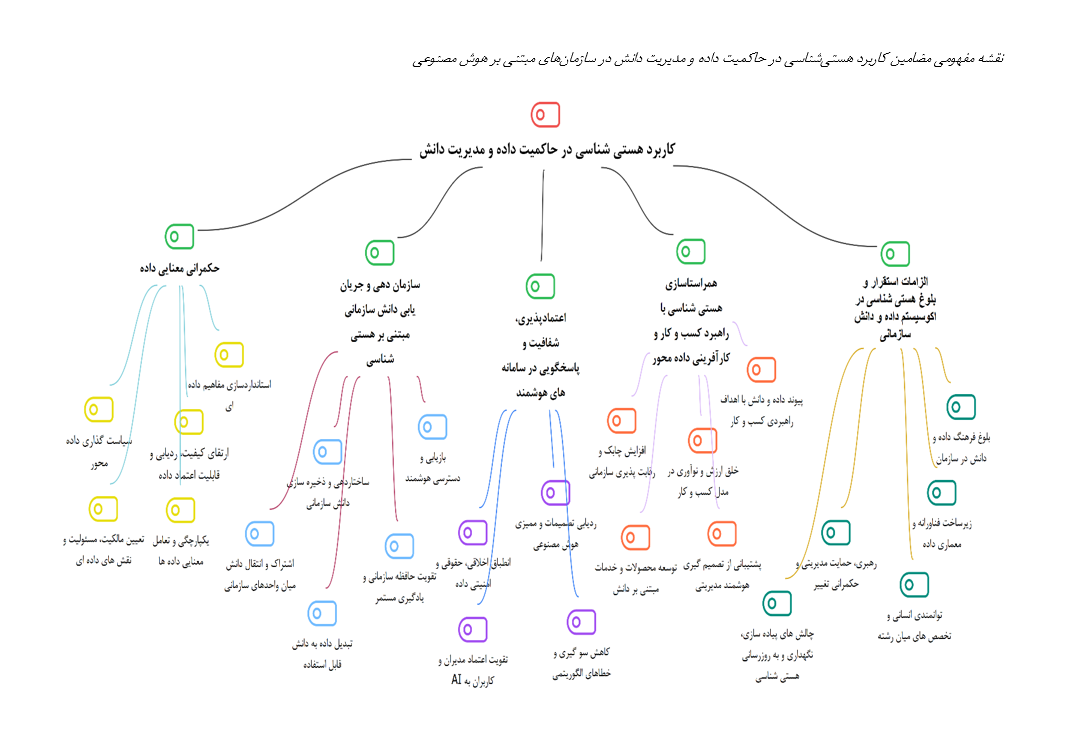
This study aimed to explain the application of ontology in improving data governance and knowledge management and to identify its implications for trustworthy intelligent systems, strategic decision-making, business innovation, and data-driven entrepreneurship in artificial intelligence-based organizations. This applied study employed a qualitative, exploratory design based on thematic analysis. The study population consisted of managers and specialists in artificial intelligence, data governance, knowledge management, data analytics, information architecture, digital transformation, and technology-based businesses. Participants were recruited through purposive sampling, and theoretical saturation was achieved after 12 semi-structured interviews. Following complete transcription, the data were analyzed using Braun and Clarke’s reflexive thematic analysis at the levels of basic, organizing, and global themes. MAXQDA software was used to organize and code the qualitative data. The trustworthiness of the findings was established through the criteria of credibility, transferability, dependability, and confirmability. The analysis generated 320 initial concepts. After removing repetitions and integrating semantically similar codes, 201 basic themes, 25 organizing themes, and five global themes were identified. The global themes comprised semantic data governance, ontology-based organization and flow of organizational knowledge, trustworthiness and accountability in intelligent systems, alignment of ontology with business strategy and data-driven entrepreneurship, and requirements for ontology implementation and maturity. The findings demonstrated that ontology supports the standardization of organizational concepts, semantic integration of heterogeneous data, improvement of data quality and traceability, and clarification of data ownership and responsibilities. It also facilitates knowledge sharing and retrieval, strengthens organizational memory, improves the explainability and auditability of algorithmic decisions, and contributes to the identification and reduction of algorithmic bias. Furthermore, ontology connects organizational data and knowledge with managerial decisions, innovation opportunities, knowledge-based products, and value creation. Ontology constitutes a strategic semantic infrastructure for integrating data, knowledge, artificial intelligence, and business objectives. Its successful implementation requires an integrated data architecture, a knowledge-sharing culture, interdisciplinary expertise, senior management support, effective change governance, and the continuous maintenance and updating of conceptual models.
Downloads
References
Afroogh, S., Akbari, A., Malone, E., Kargar, M., & Alambeigi, H. (2024). Trust in AI: Progress, Challenges, and Future Directions. Humanities and Social Sciences Communications, 11, 1568. https://doi.org/10.1057/s41599-024-04044-8
Akbari, S. (2025). Policy Requirements and Data Governance in the Age of Artificial Intelligence: A Conceptual Framework for Responsible Development of Intelligent Systems First International Conference on Management, Computer Science and Artificial Intelligence, Tehran.
Alshammakhi, Q. M., & Sheikh, R. A. (2025). Driving Sustainable Entrepreneurship through AI and Knowledge Management: Evidence from SMEs in Emerging Economies. Sustainability, 17(24), 10928. https://doi.org/10.3390/su172410928
Ambalavanan, R., Snead, R. S., Marczika, J., Towett, G., Malioukis, A., & Mbogori-Kairichi, M. (2025). Ontologies as the Semantic Bridge between Artificial Intelligence and Healthcare. Frontiers in Digital Health, 7, 1668385. https://doi.org/10.3389/fdgth.2025.1668385
Babaei Giglou, H., D'Souza, J., & Auer, S. (2024). LLMs4OL 2024 Overview: The 1st Large Language Models for Ontology Learning Challenge. Open Conference Proceedings, 4, 3-16. https://doi.org/10.52825/ocp.v4i.2473
Bernardo, B. M. V., Mamede, H. S., Barroso, J. M. P., & dos Santos, V. M. P. D. (2024). Data Governance and Quality Management—Innovation and Breakthroughs across Different Fields. Journal of Innovation & Knowledge, 9(4), 100598. https://doi.org/10.1016/j.jik.2024.100598
Girón, D. C. A., Ramos, S. E., Soto, F. G. C., & Cadenas, D. I. V. (2025). The Relationship between Knowledge Management and Artificial Intelligence: A Thematic Analysis from Scopus. Iberoamerican Journal of Science Measurement and Communication, 5(1), 10. https://doi.org/10.47909/ijsmc.1713
Guizzardi, G., & Guarino, N. (2024). Explanation, Semantics, and Ontology. Data & Knowledge Engineering, 153, 102325. https://doi.org/10.1016/j.datak.2024.102325
Jorzik, P., Klein, S. P., Kanbach, D. K., & Kraus, S. (2024). AI-Driven Business Model Innovation: A Systematic Review and Research Agenda. Journal of Business Research, 182, 114764. https://doi.org/10.1016/j.jbusres.2024.114764
Kazemnejad, S., & Tavakkolifar, E. (2024). Data Sovereignty and the Right of Ownership over AI-Generated Data: Legal Challenges and Cyber Requirements. Journal of Cyber Law, 1(3), 61-71. https://www.sid.ir/paper/1782187/en
Kumar, R., Ishan, K., Kumar, H., & Singla, A. (2025). LLM-Powered Knowledge Graphs for Enterprise Intelligence and Analytics 2025 6th International Conference on Recent Advances in Information Technology, https://doi.org/10.1109/RAIT65068.2025.11088890
Merono-Penuela, A., Simperl, E., Kurteva, A., & Reklos, I. (2025). KG.GOV: Knowledge Graphs as the Backbone of Data Governance in AI. Journal of Web Semantics, 85, 100847. https://doi.org/10.1016/j.websem.2024.100847
Oecd. (2024). AI, Data Governance and Privacy: Synergies and Areas of International Co-Operation. https://www.oecd.org/en/publications/ai-data-governance-and-privacy_2476b1a4-en.html
Oecd. (2025). Generative AI and the SME Workforce: New Survey Evidence. https://www.oecd.org/content/dam/oecd/en/publications/reports/2025/11/generative-ai-and-the-sme-workforce_83bafdfb/2d08b99d-en.pdf?utm_source=chatgpt.com
Papagiannidis, E., Mikalef, P., & Conboy, K. (2025). Responsible Artificial Intelligence Governance: A Review and Research Framework. The Journal of Strategic Information Systems, 34(2), 101885. https://doi.org/10.1016/j.jsis.2024.101885
Rezaei, M. (2025). Artificial Intelligence in Knowledge Management: Identifying and Addressing the Key Implementation Challenges. Technological Forecasting and Social Change, 217, 124183. https://doi.org/10.1016/j.techfore.2025.124183
Rosic, M., Sumic, D., & Males, L. (2025). Semantic Interoperability of Multi-Agent Systems in Autonomous Maritime Domains. Electronics, 14(13), 2630. https://doi.org/10.3390/electronics14132630
Tzitzikas, Y., Marketakis, Y., Fafalios, P., Kritsotaki, A., Axaridou, A., Mountantonakis, M., & Theodoridou, M. (2024). Governance Model for Ontologies. https://doi.org/10.2903/sp.efsa.2024.EN-9119
Wang, S., & Zhang, H. (2024). Green Entrepreneurship Success in the Age of Generative Artificial Intelligence: The Interplay of Technology Adoption, Knowledge Management, and Government Support. Technology in Society, 79, 102744. https://doi.org/10.1016/j.techsoc.2024.102744
Xhani, D., Sedrakyan, G., Gavai, A., Guizzardi, R., & van Hillegersberg, J. (2025). The Role and Applications of Semantic Interoperability Tools and Explainable AI in the Development of Smart Food Systems: Findings from a Systematic Literature Review. Intelligent Systems with Applications, 27, 200547. https://doi.org/10.1016/j.iswa.2025.200547
Zahedi, S. (2024). Management with AI and on AI. Development of humanities, 4(8), 45-58. https://doi.org/10.22047/hsd.2024.194458
Zolghadr, A., Sarmad Saeidi, S., & Ghasemi, B. (2026). Designing a Model for the Application of Artificial Intelligence in the Export of Electronic Industry Products. Technology in Entrepreneurship and Strategic Management, 5(1), 1-18. https://journaltesm.com/index.php/journaltesm/article/view/389
Downloads
Publication Timeline
- Submitted
- Revised
- Accepted
Issue
Section
License
Copyright (c) 2025 Zahra Razmi; Zahra Tanha (Author)

This work is licensed under a Creative Commons Attribution-NonCommercial 4.0 International License.